

Superconductivity, the ability of a material to conduct electricity with zero resistance, typically breaks down in the presence of strong magnetic fields, a phenomenon known as the Pauli limit. However, a team led by Jixiang Yang, Omid Sharifi Sedeh, and Chiho Yoon, alongside colleagues including Shenyong Ye, Henok Weldeyesus, and Armel Cotten, now reports a remarkable discovery that challenges this established boundary. They observe a spin-polarized superconducting state in a specially prepared material, exhibiting superconductivity at magnetic fields far exceeding the expected Pauli limit, with a violation ratio of at least 80 percent, a new record among all known superconductors. This achievement not only expands the fundamental understanding of superconductivity but also opens exciting possibilities for developing future technologies that rely on robust, high-field superconducting materials.
Fermi Surface Mapping via Quantum Oscillations
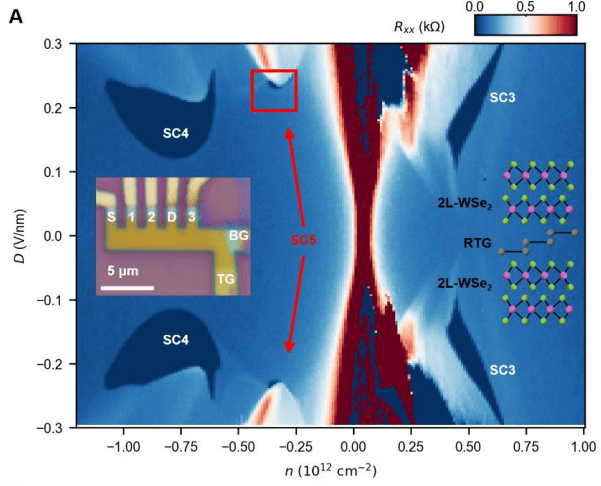
This research pioneered a new approach to understanding the electronic structure of a unique superconducting state, designated SC5, found within a specially prepared trilayer material combined with tungsten diselenide. Scientists meticulously mapped the allowed energy states for electrons by precisely measuring the material’s electrical resistance as a function of both the number of charge carriers and an applied magnetic field. By applying magnetic fields up to 0. 45 Tesla and carefully monitoring the resulting quantum oscillations in resistance, the team gained detailed insights into the material’s electronic properties.
This analysis revealed distinct features corresponding to different shapes and sizes of electron orbits, providing a fingerprint of the material’s electronic structure. The researchers employed a mathematical technique, converting resistance measurements into a frequency spectrum, to identify and quantify these features. This revealed four distinct phases: a three-quarter-metal, a full-metal, a quarter-metal, and a half-metal. The analysis demonstrated that the three-quarter-metal and full-metal phases exhibit unique relationships between their frequency peaks, while the quarter-metal and half-metal phases are characterized by single peaks at specific frequencies.
The team created diagrams illustrating the allowed electron orbits for each phase, using color to represent the energetic favorability of different electron configurations due to interactions within the material. Crucially, this analysis identified the full-metal and half-metal phases as the parent states of SC5, suggesting that superconductivity emerges from these metallic phases. To confirm these experimental findings, scientists performed calculations that accurately reproduced the observed phases and validated the robustness of the analysis. Measurements of the anomalous Hall effect further confirmed the unique properties of the material, providing additional support for the identified parent states of SC5.
Robust Superconductivity in Graphene Heterostructures
Scientists have discovered a spin-polarized superconducting state, designated SC5, within a rhombohedral trilayer graphene material combined with tungsten diselenide. Experiments reveal that SC5 exhibits a critical temperature of 68 milliKelvin and can sustain superconductivity in the presence of a magnetic field of only 12 milliTesla when no current flows in the plane of the material. Remarkably, these values are significantly enhanced as a magnetic field is applied in the plane of the material, demonstrating superconductivity persists up to an in-plane field of 8. 8 Tesla. This achievement represents a record-high ratio of superconducting strength to magnetic field suppression among all known superconductors, indicating an exceptional robustness against magnetic fields.
Measurements confirm the true critical field exceeds the limits of the instrumentation used in the study, suggesting even greater potential for high-field superconductivity. The team observed that SC5 undergoes a transition to a spin-polarized superconducting state with increasing in-plane magnetic field, demonstrating a unique response to external magnetic stimuli. The discovery of SC5 provides a novel platform for exploring electronic interactions and spin-polarized superconductivity, potentially enabling advancements in spintronics and quantum computing. Researchers meticulously characterized the superconducting properties of SC5, establishing a clear link between the applied magnetic field and the observed superconducting behaviour. These findings open new avenues for investigating unconventional superconductivity and developing materials with tailored magnetic properties, paving the way for future technological innovations.
Robust Spin Polarization in Novel Superconductor
This research demonstrates the observation of a robust spin-polarized superconducting state, designated SC5, within a specifically engineered trilayer material. The team successfully induced and characterized superconductivity exhibiting a remarkably high degree of spin polarization, evidenced by a record-high ratio of superconducting strength to magnetic field suppression exceeding 80%. Importantly, the superconducting critical temperature and critical magnetic field were both significantly enhanced by the application of an in-plane magnetic field, a behaviour not previously observed to this extent in other candidate spin-polarized superconductors. The findings suggest that SC5 arises from a unique combination of electron pairing mechanisms, facilitated by the breaking of symmetry within the material.
The researchers propose that increasing the in-plane magnetic field induces a tilting of electron spins, progressively enabling superconductivity through a spin-polarized pairing channel and enhancing the overall superconducting strength. While the precise pairing mechanism within this spin-polarized pairing channel remains unclear, this work establishes a new platform for exploring unconventional superconductivity and manipulating spin states within a crystalline system. Further investigation is needed to fully elucidate the underlying pairing mechanism driving the observed behaviour, but the discovery of SC5 represents a significant advance in the field, offering a clean and tunable system for future research into spin-polarized superconductivity and its potential applications.
👉 More information
🗞 Magnetic Field-Enhanced Graphene Superconductivity with Record Pauli-Limit Violation
🧠 ArXiv: https://arxiv.org/abs/2510.10873

