The behaviour of plasmons , collective oscillations of electrons , within graphene continues to reveal surprising complexities, as demonstrated by new research from Suheng Xu, Birui Yang, Nishchhal Verma, and colleagues. This study utilises terahertz spacetime metrology to investigate plasmon dynamics in both single and double layers of graphene, revealing a systematic enhancement of the Drude weight compared to theoretical predictions based on non-interacting electrons. The research, conducted with contributions from the University of California at San Diego and the Instituto de Ciencia de Materiales de Madrid ICMM-CSIC, highlights this effect is particularly significant at extremely low carrier densities. Researchers attribute this deviation to the pseudospin dynamics of Dirac fermions in multi-layer graphene, suggesting a breakdown of Galilean invariance and establishing a direct link between single-particle electronic structure and collective excitations with broad implications for materials science.
This study utilises terahertz spacetime metrology to investigate plasmon dynamics in both single and double layers of graphene, revealing a systematic enhancement of the Drude weight compared to theoretical predictions based on non-interacting electrons. Researchers attribute this deviation to the pseudospin dynamics of Dirac fermions in multi-layer graphene, suggesting a breakdown of Galilean invariance and establishing a direct link between single-particle electronic structure and collective excitations. This finding has broad implications for materials science.
Vanadium Dioxide’s Metal-Insulator Transition Mechanisms
This research investigates the electronic and structural properties of vanadium dioxide (VO2) during its metal-insulator transition (MIT), aiming to understand the interplay between electron correlation, lattice dynamics, and symmetry breaking that drives this phase transition. The approach combines density functional theory (DFT) calculations, dynamical mean-field theory (DMFT), and experimental data from spectroscopic techniques, specifically resonant inelastic x-ray scattering (RIXS), allowing for a comprehensive examination of the MIT in VO2. DMFT calculations, with a realistic parameterisation based on experimental observations, provide insights into the evolution of the electronic structure across the transition, revealing a significant spectral weight transfer near the Fermi level. The study demonstrates that the MIT in VO2 is not simply a band gap opening, but a more complex reconstruction of the electronic structure.
Analysis of the RIXS spectra, combined with theoretical modelling, identifies the emergence of a coherent peak associated with the metallic phase, while elucidating the role of specific lattice distortions in stabilising the metallic phase and suppressing charge ordering. The findings provide a detailed understanding of the microscopic mechanisms governing the MIT in VO2, and achieve improved agreement with experimental data by incorporating DMFT, allowing for more accurate predictions of the material’s behaviour. This research highlights the importance of considering electron correlation effects when modelling transition metal oxides and presents a refined understanding of the symmetry breaking that accompanies the MIT in VO2, with implications for the design of novel electronic devices.
Terahertz Metrology Reveals Enhanced Graphene Plasmons
Plasmons, collective oscillations of mobile electrons, were investigated in mono- and bi-layer graphene using terahertz spacetime metrology to understand their behaviour and assess the accuracy of existing theoretical models. The experimental setup precisely measured the Drude weight, related to the strength of these oscillations, in both single-layer and two-layer graphene systems. The study revealed that the experimentally determined Drude weight consistently exceeded predictions derived from models treating electrons as independent entities, particularly at extremely low carrier densities. Scientists attribute this deviation to the pseudospin dynamics of Dirac fermions within the multi-layer graphene, a phenomenon that disrupts Galilean invariance, a principle typically assumed to hold in these systems.
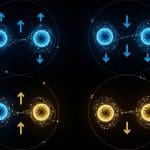
This research demonstrates that electron-electron interactions fundamentally influence plasmon dynamics, challenging the notion that single-particle properties alone determine collective excitations. The electronic states in monolayer graphene and Bernal bilayer graphene are described as coherent superpositions of orbitals, exhibiting a momentum-dependent phase. Researchers conclude that this pseudospin structure of the single-particle electronic wave function directly governs collective excitations and has broader implications for understanding quantum materials.
Graphene Plasmon Dynamics Exceed Theoretical Predictions
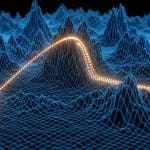
Scientists achieved a breakthrough in understanding electron behaviour within graphene using terahertz spacetime metrology to probe plasmon dynamics in both mono- and bi-layer graphene systems. Experiments revealed that the experimentally measured Drude weight, a key indicator of carrier density and collective electron motion, systematically exceeds predictions based on models of non-interacting electrons, particularly at ultra-low carrier densities. Data shows this deviation stems from the pseudospin dynamics of Dirac fermions within the multi-layer graphene, leading to a breakdown of Galilean invariance. Measurements confirm that the plasmon velocities and Drude weights were extracted by visualizing the spacetime trajectories, or ‘worldlines’, of plasmonic waves using a novel nano-THz spacetime mapping technique.
This technique allowed for direct measurement of plasmon velocity, which directly correlates to the Drude weight of the electron liquid in graphene. The observed enhancement of the Drude weight indicates a non-trivial interplay between electron-electron correlations and quantum geometry, contrary to expectations that interactions would suppress charge motion. This breakthrough delivers a powerful new tool for probing many-body correlations in solids, both in space and time.
Graphene Plasmonics Reveal Broken Galilean Invariance
This research demonstrates that the collective electronic behaviour in graphene, specifically plasmon dynamics in both mono- and bi-layer systems, deviates from predictions based on non-interacting electron models. Through terahertz spacetime metrology, the team observed a systematic enhancement of the Drude weight, a measure of mobile electron density, particularly at very low carrier densities. This enhancement is attributed to the pseudospin dynamics of Dirac fermions within multi-layer graphene, indicating a breakdown of expected Galilean invariance. The significance of these findings lies in establishing a direct link between the pseudospin structure of individual electron wave functions and the resulting collective excitations within the material, suggesting that understanding the internal quantum state of electrons is crucial for predicting macroscopic properties like plasmon behaviour. While acknowledging limitations inherent in the experimental setup and analysis, the authors propose future research should explore these pseudospin-driven effects in other two-dimensional materials, potentially broadening understanding of collective electronic phenomena and informing the design of novel electronic and optical devices.
👉 More information
🗞 Plasmon dynamics in graphene
🧠 ArXiv: https://arxiv.org/abs/2601.10493