

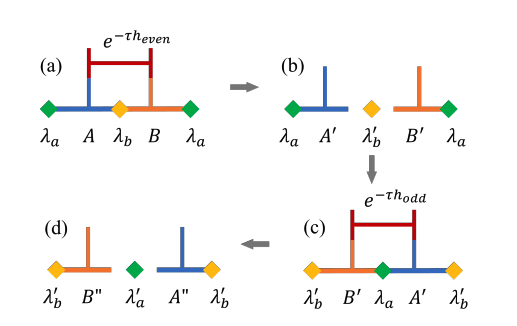
Understanding the behaviour of interacting quantum systems remains a central challenge in modern physics, and researchers continually seek more accurate computational methods to model these complex phenomena. Tao Yang, Rui Wang, and Baigeng Wang, all from Nanjing University, present a new approach to determining the ground states of one-dimensional quantum systems, building upon the established infinite time-evolving block decimation algorithm. Their method, termed cluster iTEBD, enhances the representation of entanglement within the quantum system, leading to significantly improved accuracy in calculating key physical properties like magnetization and energy. This advancement is particularly important because it offers a scalable framework for studying complex systems where simply increasing computational power does not always guarantee reliable results, opening new avenues for exploring strongly correlated physics.
Cluster Updates Enhance Tensor Network Simulations
This research introduces a new method for improving the accuracy and efficiency of tensor network state (TNS) algorithms, essential tools for simulating quantum many-body systems. These systems, governed by quantum mechanics, are notoriously difficult to model on classical computers due to the exponential growth in computational demands as the number of particles increases. The authors address these challenges with a novel cluster update technique, simultaneously updating larger, more coherent clusters of tensors, improving accuracy and stability compared to traditional methods. Researchers focused on systems with anisotropy and frustration, features that make simulations particularly challenging.
The team demonstrated that their new method improves the accuracy of identifying phase transitions and determining critical exponents. They successfully applied the method to frustrated systems and validated it by applying it to well-known models in condensed matter physics, such as the spin-1 Heisenberg antiferromagnet and the Haldane chain. This research is significant because it provides a new tool for simulating quantum many-body systems, potentially leading to advances in materials science, condensed matter physics, and quantum computing.
Cluster iTEBD for Quantum Many-Body Simulations
Researchers have developed a novel computational method, termed cluster infinite time-evolving block decimation (iTEBD), to overcome challenges in simulating strongly correlated quantum many-body systems. This approach builds upon existing techniques like density matrix renormalization group and time-evolving block decimation, extending their capabilities for more complex systems by incorporating a ‘cluster size’ to represent multiple degrees of freedom within each tensor, enhancing the representation of quantum entanglement and improving the accuracy of ground state calculations. The method involves evolving the quantum system in imaginary time, seeking the lowest energy state, using a decomposition of the time evolution into intra-cluster and inter-cluster components. Scientists then apply a singular value decomposition truncation strategy, guided by entanglement spectra, to efficiently manage computational complexity. To demonstrate its effectiveness, researchers applied cluster iTEBD to the gapless spin-1/2 Heisenberg chain, the spin-1 anisotropic XXZD chain, and a spin-1/2 twisted triangular prism, demonstrating improved accuracy in key physical quantities compared to standard iTEBD calculations.
Cluster iTEBD Accurately Models Quantum Correlations
Researchers have developed a new computational method for simulating complex quantum systems, addressing limitations in existing techniques for strongly correlated materials. This advancement centers on an improved version of the infinite time-evolving block decimation algorithm, enhanced by a novel approach to representing the wave function of the system. The team redefined the mathematical description of the quantum state to incorporate multiple physical degrees of freedom, thereby capturing entanglement more effectively and improving the accuracy of ground state calculations. The method, termed cluster iTEBD, maintains comparable computational complexity to the original iTEBD algorithm while significantly enhancing its ability to model correlations within the quantum system.
This is achieved by introducing a “cluster size” parameter, allowing for a more nuanced representation of entanglement than simply increasing computational power. Experiments demonstrated improved accuracy in calculating key physical quantities, including magnetization, ground-state energy, and entanglement entropy, across a range of challenging quantum models. The team successfully applied this new algorithm to the gapless spin-1/2 Heisenberg chain, the spin-1 anisotropic XXZD chain, and a spin-1/2 twisted triangular prism, verifying a third-order phase transition and confirming the existence of a 1/3-plateau phase.
Cluster ITED Improves Entanglement and Accuracy
This research introduces a cluster version of the infinite time-evolving block decimation algorithm, a computational method used to determine the ground state of one-dimensional quantum lattice systems. By modifying the standard approach to incorporate multiple physical degrees of freedom within the wave function, the team enhances the representation of entanglement and improves the accuracy of ground state calculations. The method maintains comparable computational complexity to existing techniques while offering improved performance in capturing correlations within the system. The validity of this cluster approach has been demonstrated through applications to the spin-1/2 Heisenberg chain, the spin-1 anisotropic XXZD chain, and a spin-1/2 twisted triangular prism. In each case, the algorithm yields more accurate results for physical quantities like energy, magnetization, and entanglement entropy compared to standard methods with similar computational demands. Notably, the researchers identified a metastable phase in the triangular prism model, suggesting that the observed plateau phase may be an artifact of the finite system size used in the calculations.
🗞 Determination of ground states of one-dimensional quantum systems using the cluster iTEBD method
🧠 ArXiv: https://arxiv.org/abs/2508.21405


