All-solid-state sodium batteries offer a promising pathway to safer, more affordable energy storage, but widespread adoption requires improvements in the performance of solid electrolytes. Tianyi Wu, Yiyang Zhang, and Zhu Fang, from Tsinghua University, alongside colleagues including Shuting Lei, Xing Jin, and Shuiqing Li, now report a significant advance in this field. The team developed a novel method using swirling spray flame synthesis to create magnesium-doped NASICON-type solid electrolytes, achieving simultaneous enhancement of both bulk and grain boundary ionic conduction. This innovative approach yields nanoparticles with exceptionally uniform elemental distribution and nanoscale sinterability, resulting in a material exhibiting an optimal ionic conductivity of 1. 91 mS/cm at room temperature and a reduced activation energy, ultimately lowering production costs and paving the way for more efficient solid-state sodium batteries.
Researchers investigate a novel approach to enhance ionic conductivity in solid electrolytes for sodium-ion batteries, focusing on high-entropy NASICON-type materials doped with magnesium. The team employs swirling spray flame synthesis, a technique that allows precise control over material composition and microstructure, to create the solid electrolyte. This method facilitates a synergistic effect, boosting both bulk and grain boundary ionic conduction, critical for battery performance. The resulting material exhibits significantly improved sodium-ion transport properties compared to conventional solid electrolytes, offering a promising pathway towards high-performance solid-state sodium batteries. The study demonstrates that careful compositional design and processing can unlock enhanced ionic conductivity by optimising both the intrinsic material properties and the intergranular transport pathways.
Flame Spray Synthesis of Novel Electrolytes
This research details the synthesis and characterization of a novel solid electrolyte material for use in all-solid-state batteries. The team utilizes spray flame pyrolysis, a versatile technique for the continuous, scalable production of nanoparticles with controlled composition and morphology. This method offers advantages including high production rates, fine particle size control, and the ability to create complex compositions. Researchers focus on optimising the process to achieve desirable properties in the synthesized electrolyte material, aiming for high ionic conductivity for efficient ion transport. The synthesized materials undergo thorough characterization to understand their physical and chemical properties, with researchers controlling parameters such as precursor solution concentration and flame conditions to tailor the material’s characteristics. Ultimately, this research aims to develop a solid electrolyte that contributes to the advancement of all-solid-state batteries, offering potential advantages over traditional lithium-ion batteries, including improved safety, higher energy density, and longer cycle life.
Magnesium Doping Enhances Sodium Conduction Pathways
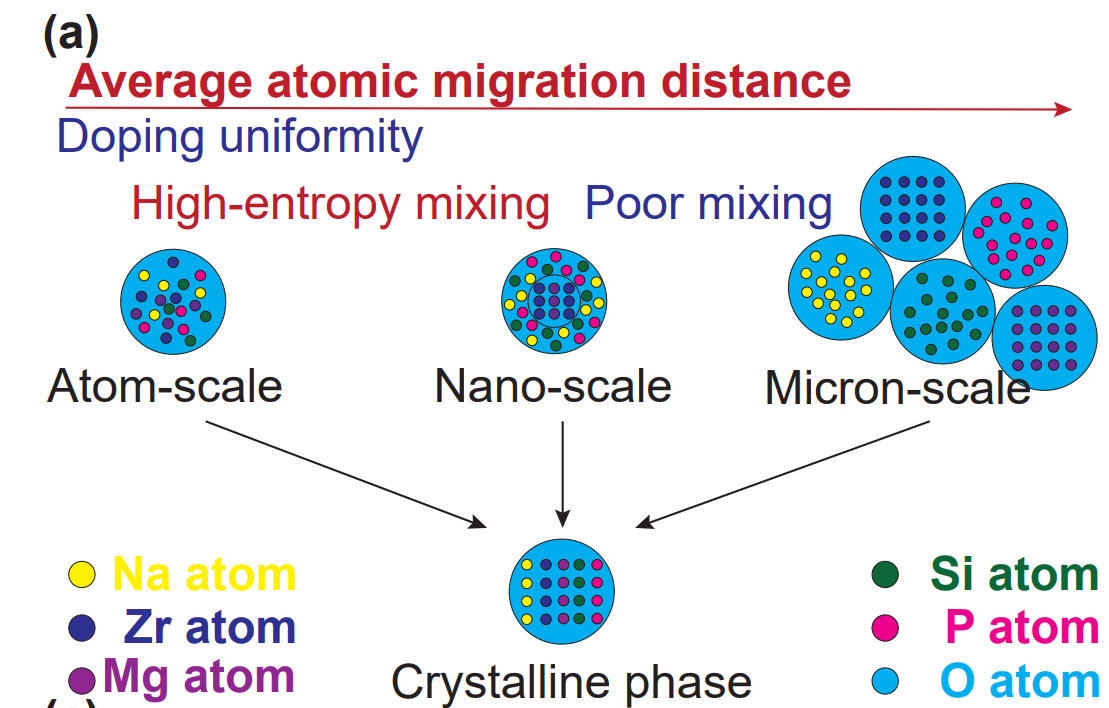
This research demonstrates a novel approach to producing high-performance solid electrolytes for sodium batteries, utilizing swirling spray flame synthesis to create magnesium-doped NASICON particles. The team successfully produced nanoparticles with a unique core-shell architecture and nanoscale mixing, significantly reducing the distances atoms need to travel during the manufacturing process. This enabled reactive sintering, preserving the particles’ ability to compact and densify at lower temperatures than conventional methods. Characterization of the resulting electrolyte pellets reveals that increasing magnesium content promotes the formation of a secondary phase which effectively fills spaces between grains, improving contact and enhancing ionic transport.
The optimized composition, containing 25% magnesium, achieves a room temperature ionic conductivity of 1. 91 mS/cm, representing a significant improvement over undoped materials. Comparative studies confirm that this gas-phase flame synthesis method delivers superior performance alongside reduced processing costs, establishing a promising route towards scalable production of NASICON-based solid electrolytes for commercial battery applications. The authors acknowledge that further research is needed to explore the potential of multi-element co-doping strategies, suggesting that introducing multiple dopants could create even more complex and higher-performing NASICON structures, building on the advantages of facile dopant incorporation offered by flame synthesis.
🗞 Synergetic Enhancement on Bulk and Grain Boundary Ionic Conduction of Mg Doped High-Entropy NASICON-Type Solid Electrolyte for Solid-State Na+ Batteries by Spray Flame Synthesis
🧠 ArXiv: https://arxiv.org/abs/2511.08449