

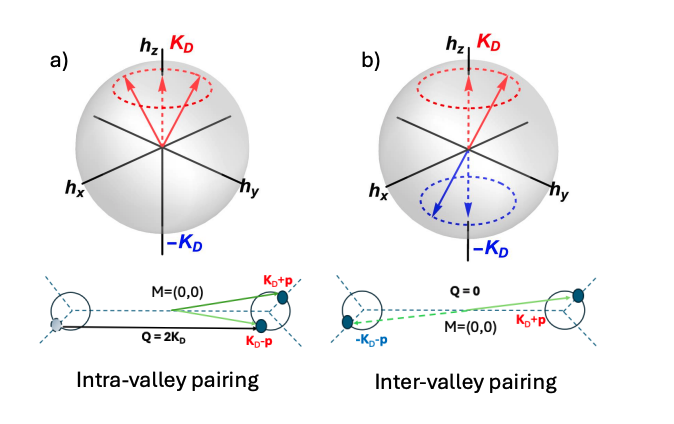
Chiral two-dimensional electron gases, materials exhibiting unique electronic properties found in systems like rhombohedral metals, can give rise to intriguing topological phases of matter. Yafis Barlas, Fan Zhang, and Enrico Rossi investigate how these materials behave when electrons pair up, revealing a surprising link between the material’s topology and the emergence of superconductivity. The team demonstrates that specific topological features within these materials amplify the tendency for electrons to form pairs, favouring a unique type of superconducting order known as a Kekulè pattern. This research establishes a connection between quantum geometry and superconductivity, offering potential insights into the behaviour of materials like rhombohedral and Kagome metals and potentially guiding the development of novel superconducting materials.
Researchers are increasingly interested in understanding the interplay between topology and superconductivity, as combining these phenomena could lead to novel quantum materials with enhanced properties. This work investigates pairing interactions within inversion-symmetric Haldane phases of chiral two-dimensional electron gases, specifically exploring how geometric effects influence the emergence of superconductivity, and aims to determine whether quantum geometry can induce unconventional pairing mechanisms, potentially leading to a unique form of superconductivity known as Kekulé superconductivity.
Chiral Electron Gas Hamiltonian and Haldane Mass
Researchers investigated pairing interactions within chiral two-dimensional electron gases using a theoretical framework based on a continuum model Hamiltonian. This model accounts for the unique characteristics of electrons within these materials and their behavior within valleys, allowing for detailed analysis of band dispersion and wave function characteristics. The team constructed the Hamiltonian to include terms representing the Haldane mass, which induces a quantum anomalous Hall state, and a sublattice staggered potential, enabling investigation of how these factors influence the electronic structure. Analysis of the resulting band dispersion demonstrated that the interplay between these terms creates conditions favorable for spontaneous symmetry breaking, potentially leading to novel superconducting states.
Specifically, the team focused on the behavior of electrons near specific points in the material’s structure, revealing a frustrated arrangement crucial for understanding pairing interactions. Through theoretical calculations, they demonstrated that specific interactions can induce a quantum anomalous Hall state, while others lead to full layer polarization, allowing for prediction of the emergence of topological superconductivity and providing a framework for interpreting experimental observations in rhombohedral and Kagome metals. Experiments confirming interaction-driven Haldane phases in multi-layer graphene systems, including observations of quantized conductance, support the validity of this theoretical framework.
Chiral Superconductivity via Pair-Density Waves
Researchers have discovered a novel superconducting state in chiral two-dimensional electron gases, revealing how the unique topological properties of these materials dramatically influence pairing interactions. The team demonstrates that the inherent band topology enhances the tendency for electrons to pair within the same valley, fostering the emergence of a lattice-scale pair-density wave order. The investigation reveals that when interactions with vibrations within the material mediate pairing, the system supports a chiral Kekulè superconducting order, a distinct form of superconductivity characterized by a specific arrangement of electron pairs, directly linked to the geometric features of the Haldane phase. Calculations show that the Haldane mass term can be significant, reaching approximately 50 meV for certain device configurations.
Crucially, the research demonstrates that the topology of the electronic bands strongly governs the pairing preferences, leading to qualitatively different superconductivity compared to conventional materials. The team’s analysis reveals that pairing between valleys is suppressed due to destructive interference, while pairing within valleys remains robust, potentially enabling new functionalities and applications in areas like quantum computing and advanced materials design. The findings are particularly relevant to understanding superconductivity in rhombohedral and Kagome metals.
Chiral Topology Drives Unconventional Superconductivity
This research demonstrates that specific topological properties within chiral two-dimensional electron gases significantly influence how electrons pair up, potentially leading to unconventional superconductivity. The team finds that the inherent band topology enhances the tendency for electrons to form pairs within the same valley, fostering the emergence of a lattice-scale pair density wave order. When pairing occurs through interactions with vibrations within the material, this results in a chiral Kekulè superconducting order, directly linked to the geometric features of the Haldane phase. The findings are particularly relevant to understanding superconductivity in rhombohedral and Kagome metals, highlighting how the unique band topology alters typical electron pairing behaviour and promotes this distinct pairing mechanism. The authors acknowledge that their model uses a simplified framework and that further investigation is needed to fully account for complexities in real materials. Future work could explore the impact of other factors, such as spin-orbit coupling and electron-electron interactions, on these pairing mechanisms, potentially refining the understanding of unconventional superconductivity in these materials.
🗞 Quantum Geometry Induced Kekulé Superconductivity in Haldane phases
🧠 ArXiv: https://arxiv.org/abs/2508.21791


