

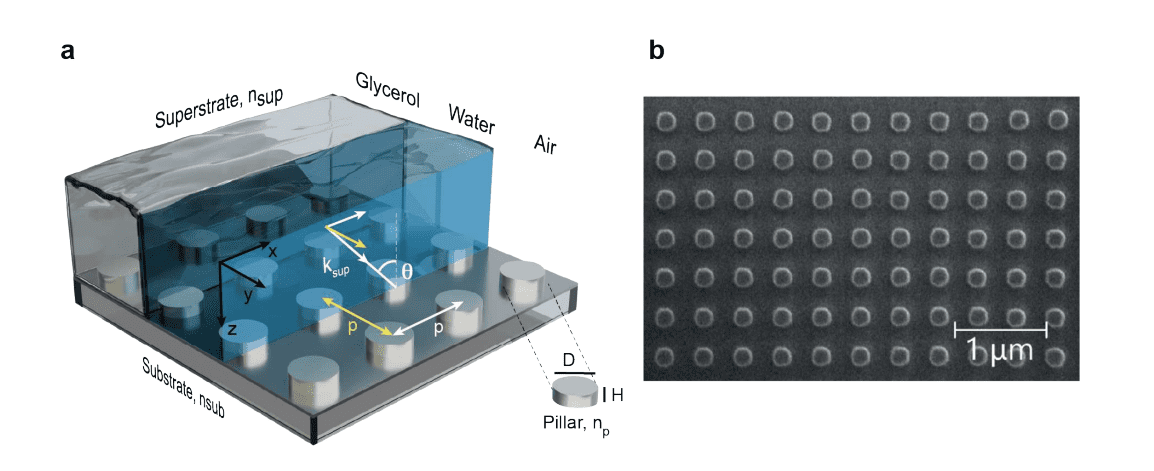
Dielectric metasurfaces represent a powerful platform for manipulating light, and researchers are continually seeking new ways to enhance their capabilities through strong light-matter interactions. Izzatjon Allayarov from Leibniz University Hannover, Vittorio Aita from King’s College London, Diane J. Roth from QinetiQ, Boaz van Casteren from King’s College London, Anton Yu. Bykov from University of Cambridge, and Andrey B. Evlyukhin from Leibniz University Hannover, now demonstrate a crucial step forward by achieving strong coupling between different types of collective resonances within these structures. Their work reveals how symmetry-protected quasi-bound states in the continuum and surface lattice resonances can interact and hybridize, leading to phenomena like Rabi splitting and the formation of accidental bound states. This foundational study not only expands our understanding of light manipulation at the nanoscale, but also provides a pathway towards designing metasurfaces with precisely tailored optical properties and enhanced control over near-field behaviour, promising significant advances in tunable nanophotonics and light-based technologies.
Metasurface Optics, Simulation and Experimental Validation
This research details theoretical modeling and experimental validation of dielectric metasurface behaviour, focusing on electromagnetic interactions between nanoparticles and their optical properties under various conditions. Detailed analysis focuses on symmetry-protected bound states in the continuum (BICs), accidental BICs (aBICs), and the influence of the surrounding medium, with simulations and experiments confirming the model’s accuracy and demonstrating tunability. The study provides a detailed understanding of both symmetry-protected and accidental BICs, explaining their formation and potential for optical applications.
Precise Angle Control for Metasurface Spectroscopy
Researchers developed a custom spectroscopic system to meticulously investigate the optical properties of dielectric metasurfaces, focusing on the coupling between collective resonances. The system precisely controls the angle and polarization of light, allowing for accurate measurements of transmitted and reflected light, and incorporates a sample housing within a glass cuvette for measurements in different environments. Complementing the experimental work, researchers performed numerical simulations using Finite-Difference Time-Domain and Rigorous Coupled-Wave Analysis to calculate scattering efficiency, dipole moments, and polarizabilities.
Strong Coupling of Quasi-BICs and Lattice Resonances
The research team demonstrated strong coupling and hybridization between symmetry-protected quasi-bound states in the continuum (quasi-BICs) and surface lattice resonances (SLRs) within a dielectric metasurface, achieving a significant energy splitting of approximately 130 meV. Experiments with polycrystalline silicon nanodisks revealed suppression of reflection due to anticrossing of SLR and quasi-sBIC features, confirming strong coupling, and analysis of electric field distributions revealed the formation of a hybridized mode with amplified near-field intensity. Under transverse magnetic (TM) polarization, a narrow feature evolved, demonstrating the influence of polarization on the collective resonances.
Hybridizing Resonances, Controlling Coupling with Angle
This research demonstrates the successful coupling and hybridization of surface lattice resonances and quasi-bound states in the continuum within a dielectric metasurface, evidenced by anticrossing behaviour and suppressed reflection. The team established that this coupling can be actively controlled by manipulating the angle of incidence, polarization of light, and the surrounding environment, providing a pathway towards designing metasurfaces with tailored optical properties. Future work may focus on extending these principles to more intricate designs and exploring applications in sensing, nonlinear optics, and photon generation.
👉 More information
🗞 Strong coupling of collective optical resonances in dielectric metasurfaces
🧠 ArXiv: https://arxiv.org/abs/2510.09117

