

The pursuit of precise control over individual atoms unlocks possibilities in diverse fields, from quantum computing to advanced sensing, and researchers continually seek improved methods for detecting and manipulating atomic states. Tai Xiang, Yue-Hui Lu, and Jacquelyn Ho, along with colleagues at the University of California, Berkeley and Lawrence Berkeley National Laboratory, now demonstrate a novel spectroscopic technique for probing atoms as they ascend to highly excited Rydberg states. Their work introduces the two-photon Autler-Townes resonance, an alternative to conventional electromagnetically induced transparency, which offers a significantly stronger signal, allowing the team to resolve Rydberg resonances with unprecedented clarity. This enhanced sensitivity promises to improve the stability of atomic systems and facilitate more precise investigations into the properties of these exotic states of matter.
From a ground state, to an intermediate excited state, and finally to a Rydberg state, has a variety of uses ranging from quantum information to sensing. Scientists have developed a new method for detecting these transitions, offering a significant advantage over traditional techniques when signals are weak. This work centers on observing a phenomenon termed the two-photon Autler-Townes resonance, and offers a robust pathway for investigating Rydberg state physics and enabling more sensitive spectroscopic measurements.
Rydberg Atoms and Electromagnetically Induced Transparency Experiments
This research details an investigation of Rydberg atoms and electromagnetically induced transparency (EIT), combining experimental measurements with theoretical calculations. Rydberg atoms, which are atoms with highly excited electrons, possess exaggerated properties such as large size and long lifetimes, making them valuable for quantum technologies, sensing, and nonlinear optics. EIT is a quantum interference effect that creates a narrow window of transparency within an otherwise opaque medium, allowing for precise control of light and atoms. The team utilized various spectroscopic techniques, including EIT and absorption spectroscopy, to probe the energy levels and properties of these Rydberg states, employing a two-photon excitation scheme to reach them.
Experiments were conducted within a heated atomic vapor cell containing rubidium atoms, where the temperature controls the density of the atomic vapor. A complex laser system generated the necessary light beams, carefully tuned and stabilized to manipulate the atoms. The transmitted light was detected using a sensitive photodetector, allowing scientists to measure the absorption and transparency of the vapor. A magnetic field was applied to the cell to further control the energy levels of the atoms. The researchers successfully observed EIT in the rubidium vapor cell, evidenced by a narrow dip in the absorption spectrum. They used this and other techniques to identify and characterize the Rydberg states of rubidium, determining their energy levels and lifetimes. Experimental results were compared with theoretical calculations, validating the understanding of Rydberg states and EIT.
Rydberg Resonances Resolved Via Two-Photon Transitions
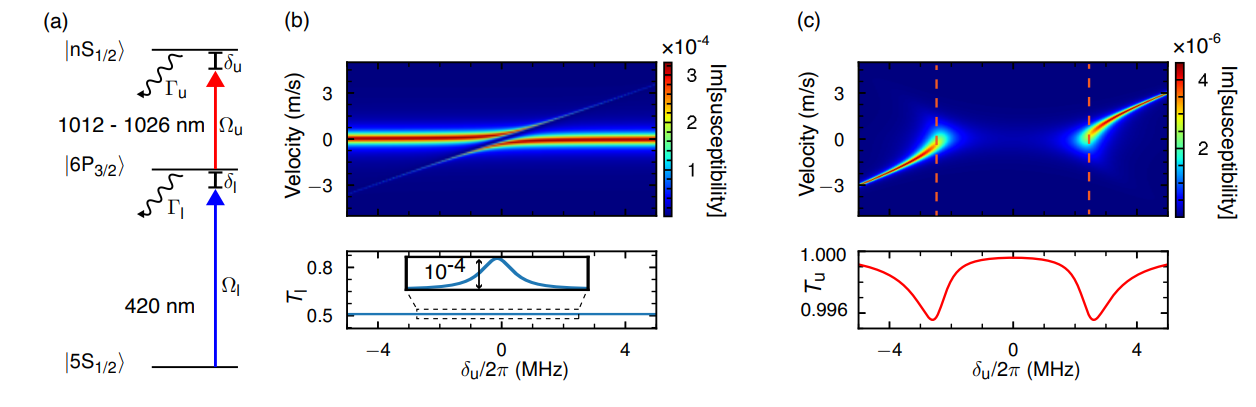
Scientists have demonstrated a novel method for detecting two-photon transitions in atoms, achieving high signal resolution even in challenging conditions where traditional techniques fail. This work centers on observing a phenomenon termed the two-photon Autler-Townes resonance, and offers a robust pathway for investigating Rydberg state physics and enabling more sensitive spectroscopic measurements. The team successfully resolved Rydberg resonances, identifying atomic states with a principal quantum number as high as 30. The research involved exciting atoms in stages, first to an intermediate state and then to a Rydberg state, a highly energetic state crucial for quantum technologies.
By coupling these states with precisely tuned light beams, scientists created a system where the interaction with light dramatically alters the atom’s absorption properties. Traditional EIT relies on observing a reduction in absorption at specific frequencies, but this signal weakens in “inverted wavelength schemes” where the lower-leg light has a shorter wavelength than the upper-leg light. The team circumvented this limitation by focusing on the Autler-Townes resonance, which provides a stronger, clearer signal. Experiments revealed that the two-photon Autler-Townes resonance exhibits a superior signal-to-noise ratio compared to EIT, enabling the precise identification of Rydberg states.
Simulations and observations show that the absorption profiles are influenced by the velocity distribution of the atoms, with overlapping features arising from atoms moving at different speeds. The team accounted for these Doppler shifts to accurately pinpoint the resonance conditions. Furthermore, the researchers demonstrated that this technique can be used to stabilize the frequency of the upper-leg beam, a critical requirement for maintaining the precision of the experiment and for potential applications in quantum information processing. This breakthrough delivers a powerful new tool for exploring and manipulating atoms for advanced scientific research and technological development.
Two-Photon Autler-Townes Resonance Identifies Rydberg States
This research demonstrates a novel spectroscopic feature, termed the two-photon Autler-Townes resonance, observed during two-photon excitation of atoms to Rydberg states. The team successfully identified this resonance by probing the upper-leg laser in an inverted wavelength scheme, where the initial excitation wavelength is shorter than that of the subsequent transition to the Rydberg state. Importantly, the two-photon Autler-Townes resonance exhibits a superior signal-to-noise ratio compared to conventional electromagnetically induced transparency, allowing for the resolution of Rydberg resonances with higher principal numbers. The findings reveal that this resonance can be effectively utilized to locate Rydberg states, proving particularly useful when resonance frequencies are known or when exploring new atomic species. Furthermore, the researchers demonstrated the resonance’s ability to generate an error signal for stabilizing the frequency of the laser driving the upper excitation, offering a potential low-cost and low-maintenance alternative to existing laser locking methods.
🗞 Autler-Townes spectroscopy of a Rydberg ladder
🧠 ArXiv: https://arxiv.org/abs/2510.13150


