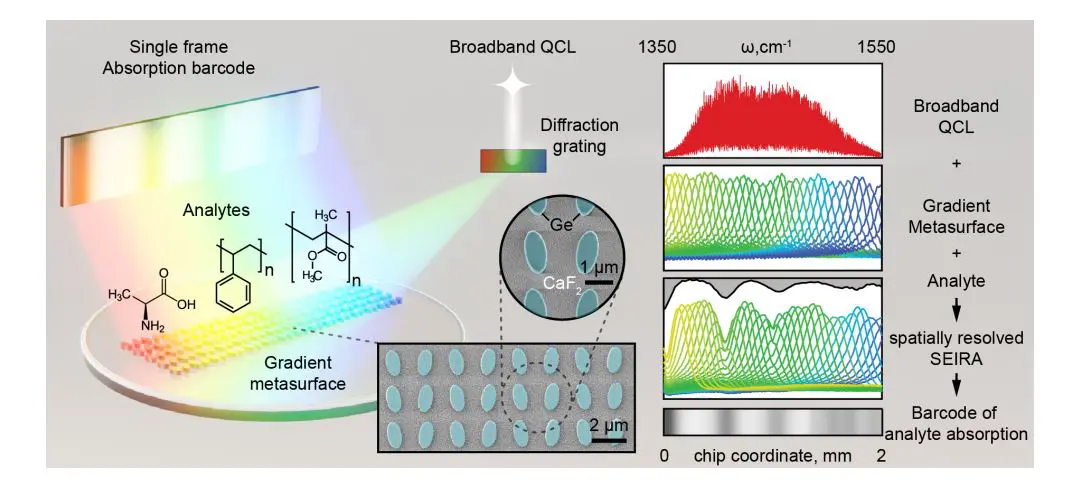
Mid-infrared spectroscopy holds immense promise for identifying molecules through their unique absorption patterns, but its widespread use has been hampered by weak signal strength and complex instrumentation. Now, Ivan Sinev, Alessio Cargioli, and Diego Piciocchi, alongside colleagues at École Polytechnique Fédérale de Lausanne and ETH Zurich, demonstrate a significant advance in surface-enhanced infrared absorption spectroscopy. Their research introduces a compact imaging platform that combines specially designed metasurfaces with a broadband quantum cascade laser, dramatically boosting signal strength and reducing measurement times. This innovative approach eliminates the need for bulky spectrometers and expensive detectors, paving the way for rapid, miniaturised, and highly specific molecular diagnostics in fields ranging from chemistry to biology.
paralleled opportunities in sensing exist through chemically specific detection of molecular absorption fingerprints. However, practical applications are limited by the weak light-matter interaction in the mid-IR range and the low brightness of mid-IR light sources. Surface-enhanced infrared absorption (SEIRA) spectroscopy addresses these sensitivity limitations by leveraging resonant photonic structures, particularly plasmonic and frequency-selective dielectric metasurfaces.
Broadband Laser Spectroscopy with Metasurfaces
The study pioneers a compact and high-throughput imaging platform for surface-enhanced infrared absorption (SEIRA) spectroscopy, overcoming limitations imposed by weak light-matter interactions in the mid-infrared range. Scientists engineered a system that combines broadband gradient metasurfaces with a radiofrequency-modulated quantum cascade laser (QCL) to generate remarkably broad instantaneous emission spectra, spanning 250cm⁻¹, capable of covering multiple molecular vibrational modes simultaneously. This technique enables rapid, non-destructive analysis of sample absorption spectra, achieving acquisition times reduced by up to three orders of magnitude compared to conventional infrared techniques. The study demonstrates this capability by analyzing films of polystyrene and polymethylmethacrylate, successfully reproducing reference absorption spectra from the spatial intensity profiles of the transmitted QCL beam.
To further enhance sensitivity, scientists utilized resonant gradient metasurfaces fabricated with elliptical germanium nanoresonators. The metasurface design incorporates a smooth variation in unit cell size, creating a gradient that tunes the resonant frequency across the laser’s emission band. Researchers then demonstrated imaging SEIRA spectroscopy by covering the metasurface with polymethylmethacrylate and acquiring infrared transmission and reflection spectra, confirming strong modulation of the peaks by polymer absorption.
Gradient Metasurfaces Enhance Mid-Infrared Light-Matter Coupling
This research details the development and characterization of gradient high-quality dielectric metasurfaces for enhanced mid-infrared sensing and control of vibrational light-matter coupling. The core innovation lies in creating metasurfaces with spatially varying structural parameters, a gradient that allows for broadband operation and improved performance compared to traditional, uniform metasurfaces. These metasurfaces utilize high-quality factor (Q) dielectric resonators, maximizing light-matter interaction and enhancing sensitivity. Researchers fabricated the metasurfaces using nanofabrication techniques and characterized their optical properties using spectroscopic methods.
The gradient design significantly broadened the operational bandwidth, making it suitable for a wider range of applications. Computational modeling was used to optimize the metasurface design and understand the underlying physics of light-matter interaction. The research demonstrates the potential of these metasurfaces for applications like molecular barcoding and sensitive detection of trace amounts of substances.
Rapid Molecular Detection via Metasurface Imaging
This research demonstrates a new approach to mid-infrared spectroscopy, achieving rapid and high-throughput molecular detection through a compact imaging platform. By combining broadband gradient metasurfaces with a uniquely modulated quantum cascade laser, scientists have overcome limitations associated with traditional mid-infrared techniques, which often require complex instrumentation and lengthy acquisition times. The system efficiently enhances light-matter interaction, enabling the detection of molecular absorption fingerprints as a barcode-like image on a room-temperature camera. The team successfully detected the unique absorption signatures of three different molecules deposited on a metasurface with a footprint of less than one square millimeter, achieving acquisition times up to three orders of magnitude faster than conventional infrared spectroscopy. This advancement significantly improves the speed and efficiency of mid-infrared analysis, paving the way for more practical and widespread applications in chemical and biological diagnostics.
🗞 Metasurface-Enhanced Mid-Infrared Imaging Spectroscopy with Broadband Quantum Cascade Lasers
🧠 ArXiv: https://arxiv.org/abs/2511.22452