

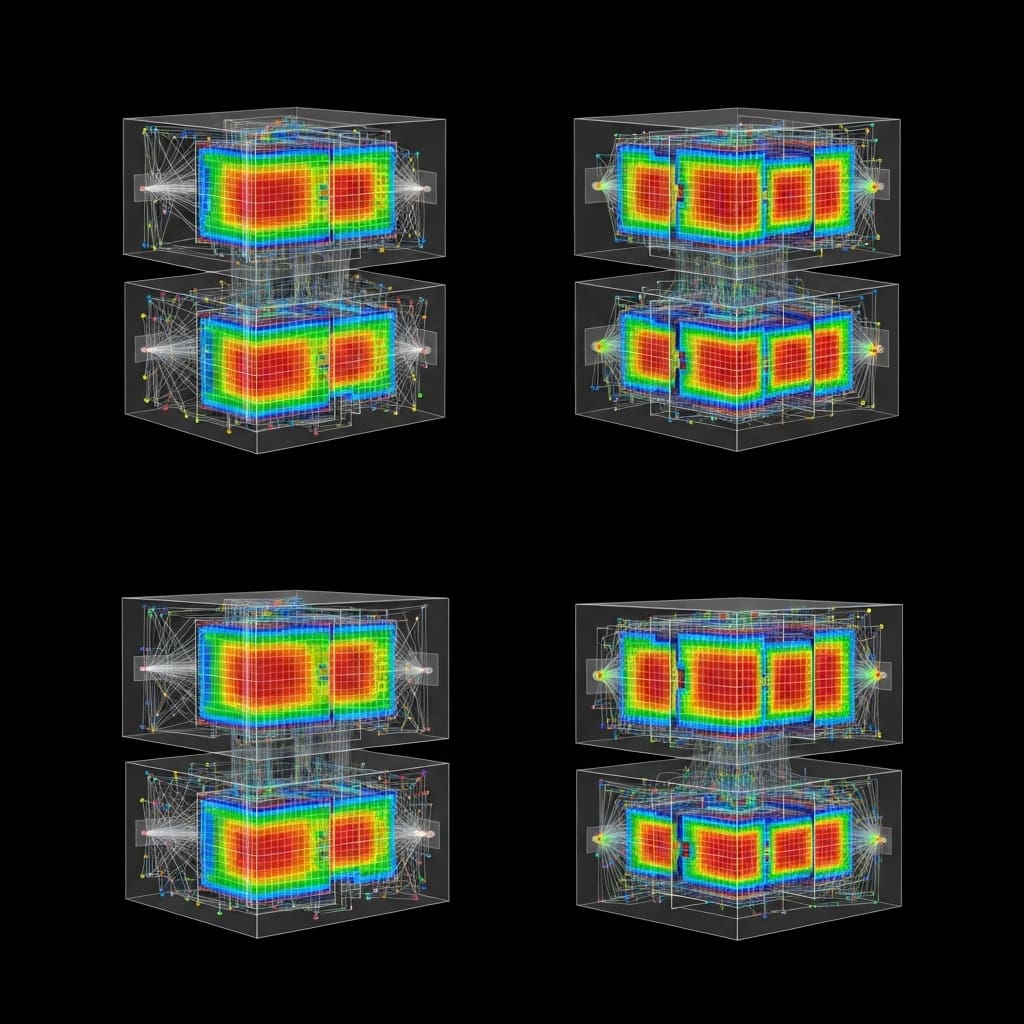
Researchers are tackling the longstanding problem of designing metasurfaces, artificial materials engineered to control light, which is hampered by the complex link between their shape and how they interact with electromagnetic waves. Mathys Le Grand, Pascal Urard, and Denis Rideau from STMicroelectronics, alongside et al., have developed a new generative framework utilising diffusion models to dramatically improve the speed and accuracy of metasurface inverse design. Their innovative approach incorporates a consistency constraint and enhanced posterior sampling, ensuring designs meet specific electromagnetic targets with greater reliability. This work is significant because it not only boosts design precision but also introduces a scalable methodology capable of handling large-scale metasurfaces , generating designs in minutes based on training from smaller arrays , paving the way for more efficient and powerful optical devices.
Diffusion Models for Metasurface Inverse Design
Scientists have demonstrated a novel generative framework based on diffusion models for the inverse design of metasurfaces, overcoming limitations inherent in traditional optimisation approaches. The research addresses the complex, nonlinear relationship between metasurface geometry and electromagnetic behaviour, which often leads to excessive computational demands and suboptimal solutions. This breakthrough reveals a method incorporating a dedicated consistency constraint and advanced posterior sampling techniques to ensure generated designs adhere to desired electromagnetic specifications. Rigorous validation using small-scale metasurface configurations confirms marked enhancements in both the accuracy and reliability of the resulting designs.
The team achieved a scalable methodology extending inverse design capabilities to large-scale metasurfaces, successfully validating configurations of up to 98 × 98 nanopillars. Notably, this approach enables rapid design generation, completed in a matter of minutes, by leveraging models trained on substantially smaller arrays of 23 × 23. Experiments show that the diffusion-based generative framework significantly outperforms conventional methods in terms of both efficiency and precision. This innovation establishes a robust and efficient framework for high-precision metasurface inverse design, paving the way for more complex and functional optical devices.
The study focuses on a beam-shaping problem, a generalisable methodology applicable to diverse photonic and material science applications. Researchers utilise the Finite Difference Time Domain method to compute electromagnetic field interactions with the metasurface, subsequently propagating the near field to the far field using the Fraunhofer diffraction approximation. The optimised structure comprises a regular grid of dielectric pillars with a centre-to-centre spacing of λ/2, illuminated by a normally incident monochromatic plane wave at wavelength λ. This meticulous approach allows for precise manipulation of both near- and far-field electromagnetic interactions, ultimately optimising far-field power distribution.
Furthermore, the work builds upon the ancestral sampling approach inherent in diffusion models, introducing a consistency term within the loss function and exploring posterior sampling techniques to improve compliance with input conditions. A comparative analysis against existing research highlights the advantages of this diffusion model-based approach, particularly in generating accurate structure parameters and maintaining training stability. The research establishes a significant advancement in the field, offering a powerful tool for designing metasurfaces with tailored electromagnetic properties and opening new avenues for innovation in photonics and metamaterials.
Diffusion Models for Metasurface Inverse Design are gaining
Scientists developed a diffusion-based generative framework to tackle the complex inverse design of metasurfaces, overcoming limitations inherent in traditional optimisation approaches. The research team addressed the nonlinear relationship between metasurface geometry and electromagnetic behaviour by pioneering a method incorporating a dedicated consistency constraint and advanced posterior sampling techniques, ensuring designs adhere to specified electromagnetic requirements. Rigorous validation using small-scale metasurface configurations demonstrably improved both the accuracy and reliability of generated designs, establishing a significant methodological advance. Experiments employed a beam-shaping problem as a generalisable physical system for metasurface inverse design, focusing on the manipulation of electromagnetic waves at subwavelength scales.
The study meticulously characterised both near-field and far-field effects, recognising the near field as a crucial intermediate step for accurate far-field computation, essential for applications like sensing and imaging. Researchers harnessed Finite Difference Time Domain (FDTD), Finite Element Method (FEM), and spectral methods as baseline simulation techniques, acknowledging their scalability limitations and periodic pattern dependencies. To circumvent these limitations, the team engineered a scalable methodology extending inverse design capabilities to large-scale metasurfaces, successfully validating configurations containing up to 98 × 98 nanopillars. This innovative approach achieves rapid design generation, completing the process in under a minute by leveraging models trained on smaller 23 × 23 arrays.
The technique reveals a substantial improvement in efficiency, demonstrating the power of transfer learning within the generative framework. This diffusion model outperforms Generative Adversarial Networks (GANs) in both sample quality and training stability, offering a more robust and efficient solution for high-precision metasurface design. Furthermore, the work pioneers the integration of a consistency term into the loss function, alongside exploration of posterior sampling techniques, to enhance compliance with input design conditions. The entire codebase developed during this study has been made openly available, fostering reproducibility and further innovation in the field of metasurface design and photonic engineering.
Diffusion Models Enable Rapid Metasurface Inverse Design
Scientists achieved a breakthrough in metasurface inverse design using a generative framework based on diffusion models, demonstrating marked enhancements in both accuracy and reliability. The team developed a scalable methodology extending inverse design capabilities to large-scale metasurfaces comprising up to nanopillars. Remarkably, rapid design generation, completed in just minutes, was enabled by leveraging trained models on substantially smaller arrays of . This innovation establishes a robust and efficient framework for high-precision metasurface inverse design, overcoming challenges inherent in the nonlinear relationship between geometry and electromagnetic behaviour.
Experiments revealed that the incorporation of a dedicated consistency constraint and advanced posterior sampling methods significantly improved adherence to desired electromagnetic specifications. The work compares diffusion models (DMs) against Generative Adversarial Networks (GANs) and improved GANs like Wasserstein GAN, conclusively demonstrating that DMs are more accurate for generating structure parameters and exhibit greater stability during training, resulting in increased efficiency. This research builds upon the ancestral sampling approach, addressing its limitations by introducing a consistency term in the loss function and exploring posterior sampling techniques to improve compliance with input conditions. Measurements confirm the performance gains of diffusion models on small metasurfaces, paving the way for scaling inverse design to larger configurations.
The study focused on a beam-shaping problem, a methodology generalizable to various photonic and material science applications, utilising the Finite Difference Time Domain (FDTD) method to obtain the near field, subsequently propagated to the far field via the Fraunhofer diffraction approximation. The optimized structure comprises a regular grid of dielectric pillars with a center-to-center spacing of λ/2, illuminated by a normally incident monochromatic plane wave at wavelength λ. Tests prove the efficacy of the approach through validation against a phase retrieval and look-up-table method, as well as gradient descent utilizing a surrogate network. Results are validated by comparing the simulated far-field response to the target using the R2 metric, where values closer to 1 indicate better agreement, the metric ranges over (−∞, 1]. The evaluation workflow, detailed in Figure 1, highlights the precision of the inverse design flow using diffusion models, offering a significant advancement in the field of nanophotonics and metamaterials.
Diffusion Models Accelerate Metasurface Inverse Design significantly
Scientists have developed a new generative framework, based on diffusion models, to address challenges in the inverse design of metasurfaces. Traditional methods often struggle with the complex link between a metasurface’s geometry and its electromagnetic behaviour, leading to high computational costs and suboptimal results. This research introduces a scalable methodology, validated on configurations of up to nanopillars, that significantly improves both the accuracy and reliability of generated designs. The approach leverages trained models on smaller arrays to rapidly generate designs, completing the process in a matter of minutes.
The key innovation lies in the incorporation of a dedicated consistency constraint and advanced posterior sampling methods within the diffusion model framework. Researchers found that simply improving training metrics isn’t enough to guarantee superior inverse design performance; instead, the ultimate evaluation must be based on the far-field response verified through rigorous Finite-Difference Time-Domain (FDTD) simulation. Furthermore, the study details the importance of the noise schedule during training, testing Linear, Quadratic, and Sigmoid schedules to optimise far-field precision. The authors acknowledge that the ancestral sampling method proved ineffective for this specific inverse design problem. Future work could explore alternative sampling techniques and investigate the application of this framework to even larger and more complex metasurface designs.
👉 More information
🗞 Enhanced posterior sampling via diffusion models for efficient metasurfaces inverse design
🧠 ArXiv: https://arxiv.org/abs/2601.15210