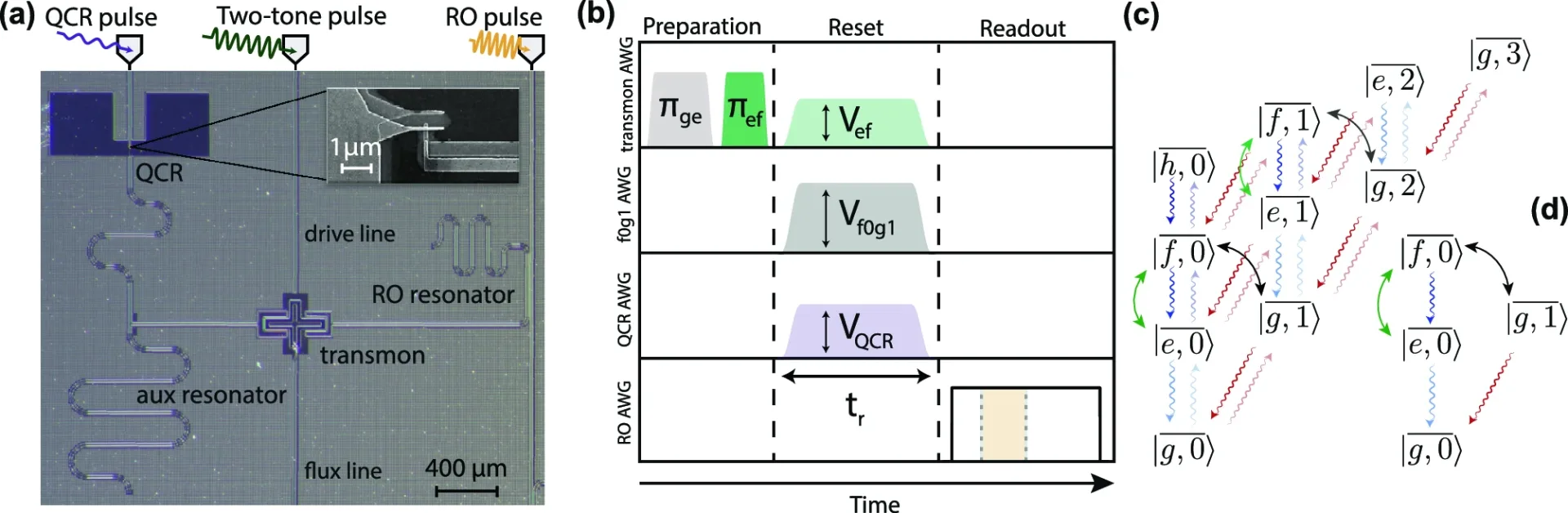
The efficient initialization of qubits, the fundamental units of quantum computers, is crucial for their optimal operation. This is particularly important for noisy intermediate-scale quantum (NISQ) devices, which are limited by noise and error correction. A promising approach for resetting these devices involves combining engineered environments with microwave techniques, using a single-junction quantum-circuit refrigerator (QCR) for rapid excitation removal from a transmon qubit. The use of a QCR and a two-tone microwave drive has shown promising results, paving the way for optimized reset of quantum-electric devices and dissipation-engineered state preparation.
What is the Importance of Fast and Precise Initialization of Qubits?
The successful operation of quantum computers hinges on the fast and precise initialization of qubits. Qubits, the basic building blocks of quantum computers, need to be efficiently reset to a known eigenstate for the device to function optimally. This requirement becomes even more critical as the complexity of quantum processors increases and as we move towards the ultimate goal of quantum error correction. In the context of noisy intermediate-scale quantum (NISQ) devices, the efficient reuse of qubits emerges as a necessity.
The rapid progress in applications of superconducting quantum computers not only necessitates improved hardware components but also optimized techniques for controlling qubits. The need for fast and accurate initialization of the device to a known eigenstate is a requirement that cannot be overstated. The efficient reuse of qubits is particularly important in the context of NISQ devices, which are a type of quantum computer that can perform complex calculations but are limited by noise and the inability to correct errors.
How Can Engineered Environments and Microwave Techniques Aid in Qubit Initialization?
The combination of engineered environments with all microwave techniques has recently emerged as a promising approach for the reset of superconducting quantum devices. In this context, a single-junction quantum-circuit refrigerator (QCR) can be utilized for the expeditious removal of several excitations from a transmon qubit. The QCR is indirectly coupled to the transmon through a resonator in the dispersive regime, constituting a carefully engineered environmental spectrum for the transmon.
The use of a single-junction quantum-circuit refrigerator (QCR) for the rapid removal of several excitations from a transmon qubit has been experimentally demonstrated. The QCR is indirectly coupled to the transmon through a resonator in the dispersive regime, creating a carefully engineered environmental spectrum for the transmon. This approach combines engineered environments with microwave techniques, a combination that has recently gained traction as a promising method for resetting superconducting quantum devices.
What are the Results of Using a QCR and a Two-Tone Microwave Drive?
Using single-shot readout, excitation stabilization times down to roughly 500 ns, a 20-fold speedup with QCR, and a simultaneous two-tone drive addressing the ef and f0g1 transitions of the system were observed. These results were obtained at a 48mK fridge temperature and without post-selection, fully capturing the advantage of the protocol for the short time dynamics and the drive-induced detrimental asymptotic behavior in the presence of relatively hot other baths of the transmon.
The results of using a QCR and a two-tone microwave drive were validated with a detailed Liouvillian model truncated up to the three-excitation subspace. From this, the performance of the protocol in optimized scenarios such as cold transmon baths and fine-tuned driving frequencies was estimated. These results pave the way for optimized reset of quantum-electric devices using engineered environments and for dissipation-engineered state preparation.
What is the Future of Qubit Initialization?
The results obtained from the use of a QCR and a two-tone microwave drive for the initialization of qubits pave the way for optimized reset of quantum-electric devices using engineered environments. This also opens up possibilities for dissipation-engineered state preparation. The performance of the protocol in optimized scenarios, such as cold transmon baths and fine-tuned driving frequencies, was estimated using a detailed Liouvillian model truncated up to the three-excitation subspace.
The future of qubit initialization looks promising with the advent of techniques such as the use of a QCR and a two-tone microwave drive. The results obtained from these techniques pave the way for the optimized reset of quantum-electric devices using engineered environments and for dissipation-engineered state preparation. The performance of the protocol in optimized scenarios, such as cold transmon baths and fine-tuned driving frequencies, can be estimated using a detailed Liouvillian model truncated up to the three-excitation subspace. This suggests that we are on the cusp of a new era in quantum computing, where the fast and precise initialization of qubits becomes a reality.
Publication details: “Many-excitation removal of a transmon qubit using a single-junction quantum-circuit refrigerator and a two-tone microwave drive”
Publication Date: 2024-06-14
Authors: Wallace S. Teixeira, Timm Mörstedt, Ari J. Viitanen, Heidi Kivijärvi, et al.
Source: Scientific reports
DOI: https://doi.org/10.1038/s41598-024-64496-5