

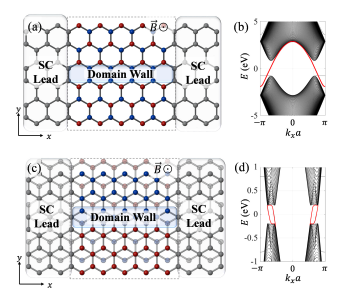
Domain walls, boundaries between regions with differing electronic properties, are emerging as powerful tools in materials science, and researchers are now exploring their potential in superconducting circuits. Xia’an Du, Junjie Qi, and Hua Jiang, alongside colleagues at Fudan University, investigate how these domain walls behave within graphene-based Josephson junctions, circuits that exhibit quantum mechanical properties. This work theoretically demonstrates that carefully engineering these domain walls unlocks a range of functionalities, from enhanced magnetic field sensitivity to the creation of ideal Josephson diodes and controllable supercurrent splitting. The findings establish a versatile platform for designing next-generation quantum devices and deepen our understanding of topological phenomena in two-dimensional materials.
Topological Electronics and Graphene Materials Research
This body of work explores the potential of topological materials, particularly graphene, to create advanced electronic devices with unique properties. Researchers aim to harness topological states of matter to build robust, low-dissipation electronics that outperform conventional semiconductors, focusing on novel Josephson junctions, superconducting diodes, and valleytronic devices. The research centers on utilizing graphene’s unique band structure and valley properties, alongside other topological materials, to create devices inherently resistant to disorder and backscattering, minimizing energy loss and maximizing performance. Researchers are also exploring the use of domain walls and topological defects as channels for carrying currents and creating new functionalities, designing structures that can split and direct currents based on topological properties.
Specific device concepts include topological current dividers and splitters, valley current splitters, and superconducting diodes created by breaking symmetry in Josephson junctions. Combining topological insulators with superconductors is also being explored to create devices with unique properties. A key insight is the paramount importance of robustness against imperfections, as topological states offer inherent protection against backscattering and dissipation, making them ideal for reliable devices. Symmetry breaking is crucial for creating non-reciprocal devices like superconducting diodes, and material engineering plays a vital role, as device performance depends critically on material quality.
Integrating different materials, such as graphene, topological insulators, and superconductors, offers a promising approach to enhance functionalities. Previous studies have demonstrated concepts like current partitioning at topological intersections and soliton-dependent electronic transport across bilayer graphene domain walls. Recent work has reported on the zero-field superconducting diode effect in twisted bilayer graphene and the potential of valley polarization to induce a Josephson diode effect, collectively representing a vibrant and rapidly evolving field with the potential to revolutionize electronics.
Graphene Josephson Junctions and Topological Kink States
Researchers have developed a sophisticated method to investigate transport properties in graphene-based Josephson junctions, focusing on how topological kink states within domain walls influence device performance. The team designed a system comprising a graphene central region containing domain walls, coupled to superconducting leads, and employed a theoretical framework to account for both electron and hole excitations within the material. This allows for detailed calculations of supercurrent flow and the exploration of various domain wall configurations. To model the graphene systems, scientists constructed a Hamiltonian describing the central region and superconducting leads, incorporating parameters for hopping between atoms and onsite potentials that define the domain wall structure.
They investigated both monolayer and bilayer graphene, adapting the Hamiltonian construction to suit each material’s unique electronic properties. A crucial element involved applying a perpendicular magnetic field to the device, which modifies the hopping terms and allows researchers to simulate the impact of external magnetic fields on supercurrent flow. The team focused on three distinct domain wall engineering strategies, revealing a continuous evolution from Aharonov-Bohm oscillation to Fraunhofer diffraction as the number of domain walls increased, reproducing experimental observations and suggesting potential for high-resolution magnetometry. Researchers induced unidirectional critical current under a magnetic field by breaking inversion symmetry, demonstrating potential applications as superconducting diodes, and found that manipulating the geometry of domain walls enabled controllable supercurrent splitting, with ratios tunable through the intersection angle, magnetic field, and superconducting phase difference.
Graphene Domain Walls Control Superconducting Junctions
Researchers have achieved breakthroughs in designing novel Josephson junctions based on graphene domain walls, establishing a versatile platform for next-generation quantum devices. These junctions, utilizing topological kink states within the graphene, demonstrate controllable superconducting properties with potential applications in sensitive magnetometry and low-dissipation computing. The team investigated three distinct strategies for engineering these junctions, revealing a rich landscape of tunable behaviors. Experiments and theoretical modeling demonstrate that manipulating the number of domain walls within the junction allows for a continuous transition between Aharonov-Bohm oscillations and Fraunhofer diffraction patterns, suggesting enhanced sensitivity for magnetometry applications.
Furthermore, researchers discovered that asymmetric configurations of domain walls, induced by applied magnetic fields, create a Josephson diode, a device exhibiting pronounced non-reciprocal transport. Beyond number and symmetry, the geometry of intersecting domain walls provides another avenue for control. The team found that the angle between intersecting domain walls, combined with magnetic field and superconducting phase difference, allows for tunable splitting of the supercurrent among different leads, opening possibilities for programmable superconducting logic devices. These graphene-based Josephson junctions represent a significant step towards realizing advanced quantum technologies with enhanced performance and functionality.
Domain Walls Control Supercurrent and Junction Properties
This research investigates the potential of domain walls within graphene-based Josephson junctions, exploring how these walls can be engineered to control superconducting properties. The team proposes and demonstrates three distinct strategies for manipulating these junctions: controlling the number of domain walls, engineering their symmetry, and manipulating their geometry. Results show that varying the number of domain walls leads to a transition from Aharonov-Bohm oscillation to Fraunhofer diffraction, suggesting improved sensitivity for magnetometry applications. Furthermore, an asymmetric arrangement of domain walls creates a Josephson diode, exhibiting non-reciprocal transport, while intersecting domain walls enable controllable splitting of supercurrent between leads, tunable by angle, magnetic field, and phase difference. These findings establish domain wall engineering as a versatile platform for developing next-generation superconducting circuits and low-dissipation quantum devices.
🗞 Domain Wall Engineering in Graphene-Based Josephson Junctions
🧠 ArXiv: https://arxiv.org/abs/2509.02082


