

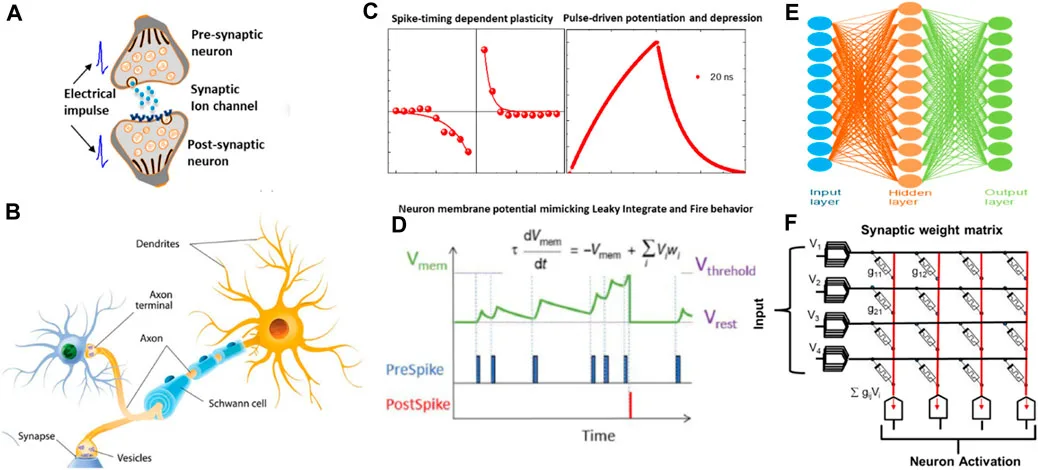
The future of computing beyond the Von Neumann era is expected to rely on emerging devices that utilize material and device physics for novel functionalities. These devices, crucial for power-efficient and real-time computing for AI tasks, will likely move beyond the traditional model of a stored-program digital computer. The development of neuromorphic computing hardware, which implements neural network operations, is key to this future. Nanotechnology will support hardware development, creating smaller, faster, and more energy-efficient devices. Nanoelectronic devices using ferroic ordering are a promising alternative, with research focusing on the basic architectures of spintronic and ferroelectric devices and their integration into neuromorphic and analog memory applications.
What is the Future of Computing Beyond the Von Neumann Era?
The future of computing beyond the Von Neumann era is heavily reliant on emerging devices that can extensively harness material and device physics to bring novel functionalities. These devices are expected to perform power-efficient and real-time computing for artificial intelligence (AI) tasks. The Von Neumann architecture, named after the mathematician and physicist John Von Neumann, is a design model for a stored-program digital computer that uses a processing unit and a single separate storage structure to hold both instructions and data. However, the future of computing is expected to move beyond this traditional model.
The development of neuromorphic computing hardware, devices with bioplausible functionalities for implementing neural network operations in hardware, is a key aspect of this future. These devices require different kinds of volatile and nonvolatile memories to implement synaptic and neuronal functionalities. While synaptic plasticity, runtime weight update, and supervised learning require well-controlled multilevel conductance in nanoscale devices with long and short-term synaptic potentiation and depression, neuronal leaky-integrate-and-fire (LIF) activity demands an accumulative nature of switching from one conductance state to the other and a finite decay rate of conductance states to return to its previous condition.
How Can Nanotechnology Support Hardware Development for AI?
Brain-like computing demands large-scale integration of synapses and neurons in practical circuits. This requires nanotechnology to support the hardware development. Nanotechnology, the manipulation of matter on an atomic, molecular, and supramolecular scale, can help in creating devices that are smaller, faster, and more energy-efficient. This is crucial for the development of AI technologies, which require high computational power and energy efficiency.
Moreover, for bringing AI closer to quantum computing and space technologies, additional requirements are operation at cryogenic temperatures and radiation hardening. Cryogenic temperatures, extremely low temperatures, are necessary for quantum computing as quantum bits or qubits, the basic unit of quantum information, require such conditions to function. Radiation hardening, the act of making electronic components and systems resistant to damage or malfunctions caused by high levels of ionizing radiation, is necessary for space technologies.
What Role Does Ferroic Ordering Play in Nanoelectronic Devices?
Nanoelectronic devices utilizing ferroic ordering have emerged as one promising alternative for the future of computing. Ferroic materials are those that exhibit spontaneous ordering, meaning they have a property that exists without an external influence. This property can be electric polarization (ferroelectric), magnetization (ferromagnetic), or both (multiferroic).
The current review discusses the basic architectures of spintronic and ferroelectric devices for their integration in neuromorphic and analog memory applications. Spintronics, or spin electronics, is the study of the intrinsic spin of the electron and its associated magnetic moment, in addition to its fundamental electronic charge, in solid-state devices. Ferroelectric devices, on the other hand, are based on materials that have a spontaneous electric polarization that can be reversed by the application of an external electric field.
How Can Ferromagnetic and Ferroelectric Domain Structures Be Controlled?
Ferromagnetic and ferroelectric domain structures and the control of their dynamics are crucial for reliable multibit memory operation. A domain in ferromagnetic material is a region in which the magnetization is uniform. This means that the individual magnetic moments of the atoms are aligned with one another and they point in the same direction. In ferroelectric materials, a domain is a region in which the electric polarization is uniform.
The control of these domain structures and their dynamics is a complex process that involves manipulating the material at the atomic level. This can be achieved through various methods, such as the application of external electric or magnetic fields, changes in temperature, or mechanical stress.
What Are the Challenges and Future Research Directions in This Field?
The large-scale integration of these devices presents several challenges. These include the need for an affordable process complexity and cost to bring the solutions close to market rather soon. Despite these challenges, the potential benefits of these devices, such as their ability to perform power-efficient and real-time computing for AI tasks, make them a promising area of research.
Future research directions in this field include further exploration of the basic architectures of spintronic and ferroelectric devices, as well as the development of methods for controlling ferromagnetic and ferroelectric domain structures. Additionally, research into how these devices can be integrated into neuromorphic and analog memory applications will also be crucial.
Publication Date: 2024-05-15
Authors: Sayani Majumdar
Source: Frontiers in nanotechnology
DOI: https://doi.org/10.3389/fnano.2024.1371386


