

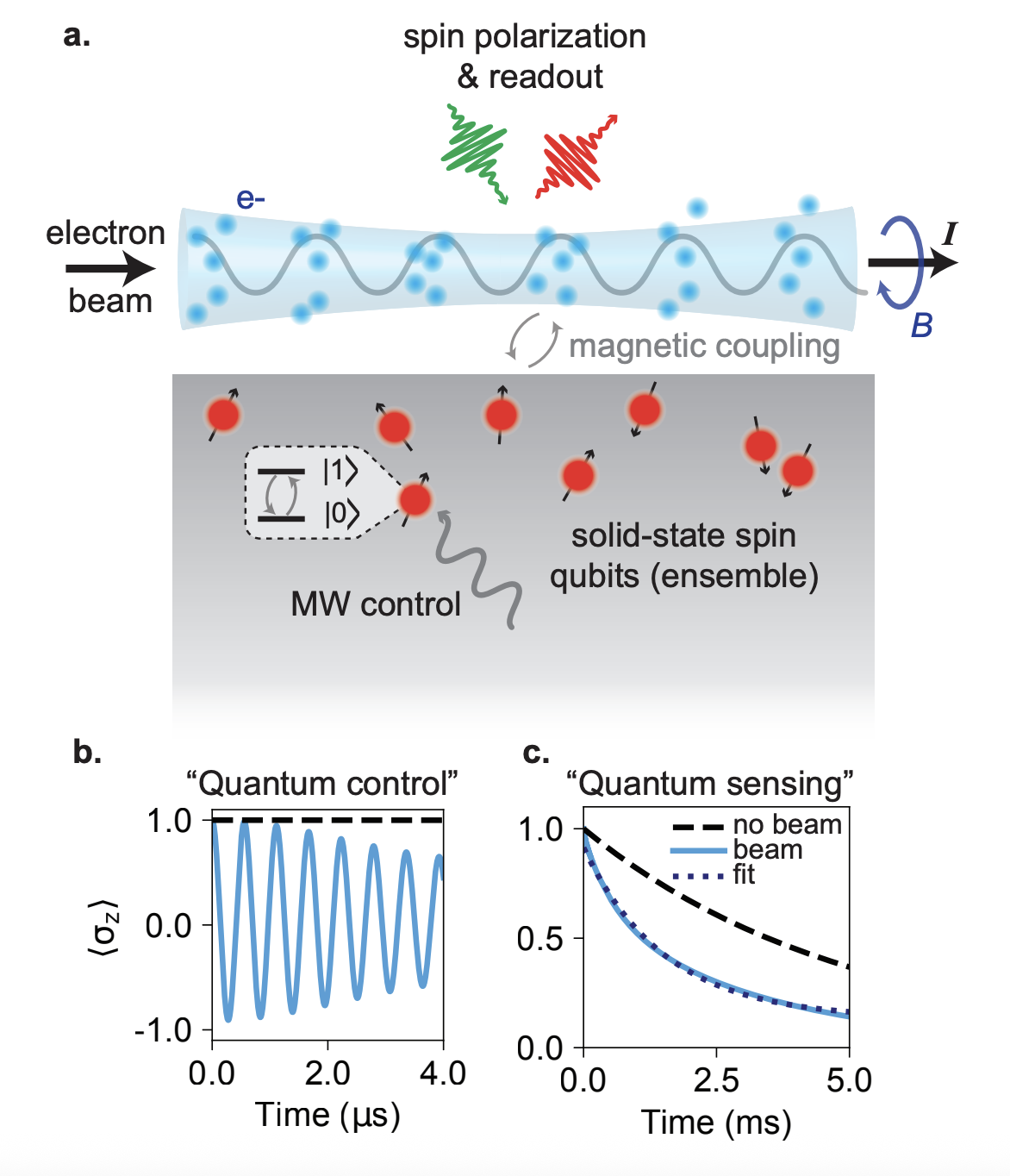
Revealing the structure of matter traditionally relies on scattering experiments using energetic particles like electrons, but achieving coherent interactions between these beams and solid-state systems has proven remarkably difficult due to weak coupling. Now, Jakob M. Grzesik, Dominic Catanzaro, Charles Roques-Carmes, and colleagues at Stanford University, alongside Ido Kaminer from the Technion-Israel Institute of Technology and others, demonstrate a pathway towards bridging this gap by employing nitrogen-vacancy (NV-) centers in diamond as sensitive probes of free-electron beams. The team develops a theoretical framework and integrates advanced microscopy with a microwave-bunched electron beam line, successfully monitoring charge-state dynamics and establishing an upper bound on the interaction strength between electrons and the diamond spins. This work not only establishes NV- centers as quantitative detectors of free electrons, providing a crucial benchmark for future hybrid quantum systems, but also charts a course towards unprecedented solid-state control using electron beams for nanoscale sensing and information processing.
Electrons Probe and Control Quantum Materials
This research explores a burgeoning field at the intersection of quantum optics, materials science, and electron microscopy. It focuses on using free electrons as quantum probes to study and control quantum systems, particularly nitrogen-vacancy (NV) centers in diamond, and investigates the potential for building new quantum technologies. Key areas of investigation include resonant phase matching and electron-induced state conversion, and researchers are also exploring polariton interactions. Nitrogen-vacancy (NV) centers in diamond are a primary target, exhibiting quantum properties like spin and fluorescence, making them promising for quantum sensing, computing, and communication.
The research focuses on understanding and extending the coherence time of NV center spins, and on controlling their spin state using microwaves, light, and free electrons. Advanced electron microscopy techniques, including transmission electron microscopy and cathodoluminescence, are employed to visualize materials at the nanoscale and study the interaction of electrons with these quantum systems. Ultimately, this research aims to develop new quantum technologies based on these principles. NV centers are being explored as potential quantum bits (qubits) for quantum computers and as the basis for highly sensitive quantum sensors. Combining different quantum systems, such as NV centers and free electrons, could create more powerful and versatile quantum devices. Researchers are achieving extremely fast measurements of quantum phenomena using free electrons, enabling the study of transient quantum states and the development of quantum sensing with nanosecond resolution.
Electron Beam Interaction with Diamond NV Centers
Researchers have developed a methodology to investigate the interaction between free electrons and solid-state quantum systems, specifically nitrogen-vacancy (NV) centers in diamond. The team integrated a confocal fluorescence microscopy setup with a microwave-bunched electron beam line, creating a platform to simultaneously monitor the spin state of the NV centers while exposing them to the electron beam. A key innovation lies in the precise control and characterization of the electron beam itself. The researchers utilized a cavity to concentrate the electrons into tighter packets, enhancing the interaction with the NV centers.
Detailed analysis, including cathodoluminescence imaging, confirmed the generation of a highly bunched beam with minimal spreading, ensuring focused interaction with the sample. To quantify the interaction, the team meticulously monitored changes in the NV center’s spin readout contrast under varying electron beam currents. They employed a combined photoluminescence and cathodoluminescence measurement technique, tracking the NV center’s charge state conversion between negatively charged and neutral states as the electron beam exposed the diamond. Spectral analysis revealed a decrease in the negatively charged NV center population with increasing current, demonstrating that the electron beam induces charge conversion, which reduces the sensitivity of the NV center as a quantum sensor. This understanding of charge instability establishes a workable range for future quantum sensing experiments and provides a metrological benchmark for quantifying the coupling strength between these disparate quantum systems.
Electron Beams Control Diamond Spins Successfully
Researchers have successfully demonstrated a pathway towards controlling solid-state quantum systems using beams of electrons, establishing a crucial benchmark for interactions between these typically disparate realms of physics. The team developed an experimental platform integrating a high-frequency electron beam with a conventional optical microscope, allowing them to probe the interaction between the electrons and the spin of nitrogen-vacancy (NV) centers within diamond. Through careful experimentation, they identified measuring the rate of spin relaxation as particularly sensitive to these interactions, providing a means to detect even weak couplings. The research addresses a long-standing challenge: achieving coherent control of quantum systems with electron beams.
Previous attempts were hampered by the inherent weakness of the interaction and the difficulty of building platforms that could simultaneously deliver well-controlled electron beams and maintain the delicate quantum state of solid-state qubits. By meticulously characterizing the impact of the electron beam on the NV center’s spin state, the team established an upper limit on the strength of the interaction, providing a crucial parameter for future experiments. Importantly, the researchers also addressed practical limitations by mapping beam-induced charge-state changes within the diamond, defining safe operating parameters for quantum sensing. This careful approach ensures that the quantum properties of the NV center are not degraded by the electron beam itself, paving the way for more sensitive and reliable measurements. The results represent a significant step towards realizing novel quantum technologies, including nanoscale sensors and potentially even quantum logic gates controlled by electron beams, opening exciting possibilities for advanced imaging and information processing. This work establishes NV centers as quantitative probes of free electrons, providing a metrological benchmark for free-electron-qubit coupling under realistic conditions and charting a route toward solid-state control with electron beams.
Free Electrons Probed via Diamond Qubits
Conclusion This research demonstrates a pathway for quantitatively probing free electrons using nitrogen-vacancy (NV-) centers in diamond, establishing a crucial link between free-electron beams and solid-state qubits. By integrating a confocal microscope with a bunched electron beam line, the team successfully created a platform for investigating the interaction between these typically disparate systems. The work establishes spin relaxometry as a particularly sensitive method for detecting this interaction, requiring significantly lower electron beam currents than previously considered, and offers a metrological benchmark for assessing free-electron-qubit coupling under realistic conditions. The key finding is that changes in spin relaxation rates can be directly linked to the presence and characteristics of the electron beam, offering a novel sensing mechanism.
This approach relaxes the stringent requirements for detecting the interaction, potentially enabling the non-destructive inspection and characterization of electron beams themselves. While the study acknowledges limitations related to achieving full quantum control, requiring further optimization of system parameters, it lays the groundwork for future research focused on realizing hybrid quantum platforms. Future work will likely explore the potential for utilizing this interaction for quantum information processing and nanoscale sensing applications, building upon the established framework and refined sensing techniques.
👉 More information
🗞 Quantum sensing of electron beams using solid-state spins
🧠 ArXiv: https://arxiv.orgx/abs/2508.13112


