Accurate electromagnetic feature extraction underpins the design of increasingly complex superconducting quantum circuits, and researchers are now offering a powerful, open-source solution to streamline this critical process. Jiale Ye, alongside Jiaheng Wang and Yu-xi Liu from the School of Integrated Circuits at Tsinghua University, and their colleagues, have developed a complete workflow built around Palace, a high-performance finite element method solver. This automated system takes circuit designs as input, generates the necessary computational mesh, performs electromagnetic simulations, and ultimately predicts circuit behaviour, offering a scalable and license-free alternative to commercial software. Benchmarking this workflow on real quantum chips demonstrates impressive accuracy, predicting resonator frequencies to within 0. 3% and external couplings with significant agreement to cryogenic measurements, establishing a new foundation for rapid development and materials analysis in quantum computing.
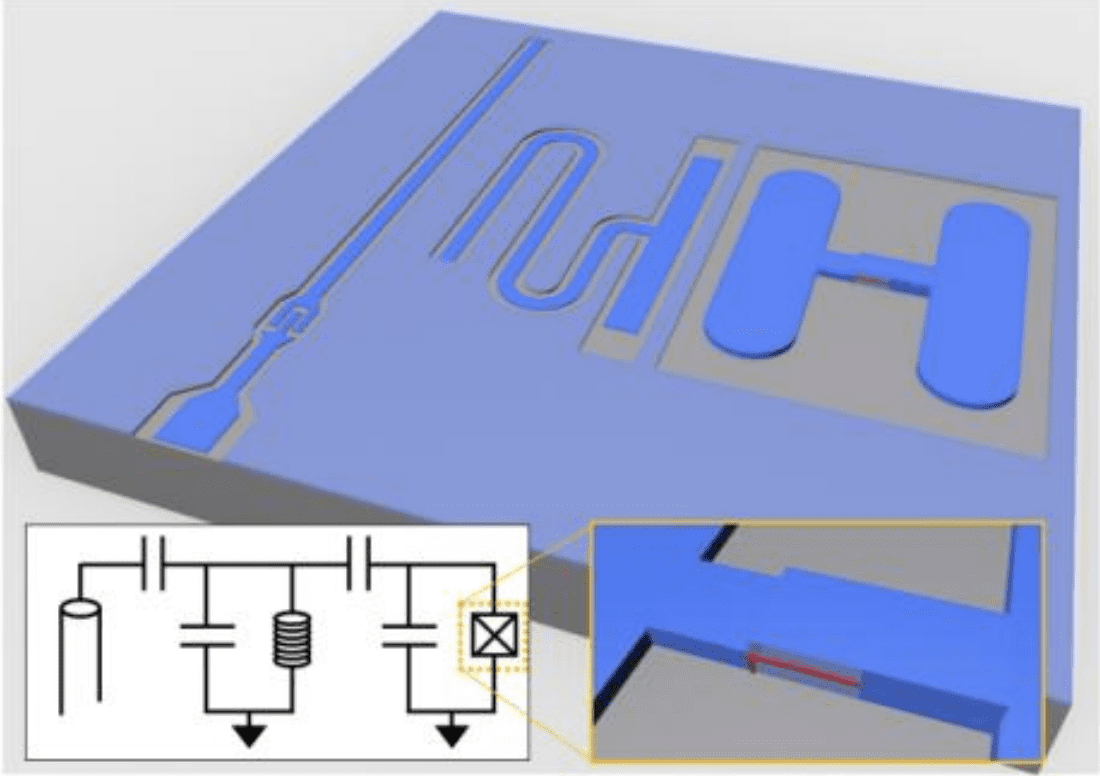
Characterization of electromagnetic properties and field distributions is essential for designing superconducting quantum circuits. To streamline this process, the researchers present a workflow built around Palace, an open-source, high-performance finite element method solver tailored for quantum applications. Starting with circuit layouts, the workflow automates mesh generation, electromagnetic simulation, and conversion of electromagnetic data into Hamiltonian parameters. The team validated the workflow on a chip containing bare resonators and qubits coupled with readout resonators, achieving resonator frequency prediction within 0. 3% and capturing three out of four external couplings within 16% of cryogenic measurements. These results demonstrate that open-source electromagnetic tools can meet the demands of complex quantum circuit design.
Automated Electromagnetic Analysis for Quantum Circuits
Scientists developed a streamlined workflow for accurate electromagnetic feature extraction crucial for designing superconducting quantum circuits. The study centers around Palace, an open-source, high-performance finite element method solver, and integrates robust open-source libraries to deliver exascale-ready performance. This approach overcomes limitations of commercial software by offering scalable, license-free analysis and native support for quantum-specific metrics. The workflow begins with circuit layouts and automates key steps, including mesh generation, electromagnetic solving, and conversion of electromagnetic data into Hamiltonian parameters.
Researchers implemented this workflow within an open-source library, PalaceForCQED, enabling efficient processing and analysis. To validate the system, scientists performed simulations on a transmon chip featuring both bare resonators and qubits coupled with readout resonators. The results demonstrate exceptional accuracy, with simulated resonator frequencies agreeing with cryogenic measurements to within 0. 3%. Furthermore, the study achieved accurate prediction of external couplings, successfully matching measurements for three out of four couplings to within 16%. This level of precision confirms that open-source electromagnetic tools can rival the accuracy of commercial software while offering significant advantages in scalability and cost. By providing an accessible and extensible foundation, this work facilitates rapid superconducting circuit optimization and systematic materials-loss studies, advancing the development of quantum technologies.
Automated Hamiltonian Extraction Predicts Qubit Behaviour
Scientists have developed a streamlined workflow for electromagnetic feature extraction crucial for designing quantum circuits, built around the open-source solver Palace. This workflow automates the process of converting circuit layouts into accurate quantum Hamiltonians, essential for predicting and controlling the behavior of qubits. The system begins with circuit designs and then automatically generates the necessary mesh for electromagnetic simulation, sets up the solver, executes the simulation, and processes the resulting data. Experiments demonstrate the workflow’s ability to predict resonator frequencies with remarkable accuracy, achieving a 0.
3% agreement with cryogenic measurements on a test chip. Furthermore, the team measured external couplings, finding that three out of four couplings aligned with cryogenic measurements to within 16%. These results confirm that open-source electromagnetic tools can match the precision of commercial software while offering scalability and eliminating licensing costs. The workflow addresses key electromagnetic problems, including extracting capacitance and inductance matrices, identifying resonant modes and electromagnetic field distributions, and obtaining port scattering parameters. Palace’s built-in support for energy participation ratios and adaptive frequency sweeps further enhances its capabilities. This breakthrough delivers an accessible foundation for rapid superconducting circuit optimization and systematic materials-loss studies, paving the way for more advanced quantum technologies.
Open-Source Tools Match Commercial Accuracy
This work addresses a critical need in superconducting quantum circuit design, namely accurate and efficient electromagnetic feature extraction. Researchers developed an automated workflow, built around the open-source solver Palace, to streamline the simulation of quantum circuits, encompassing electrostatic analysis, eigenmode calculations, and frequency response prediction. Benchmarking this workflow on a test chip demonstrates a high degree of accuracy, predicting resonator frequencies within 0. 3% and external couplings within 16% of experimental measurements. These results establish that open-source electromagnetic tools can achieve performance comparable to commercial software, offering a scalable and license-free alternative for quantum circuit development and materials loss studies. Further research directions include systematic investigation of material losses in next-generation quantum hardware, facilitated by the accessibility and extensibility of the developed workflow.
👉 More information
🗞 Electromagnetic Feature Extraction in Superconducting Quantum Circuits: An Open-Source Finite-Element Workflow Using Palace
🧠 ArXiv: https://arxiv.org/abs/2511.09041