

Reconfigurable optical beam splitters represent a crucial component for advanced photonic networks and circuits, yet existing technologies often rely on energy-intensive or unstable methods of control. Yuru Li, Wanting Ou, and Qi Lu, alongside their colleagues, now demonstrate a significant advance with an electrically reconfigurable splitter built from the low-loss material Sb2Se3. This innovative device achieves precise, multi-level control over how light divides, using tiny electrodes to trigger changes in the material’s properties without requiring continuous power. The resulting splitter exhibits low loss, broad bandwidth, and non-volatile retention of settings within a remarkably compact space, offering a promising building block for scalable and energy-efficient photonic systems and intelligent communication networks.
Silver Selenide Enables Programmable Optical Circuits
Researchers are developing a new approach to optical circuits using silver selenide, offering dynamic control and programmability previously difficult to achieve. This research addresses the limitation of traditional optical circuits, which often require mechanical adjustments or external signals to change behavior, by utilizing silver selenide as a material that reversibly changes its optical properties with electrical pulses, creating non-volatile optical components that retain settings even without power. Silver selenide offers key advantages, notably its exceptionally low optical loss, crucial for maintaining signal strength, and its non-volatility. Its refractive index can be precisely controlled with electrical pulses, allowing for the creation of compact, reconfigurable optical components integrated into silicon photonic circuits, specifically directional couplers that act as switches or beam splitters. This work builds upon silicon photonics, leveraging standard manufacturing processes to create compact optical circuits, and holds significant promise for advancements in optical computing, communication, and data storage. The development of non-volatile and programmable photonics is essential for applications like optical memory and brain-inspired optical neural networks.
Electrically Tunable Beam Splitting with Antimony Triselenide
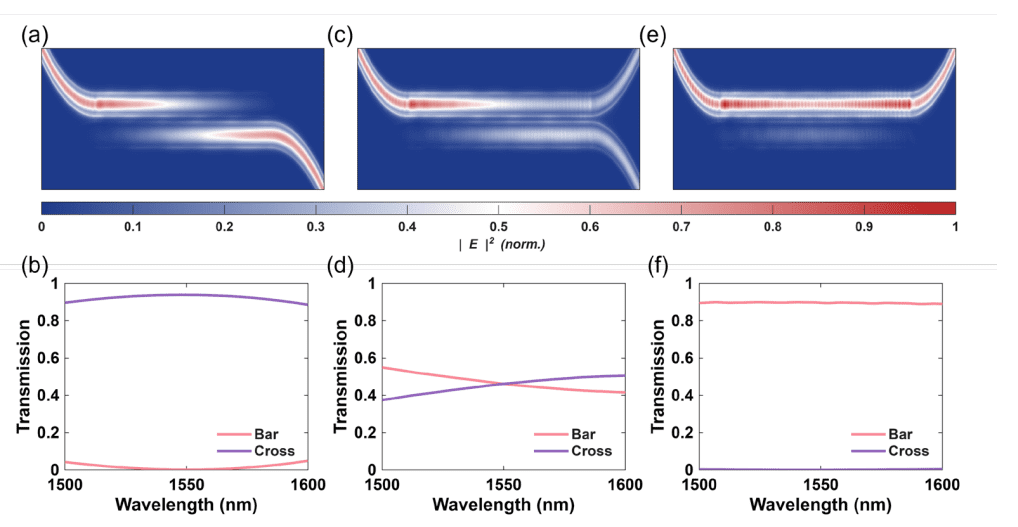
Scientists have engineered an electrically reconfigurable beam splitter using antimony triselenide, a material capable of changing its optical properties with electrical signals. This device achieves precise, multi-level control over how light is divided, a critical component for advanced photonic circuits. The team locally triggered phase transitions within the antimony triselenide using integrated micro-electrodes, exploiting the difference in refractive index between its amorphous and crystalline states to tune light coupling with minimal absorption. Simulations and experimental validation confirmed that the device efficiently directs light to different output ports depending on the material’s state, transferring nearly all light to one port in the amorphous state and directing it to the other in the crystalline state.
Partial crystallization allows for balanced splitting, directing equal amounts of light to both ports, with low insertion loss and near-zero static power consumption. The fabricated device, measuring approximately 14. 5 micrometers, demonstrates the ability to realize arbitrary and programmable splitting ratios with minimal loss, establishing a powerful platform for reconfigurable integrated photonics and paving the way for more versatile and energy-efficient optical circuits.
Electrically Tunable Beam Splitting with Antimony Selenide
Researchers have demonstrated a new electrically reconfigurable beam splitter utilizing antimony selenide, a material that changes its optical properties in response to electrical signals. This device achieves precise, multi-level control over how light is divided, a crucial capability for programmable photonic circuits and reconfigurable optical interconnects. The device is fabricated on a silicon-on-insulator platform and incorporates a rib-waveguide directional coupler with a thin layer of antimony selenide deposited on one waveguide. The team achieved efficient power transfer in the amorphous state of the antimony selenide by carefully designing the waveguide geometry and maximizing the difference in refractive index between the amorphous and crystalline states, enabling significant tunability.
Simulations and experiments demonstrate that transitioning the antimony selenide from amorphous to crystalline phases detunes the coupling, effectively switching optical power from one output port to another. Measurements reveal that the device supports eight programmable beam-splitting states achieved using fast electrical pulses to partially crystallize the antimony selenide. This continuous transition confirms the ability to achieve multi-level and arbitrary splitting-ratio control, essential for programmable photonic circuits and reconfigurable optical interconnects.
Electrically Tunable Beam Splitter Demonstrated in Silicon
Scientists have demonstrated a new electrically reconfigurable beam splitter built from antimony selenide and silicon, achieving precise control over how light is divided between two paths. The team successfully created a device that can apportion optical power with a ratio spanning from approximately 100:1 to 1:100, including a near-balanced 1:1 state, all within a compact footprint of 14. 5 micrometers. Importantly, this control is achieved with low loss and the device retains its settings without continuous power, representing a significant advance for energy-efficient photonics. The demonstrated beam splitter offers broadband operation across a specific wavelength range and supports multiple, discrete splitting states, paving the way for scalable and programmable photonic circuits.
This is the first on-chip beam splitter utilizing a phase-change material to achieve this combination of characteristics, including high-speed control and non-volatile retention of settings. While the current device demonstrates promising performance, the researchers acknowledge limitations related to fabrication reproducibility and electrode optimization. Future work will focus on refining the fabrication process and improving electrode design to enhance device performance and consistency, further solidifying the potential of this hybrid material platform for adaptive optical routing and programmable photonics.
👉 More information
🗞 Electrically Reconfigurable Arbitrary Splitting-Ratio Optical Splitter Based on Low-Loss Sb2Se3
🧠 ArXiv: https://arxiv.org/abs/2509.15943

