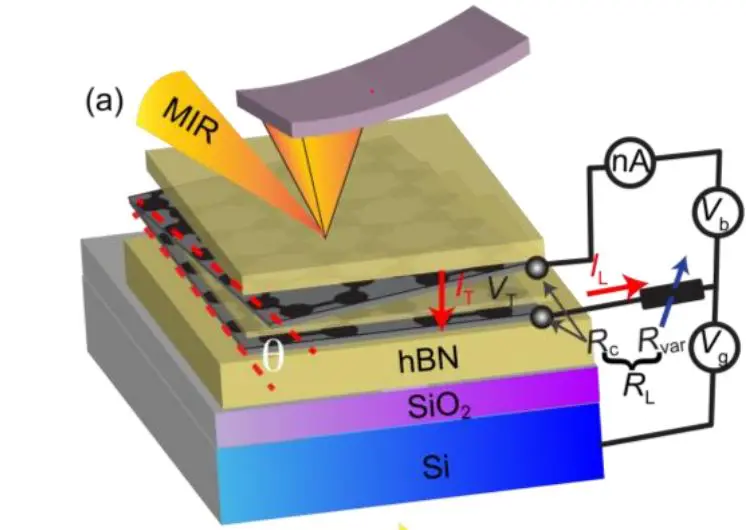
Bistability, the capacity of a system to exist in two stable states simultaneously, represents a fundamental concept with broad technological implications, yet demonstrating this phenomenon in plasmonic systems has proven elusive. Now, Shuai Zhang, Yang Xu, and Junhe Zhang, all from Columbia University, along with colleagues, report the first experimental observation of electrically driven plasmon-polaritonic bistability. The team achieved this breakthrough by engineering devices based on hexagonal-boron-nitride tunneling transistors, leveraging the unique properties of Dirac electrons to create a system where stable states depend on the device’s history. This precisely tunable plasmonic behaviour, controlled through electrical means, represents a significant advance in nanoplasmonics and paves the way for novel applications in optical memory, sensing technologies, and high-speed optoelectronic switching.
Graphene Plasmonics and 2D Heterostructure Engineering
A wealth of research converges on the exciting intersection of plasmonics, two-dimensional materials like graphene, and tunneling phenomena, potentially leading to innovative optoelectronic devices and even optical computing. This field explores how manipulating light at the nanoscale can unlock new technologies. A central theme involves leveraging graphene’s unique ability to support plasmons, which are collective oscillations of electrons that enhance light-matter interaction, particularly at terahertz and mid-infrared frequencies. Researchers are combining graphene with other two-dimensional materials, such as hexagonal boron nitride and transition metal dichalcogenides, to precisely tailor the electronic and optical properties of these structures, creating van der Waals heterostructures with novel functionalities.
Twisted bilayer graphene, where two graphene layers are stacked with a slight rotation, is a particularly active area of investigation. Scientists are maximizing the confinement of plasmons and enhancing optical signals for applications in sensing, spectroscopy, and light emission. They are also exploring methods to dynamically tune plasmonic resonances using electrical gating, chemical doping, or strain. Furthermore, research investigates electron tunneling across interfaces in graphene-based heterostructures, a process crucial for creating tunnel field-effect transistors and manipulating plasmonic behavior.
Quantum effects, including interference and confinement, play a vital role in the behavior of electrons and plasmons within these structures. These investigations are driving the development of photocurrent generation and detection techniques, near-field photocurrent microscopy, and highly sensitive infrared detectors and imaging systems. The enhanced light-matter interaction in graphene structures is also being harnessed for developing highly sensitive sensors for chemical and biological analytes. Researchers are also investigating thermoelectric effects for detecting plasmons. A key goal is achieving optical bistability, a nonlinear optical effect where the output intensity changes abruptly with input intensity, which is essential for optical switching and logic gates.
Combining bistability with non-volatile materials, like phase-change materials, offers the potential for stable optical switches. Scientists are developing devices that can switch optical signals using only light, without electrical control, and exploring the use of plasmons to manipulate and process optical signals for computing applications. Potential research directions include creating hybrid plasmonic-tunneling devices, dynamically tunable metasurfaces, graphene-based optical logic gates, and high-speed, low-power optical switches. Advanced infrared imaging systems, quantum plasmonics, exploiting Moiré patterns in twisted bilayer graphene, and integrating graphene plasmonic devices with silicon photonics are also promising avenues of investigation. Ultimately, this research paints a picture of a vibrant and rapidly evolving field with significant potential for breakthroughs in optoelectronics, sensing, and potentially, optical computing.
Electrically Driven Plasmonic Bistability Observed
Scientists have experimentally observed electrically driven plasmon-polaritonic bistability in hexagonal-boron-nitride tunneling transistors, a phenomenon predicted theoretically but previously unconfirmed. This breakthrough stems from engineering devices that exhibit both electronic and plasmonic bistability through resonant tunneling of Dirac electrons, achieved by carefully controlling the twist angle between layers. The work demonstrates a new pathway for exploring nonlinear optical and electronic phenomena in van der Waals heterostructures and opens possibilities for optical memory, sensing, and optoelectronic switching. Experiments revealed two distinct current peaks in tunneling current measurements, corresponding to two current-voltage regimes exhibiting negative differential conductance.
These peaks are directly linked to twist-controlled resonant tunneling, where the location of the peaks depends on the angle between the graphene layers, and are rooted in momentum-conserving processes. For a small twist angle, the rotation of the graphene lattices causes a displacement of the in-plane Dirac cone, and at a specific bias voltage where the energy difference between the layers equals ħvF∆K, the Dirac cones intersect, dramatically increasing the tunneling rate and resulting in a peak current. Simulations based on Bardeen’s tunneling theory accurately reproduce the experimental data, confirming the role of momentum conservation. Further investigation of the plasmonic response of doped tunneling devices under bias voltage revealed that the applied voltage both offsets the Fermi energy difference between the graphene layers and induces doping.
This doping enables tunable plasmon-polariton excitations, including acoustic and optical modes, which were investigated using mid-infrared light and a scattering-type scanning near-field optical microscope. Measurements of the plasmon-polariton dispersion along a defined line showed that fringes emerge at higher bias voltages, and the fringe spacing increases with increasing bias, demonstrating a bias voltage-dependent dispersion. This confirms that the applied voltage effectively tunes the plasmon-polariton characteristics of the device. The team also demonstrated electrical transport hysteresis arising from tunneling bistability, achieved through a simulated resonant tunneling current-voltage curve exhibiting negative differential conductance. Analysis of the intersection points between the tunneling current and load lines revealed that the device can be driven into multiple stable states, offering potential for bistable switching applications. These findings represent a significant advance in nanoplasmonics and pave the way for novel optoelectronic devices.
Electrically Driven Plasmonic Bistability Realised
This research demonstrates the experimental realisation of electrically driven plasmon-polaritonic bistability within van der Waals heterostructures, specifically graphene/hexagonal boron nitride/graphene tunnel junctions. The team achieved this by engineering devices that exhibit both electronic and plasmonic bistability, meaning the system settles into distinct stable states depending on its input history, even under identical conditions. This breakthrough stems from a combination of resonant tunneling and highly carrier-density-dependent two-dimensional plasmons, offering a new mechanism for bistability distinct from previously predicted Kerr nonlinearity-based approaches. The ability to electrically control and read out these bistable plasmonic states represents a significant advance in nanoplasmonics, potentially enabling the development of compact logic and storage circuits, neuromorphic sensing, and optical computation.
🗞 Electrically driven plasmon-polaritonic bistability in Dirac electron tunneling transistors
🧠 ArXiv: https://arxiv.org/abs/2512.02909