


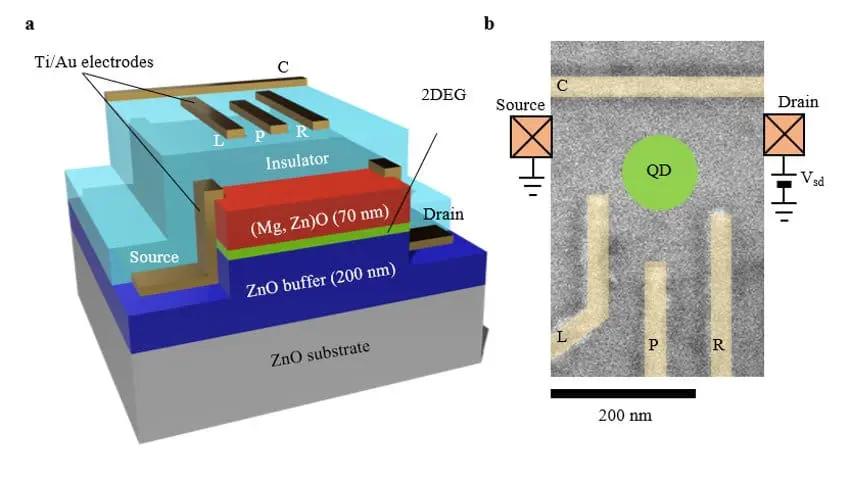
Researchers have made a significant breakthrough in the development of quantum technologies by creating electrically defined quantum dots in zinc oxide heterostructures. This achievement, published in Nature Communications on November 7, 2024, marks a milestone in the pursuit of efficient and stable qubits for quantum computing. Quantum dots, tiny semiconductor structures that can trap electrons in nanometer-scale spaces, have long been studied for their potential to serve as qubits. Until now, most research has focused on materials such as gallium arsenide and silicon, but zinc oxide, with its strong electron correlation and excellent spin quantum coherence, had not yet been explored for use in electrically defined quantum dots.
The research team, led by Tomohiro Otsuka, an associate professor at Tohoku University, was able to manipulate the internal states of quantum dots in zinc oxide using precise voltage control. This innovation allowed them to observe the Coulomb diamond, a key characteristic of quantum dots, providing insights into the behavior of electrons trapped inside. The team also discovered the Kondo effect in zinc oxide quantum dots, a quantum phenomenon where electron interactions create conduction, which adds another layer of complexity and potential to zinc oxide-based quantum devices.
Electrically Defined Quantum Dots in Zinc Oxide: A Breakthrough for Quantum Technologies
Researchers have made a significant breakthrough in the development of quantum technologies by successfully creating electrically defined quantum dots in zinc oxide (ZnO) heterostructures. This achievement, published in Nature Communications on November 7, 2024, marks a crucial milestone in the pursuit of harnessing the power of quantum computing.
Quantum dots are tiny semiconductor structures that can trap electrons in nanometer-scale spaces, allowing scientists to control their behavior and utilize them as qubits in quantum computing. The ability to manipulate these dots is essential for quantum computing, as it enables the precise control of electron behavior, similar to how a conductor might control a current of water flowing through pipes.
Until now, most research has focused on materials such as gallium arsenide (GaAs) and silicon. However, zinc oxide, a material known for its strong electron correlation and excellent spin quantum coherence, had not yet been explored for use in electrically defined quantum dots. The successful creation of these dots in ZnO heterostructures opens up new possibilities for the development of efficient and stable qubits.
Manipulating Internal States with Precise Voltage Control
The research team was able to manipulate the internal states of quantum dots in zinc oxide using precise voltage control, similar to adjusting the dials on a radio to fine-tune a signal. This innovation allowed them to observe the Coulomb diamond, a key characteristic of quantum dots, providing valuable insights into the behavior of electrons trapped inside.
The Coulomb diamond is a unique “fingerprint” that helps identify the distinct properties of each quantum dot. By using zinc oxide, researchers are opening up new frontiers in developing efficient and stable qubits, a cornerstone for quantum computing. The ability to manipulate internal states with precise voltage control is a crucial step towards harnessing the power of quantum dots.
Uncovering the Kondo Effect in Zinc Oxide Quantum Dots
One of the most remarkable findings of this study was the discovery of the Kondo effect in zinc oxide quantum dots. The Kondo effect, a quantum phenomenon where electron interactions create conduction, typically depends on the number of electrons in the quantum dot. However, in zinc oxide, the researchers observed this effect even when the number of electrons did not fit the usual pattern.
This new behavior, linked to the material’s strong electron correlation, adds another layer of complexity and potential to zinc oxide-based quantum devices. The Kondo effect observed in ZnO is different from what is typically seen in other semiconductors like GaAs, offering a unique opportunity to better understand electron behavior in this new material and improve the ability to control and manipulate qubits.

Harnessing New Findings for Practical Quantum Devices
Looking ahead, the team is focused on harnessing these new findings to develop practical quantum devices. The successful creation of electrically defined quantum dots in zinc oxide heterostructures marks a significant milestone in the pursuit of harnessing the power of quantum computing. By building upon this breakthrough, researchers can now explore new possibilities for developing efficient and stable qubits, ultimately paving the way for the development of practical quantum technologies.
The discovery of the Kondo effect in ZnO quantum dots adds another layer of complexity and potential to zinc oxide-based quantum devices. As researchers continue to uncover the secrets of electron behavior in this material, they may unlock new possibilities for developing quantum devices that can harness the power of quantum computing.
External Link: Click Here For More


