Diamond’s potential as a platform for quantum sensing hinges on its ability to control and read the state of atomic-scale defects, but current methods largely rely on optical techniques which restrict practical applications. Olga Rubinas, Michael Petrov, and Emilie Bourgeois, working at the Institute for Material Research at Hasselt University, alongside collaborators including Akhil Kuriakose and Ottavia Jedrkiewicz, now present a fully electrical method for reading these spin environments. Their approach, termed photocurrent double electron-electron resonance, allows researchers to detect and manipulate interactions between individual quantum bits and surrounding defects with unprecedented precision, even in settings where light cannot easily penetrate. This breakthrough extends the capabilities of electrical readout beyond single spins, enabling detailed characterization of noise sources and paving the way for robust, scalable diamond-based quantum technologies that can be seamlessly integrated into solid-state devices.
Electrical Spin Detection in Diamond NV Ensembles
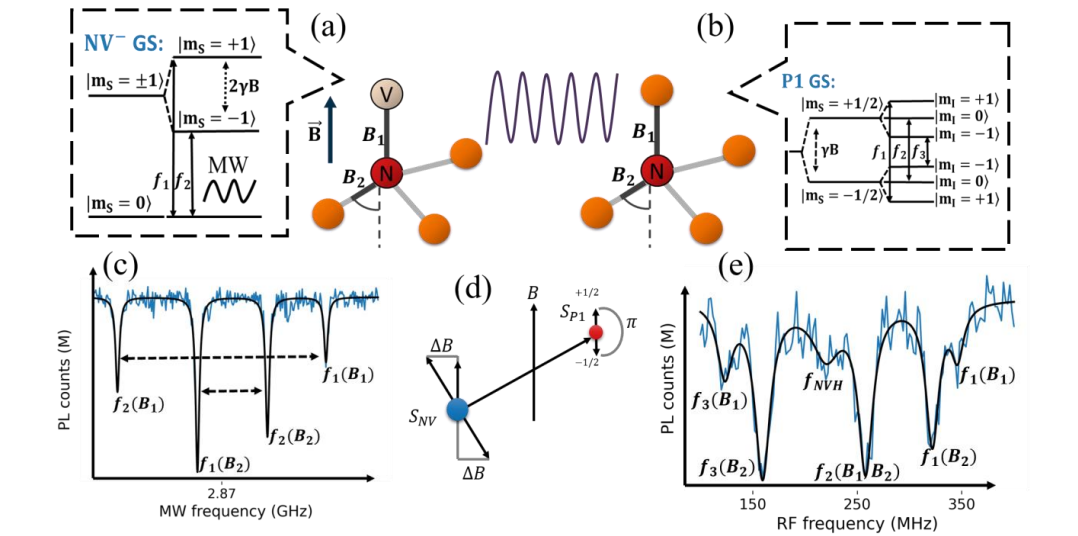
This research details a significant advancement in quantum sensing, successfully demonstrating Photoelectric Detection of Electron-Electron Resonance (PC-DEER) spectroscopy in a nitrogen-vacancy (NV) ensemble within a diamond. This achievement unlocks the potential for creating all-electrical spin-based devices and quantum sensors, eliminating the need for optical access and paving the way for miniaturization and integration. The team characterized the surrounding spin environment, identifying five resonance groups attributed to P1 centers, defects within the diamond lattice, and even detected signals consistent with NVH-related transitions. Crucially, scientists demonstrated coherent control over the spin bath, observing Rabi oscillations of P1 centers under electrical readout, proving that individual bath spin transitions can be selectively driven and detected electrically. This work opens doors to scalable quantum sensors, ideal for creating compact, chip-integrated devices, and extends the possibility of surface detection, enabling the sensing of molecular and biological systems. Furthermore, the ability to control and manipulate spin baths is crucial for developing advanced quantum information technologies, representing a vital step towards practical, all-electrical quantum sensors and devices based on diamond NV centers.
Nitrogen-vacancy (NV) centers in diamond are point defects with unique quantum properties, making them promising candidates for quantum sensing and information processing. These defects possess an electron spin that is sensitive to external fields, including magnetic, electric, and strain. Traditionally, controlling and reading out the spin state of NV centers relies on optical techniques, such as fluorescence microscopy. However, optical access can be limiting for certain applications, particularly those requiring miniaturization or integration into complex devices. This research circumvents these limitations by demonstrating all-electrical control and readout of NV center spin dynamics, opening up new possibilities for quantum sensing and device development. The PC-DEER technique employed leverages the photocurrent generated within the diamond as a proxy for the NV center’s spin state, effectively translating spin information into an electrical signal. This approach not only simplifies device architecture but also enhances the potential for integration with existing microelectronic circuitry.
Electrical Control of Diamond Spin Environments
Scientists have achieved a breakthrough in quantum sensing by demonstrating all-electrical detection and control of spin environments in diamond, eliminating the need for optical access. This work establishes Photocurrent Double Electron-Electron Resonance (PC-DEER), a method that extends photocurrent readout from single-spin control to coherent manipulation of the surrounding spin bath. Experiments reveal stable contrast and coherent spin manipulation of the bath, enabling electrical detection and control of environmental spins, a key step toward sensing external targets without optical access. The team implemented a DEER protocol, an extension of the Hahn-echo sequence, to probe the surrounding spin environment.
The Hahn-echo sequence is a fundamental technique in electron spin resonance (ESR) and nuclear magnetic resonance (NMR) spectroscopy. It involves applying a series of precisely timed pulses to a spin ensemble, effectively refocusing the dephasing caused by static inhomogeneities in the local magnetic field. By extending this sequence with a resonant pulse applied to the spin bath, the PC-DEER technique allows researchers to selectively probe the interactions between the NV center and its surrounding spins. The photocurrent generated in the diamond is directly correlated with the NV center’s coherence, providing a sensitive measure of these interactions. The observed contrast in the photocurrent signal arises from the modulation of the NV center’s coherence due to the resonant excitation of the spin bath. This electrical readout offers a significant advantage over traditional optical methods, particularly in scenarios where optical access is restricted or undesirable. The ability to manipulate and detect the spin bath coherently demonstrates a level of control previously unattainable with purely electrical techniques.
A pulse, resonant with the target spin bath, was applied during the NV center’s evolution, altering the dipolar coupling and inducing a phase shift in the NV coherence. This resulted in a measurable change in the NV echo amplitude, revealing information about the surrounding spin environment. Measurements confirm that the team successfully detected signatures of substitutional nitrogen (P1) and NVH centers with reproducible contrast using electrical signals. Data shows that P1 centers exhibit splitting when subjected to an applied magnetic field. This precise characterization of P1 centers, alongside the detection of NVH centers, demonstrates the sensitivity and resolution of the PC-DEER method.
Substitutional nitrogen (P1) centers are shallow defects in the diamond lattice, created when a carbon atom is replaced by a nitrogen atom. These defects possess a spin and contribute to the overall spin bath surrounding the NV center. The observed splitting of the P1 resonance in an applied magnetic field is a direct consequence of the Zeeman effect, where the energy levels of the spin are shifted by the magnetic field. This splitting provides valuable information about the local magnetic environment and the strength of the interaction between the P1 center and the NV center. NVH centers, representing nitrogen-vacancy centers with an adjacent vacancy, also contribute to the spin bath and exhibit distinct resonance signatures. The ability to resolve these different resonance groups demonstrates the high spectral resolution of the PC-DEER technique and its potential for characterizing complex spin environments. The reproducible contrast observed in the electrical signals confirms the reliability and stability of the measurement, paving the way for quantitative analysis of spin interactions.
🗞 Electrical Readout of Spin Environments in Diamond for Quantum Sensing
🧠 ArXiv: https://arxiv.org/abs/2509.26570