Researchers are now probing the extreme limits of bilayer graphene’s electronic properties, revealing unexpected behaviour at unprecedented electric fields. Margherita Melegari, Brian Skinner, and Ignacio Gutierrez-Lezama, alongside Alberto F. Morpurgo (all from the University of Geneva), demonstrate a novel method of applying exceptionally strong electric fields , exceeding 1V/nm , using double ionic gating. Their findings showcase a dramatic shift in the material’s transport characteristics, evidenced by a pronounced ‘knee’ in the longitudinal resistance and subsequent splitting of peaks alongside hysteresis , phenomena explained by the emergence of in-gap states. This work is significant as it unlocks access to a previously inaccessible high-field regime, fundamentally advancing our understanding of bilayer graphene’s band structure and paving the way for novel electronic devices.
Strong Electric Fields Control Graphene’s Band Structure
Scientists have demonstrated a breakthrough in controlling the electronic properties of Bernal-stacked bilayer graphene (BLG) by employing double ionic gating to achieve unprecedented perpendicular electric fields exceeding 1V/nm. This innovative approach overcomes the limitations imposed by dielectric breakdown in conventional devices, which previously restricted operation to the meV regime, and allows exploration of the regime where the interlayer potential difference, ∆, surpasses t⊥, approximately 360 meV. The research team achieved this by fabricating BLG transistors equipped with double ionic gates, enabling the application of fields strong enough to profoundly reshape the band structure and investigate previously inaccessible electronic phenomena. Experiments reveal a sharp change in the evolution of the longitudinal resistance (Rxx) peak as a function of applied gate voltages when ∆ approaches t⊥, exhibiting a pronounced “knee” in the data.
Increasing ∆ beyond this “knee” results in unusual transport properties, including a decrease in the magnitude of the Rxx peak, a splitting of the peak accompanied by multiple sign reversals of the Hall resistance, and the emergence of hysteresis in the peak position. The team explains these observations through the behaviour of in-gap bound states, whose energy is strongly dependent on the perpendicular electric field and crosses the mid-gap level for sufficiently large ∆ t⊥. This phenomenon induces significant changes in the density of in-gap states, profoundly affecting the evolution of the chemical potential within the BLG. The study establishes that double ionic gating enables access to the large-∆ regime, previously experimentally inaccessible, and reveals unique aspects of the physics governing in-gap states in Bernal bilayer graphene.
Specifically, the researchers observed that when the estimated electric field in the BLG exceeds approximately 1V/nm, corresponding to ∆≃400 meV, the behaviour of the resistance peak deviates markedly from linearity. This deviation is accompanied by a decrease in maximum resistance, peak splitting, and the appearance of hysteresis, all indicative of a fundamental shift in the electronic landscape of the material. Furthermore, the work proposes a scenario where in-gap states, formed by electrons (holes) bound to ions in the top electrolyte, rapidly shift in energy and cross the mid-gap level as ∆ increases past t⊥. This transfer of in-gap states significantly modifies the density of states, thereby influencing the chemical potential and accounting for the observed experimental phenomena. The results not only deepen our understanding of the physics of in-gap states in BLG but also pave the way for future investigations into novel electronic properties and potential applications leveraging the unique band structure control achieved through double ionic gating.
Double Ionic Gating of Bilayer Graphene Devices enables
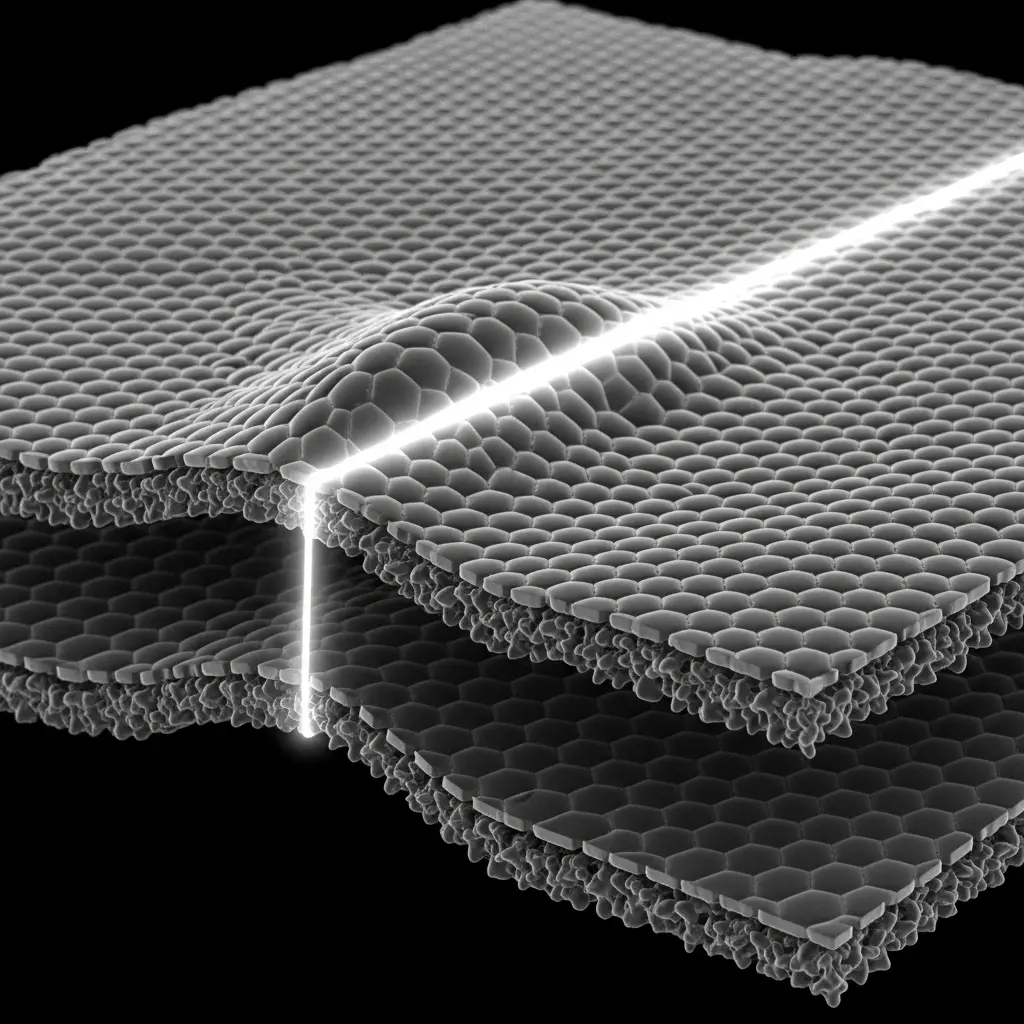
Scientists engineered a novel double ionic gating technique to overcome dielectric breakdown limitations in Bernal-stacked bilayer graphene (BLG) devices, achieving perpendicular electric fields exceeding 3V/nm. This breakthrough enabled exploration of the large interlayer potential regime, previously inaccessible due to conventional device constraints limiting operation to the meV scale. The research team fabricated BLG transistors with an innovative configuration employing an ionic liquid top gate and a lithium-ion glass-ceramic back gate, electrostatically decoupling the two electrolytes from the graphene channel. Experiments employed a Hall bar geometry patterned onto a lithium-ion glass-ceramic substrate, followed by deposition of the ionic liquid to form the top gate, a crucial step for achieving high electric fields.
Longitudinal resistance (Rxx) and Hall resistance (Rxy) were meticulously measured as a function of applied gate voltages, with a perpendicular magnetic field of 1 T applied during Rxy measurements. Initial characterisation revealed a linear shift in the Rxx peak with opposing gate polarities, consistent with established BLG behaviour and bandgap opening. The team extracted carrier mobility (μ) and carrier density (n) from these initial measurements, establishing a baseline for subsequent high-field investigations. Crucially, when the estimated electric field surpassed approximately 1V/nm, corresponding to an interlayer potential difference (∆) of around 400 meV, the transport properties underwent a dramatic transformation.
The evolution of the Rxx peak exhibited a pronounced “knee” in its slope, signalling a fundamental change in the electronic structure. Increasing the field beyond this point resulted in a decrease in peak magnitude, accompanied by a splitting of the peak and multiple sign reversals in the Hall resistance, alongside the emergence of hysteresis in the peak position. This unusual behaviour is explained by the formation of in-gap bound states, whose energy is strongly dependent on the perpendicular electric field and crosses the mid-gap level for sufficiently large ∆ t⊥, where t⊥ is the interlayer hopping integral (approximately 360 meV). The study pioneered a method to investigate the large-∆ regime, revealing unique aspects of in-gap state physics in BLG and demonstrating the potential for manipulating band structure at unprecedented scales.
Large ∆ Regime Alters Graphene Transport
Scientists have achieved a breakthrough in controlling the band structure of Bernal-stacked bilayer graphene (BLG) using double ionic gating, enabling the application of perpendicular electric fields exceeding 1V/nm. This surpasses the limitations of conventional devices, typically restricted to the meV regime due to dielectric breakdown, and opens access to a previously inaccessible large-∆ regime where ∆ exceeds the interlayer hopping integral, t⊥, approximately 360 meV. The research team measured a pronounced “knee” in the evolution of the longitudinal resistance (Rxx) peak as a function of applied gate voltages when the interlayer potential difference, ∆, approached t⊥. Experiments revealed that increasing ∆ past this “knee” induced unusual transport properties, notably a decrease in the magnitude of the Rxx peak, accompanied by a splitting of the peak and the emergence of hysteresis in its position.
Simultaneously, multiple sign reversals were recorded in the Hall resistance, providing further evidence of significant changes in the electronic structure. The team explains these observations through the formation of in-gap bound states, whose energy is strongly dependent on the perpendicular electric field and crosses the mid-gap level for sufficiently large ∆ t⊥. Measurements confirm that this phenomenon causes substantial alterations in the electronic density of in-gap states, profoundly impacting the evolution of the chemical potential within the BLG. Specifically, the study demonstrates that double ionic gating allows investigation of the large-∆ regime, previously unattainable experimentally, and reveals unique aspects of the physics governing in-gap states in Bernal bilayer graphene.
The work shows that for ∆≃t⊥, the evolution of the longitudinal resistance (Rxx) peak undergoes a sharp change in slope, exhibiting a pronounced “knee”. Further analysis indicates that when the estimated electric field in the BLG is increased past approximately 1V/nm, corresponding to ∆≃400 meV, the observed behaviour changes drastically. The evolution of the resistance peak with both gate voltages deviates pronouncedly from linearity, and the maximum resistance decreases upon increasing the interlayer potential. These findings suggest a reshaping of the band structure as predicted by theory for ∆ t⊥, where the bandgap should saturate at t⊥ and the band edges move away from the K/K′ points, potentially leading to unusual Berry curvature distributions and an “inverted” dispersion relation.
Electric Fields Reveal Bilayer Graphene Anomalies, challenging current
Scientists have demonstrated the application of substantial perpendicular electric fields, exceeding 1V/nm, to Bernal-stacked bilayer graphene using double ionic gating. This technique allows for the creation of interlayer potential differences larger than the interlayer hopping energy, a regime previously inaccessible experimentally. The. The authors acknowledge that their initial devices are limited to demonstrating the dominance of in-gap states, and future work should explore the broader range of phenomena possible in this previously unexplored regime. The significance of these findings lies in the experimental validation of theoretical predictions regarding in-gap state evolution at large interlayer potentials, a behaviour unique within semiconductor physics. Moreover, the observed properties of these in-gap states may be shared by excitons in gapped bilayer graphene, prompting further investigation into excitonic physics under these conditions. This work establishes the potential for systematic studies of bilayer graphene where the interlayer potential difference exceeds the interlayer hopping energy, opening new avenues for exploring the fundamental properties of this material.
🗞 Interband State Transfer in Double-Gated Bilayer Graphene at High Electric Field
🧠 ArXiv: https://arxiv.org/abs/2601.19869