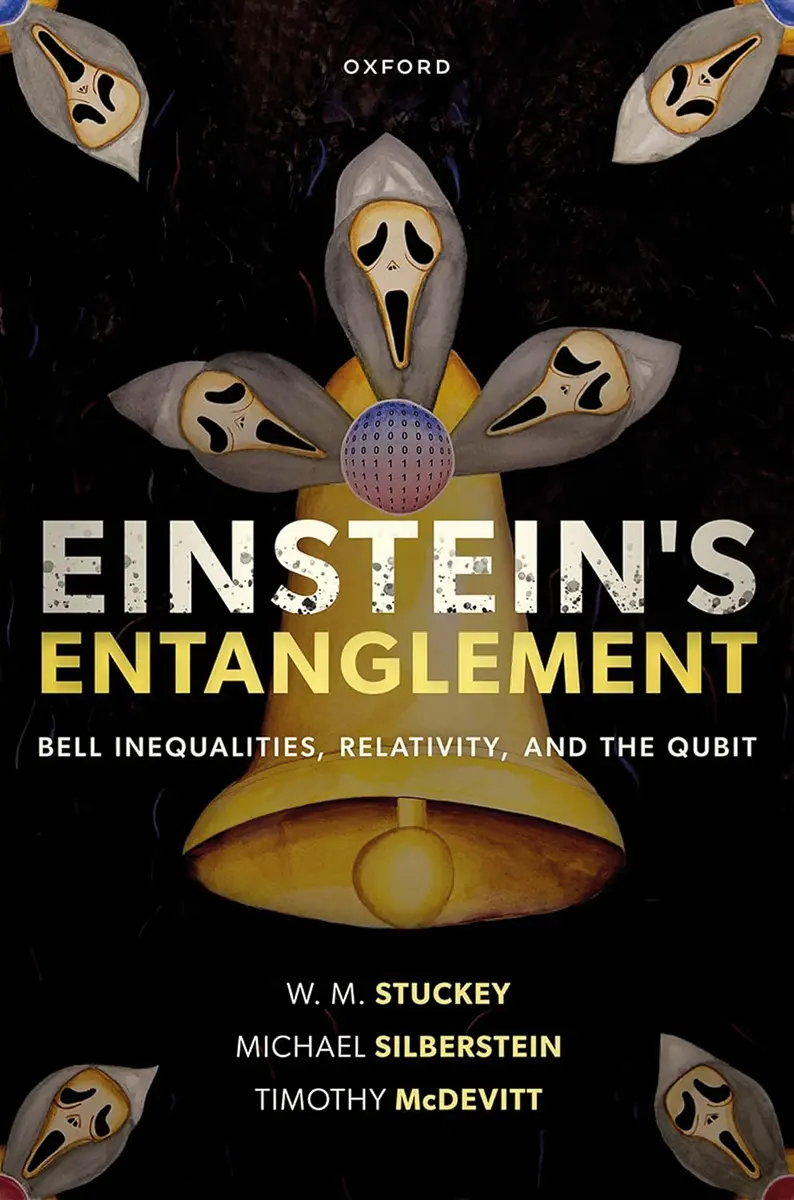
William Stuckey, Michael Silberstein, and Timothy McDevitt of Elizabethtown College present a comprehensive analysis of quantum entanglement in their new book, Einstein’s Entanglement. The text details the historical development of the concept—originating with the 1935 Einstein-Podolsky-Rosen paper—and explores its implications for understanding non-locality and the foundations of quantum mechanics. Utilizing concepts from Hilbert space and the Bloch sphere, the authors examine how entangled systems, such as decaying neutral pions producing correlated photons, defy classical descriptions of defined spin states. This work aims to clarify the persistent philosophical and physical puzzles surrounding entanglement and proposes a novel interpretation of the phenomenon.
Understanding Quantum Entanglement and Its Origins
Quantum entanglement, a cornerstone of modern quantum technologies, arises when two or more particles become linked, sharing the same fate no matter the distance separating them. Consider a neutral pion decaying into two photons; conservation of angular momentum dictates their total spin must be zero. Measuring one photon’s “helicity” (spin direction) instantaneously defines the other’s – if one is left-handed, the other must be right-handed. This isn’t simple correlation; the entangled system isn’t defined until measurement, challenging classical notions of locality and realism.
The puzzle of entanglement deepened with the 1935 EPR paradox, questioning whether quantum mechanics provided a complete description of reality. Einstein, Podolsky, and Rosen proposed “hidden variables” might predetermine particle properties, eliminating the need for instantaneous correlation. However, experiments testing “Bell inequalities” – mathematical constraints on correlations arising from local realism – have consistently violated these inequalities, providing strong evidence against hidden variable theories and supporting the fundamentally non-local nature of entanglement.
Recent work, like that by Stuckey, Silberstein, and McDevitt, emphasizes “principle explanations” over attempting to construct physical mechanisms for entanglement. They argue that invoking overarching principles – such as the consistency of Planck’s constant across all reference frames – can resolve conceptual issues. This approach contrasts with seeking a “constructive” explanation, like a signal traveling between particles, which experiments have largely ruled out, highlighting a shift in how physicists are tackling this core quantum phenomenon.
Exploring Explanations and Interpretations of Entanglement
Quantum entanglement, famously debated by Einstein, Podolsky, and Rosen (EPR) in 1935, arises when two or more particles become linked, sharing the same fate regardless of the distance separating them. Consider neutral pion decay into two photons; conservation of angular momentum dictates their total spin must be zero. If one photon’s spin is measured as “left-handed,” the other instantaneously assumes the opposite, even across vast distances. This isn’t due to a signal – faster-than-light communication is forbidden – but a fundamental correlation within the entangled system itself.
The puzzle of entanglement stems from challenging classical intuitions about locality and realism. Early interpretations proposed “hidden variables” or that measurement on one particle caused the other’s state. However, Bell’s Inequalities, developed in the 1960s, provided a mathematical test. Experiments consistently violate these inequalities, demonstrating that no local hidden variable theory can fully explain entanglement. This supports the idea that entangled particles aren’t individually defined until measured; they exist as a single, non-separable quantum object.
Recent analyses, like those presented in Einstein’s Entanglement, push towards “principle explanations” over constructing physical mechanisms. Authors Stuckey, Silberstein, and McDevitt suggest resolving conceptual issues by adhering to foundational principles, such as Planck’s constant (approximately 6.626 x 10⁻³⁴ joule-seconds) being universally measured across all inertial frames. This approach sidesteps the need to explain how entanglement happens, focusing instead on its consistency with broader physical laws.
Principle Explanations and the Authors’ Proposed Solution
Stuckey, Silberstein, and McDevitt’s Einstein’s Entanglement centers on the enduring puzzle of quantum entanglement – where two particles become linked and share the same fate, irrespective of distance. The authors critique “constructive” interpretations that attempt to explain entanglement via physical mechanisms, like one particle “causing” another to adopt a spin. Instead, they advocate for “principle explanations” – leveraging fundamental symmetries, much like relativity explains length contraction without invoking a physical contraction process.
The core of their proposed solution rests on a seemingly simple assertion: Planck’s constant (h ≈ 6.626 x 10⁻³⁴ Joule-seconds) must be measured identically in all inertial reference frames. This isn’t a new physical law, but a re-emphasis on a foundational assumption. The authors argue that demanding this consistency resolves conceptual difficulties surrounding entangled states, sidestepping the need to posit instantaneous action at a distance or pre-defined properties. They suggest this approach offers a more elegant and parsimonious explanation.
The authors’ argument isn’t about discovering new physics, but reframing how we interpret existing quantum mechanics. By prioritizing principle explanations, they aim to avoid the pitfalls of seeking concrete mechanisms for entanglement. They draw parallels to relativity, where symmetries—like the constancy of the speed of light—explain phenomena without requiring specific physical processes. The book ultimately challenges readers to consider if entanglement’s mysteries might be resolved not through what happens, but why it must happen according to fundamental principles.