

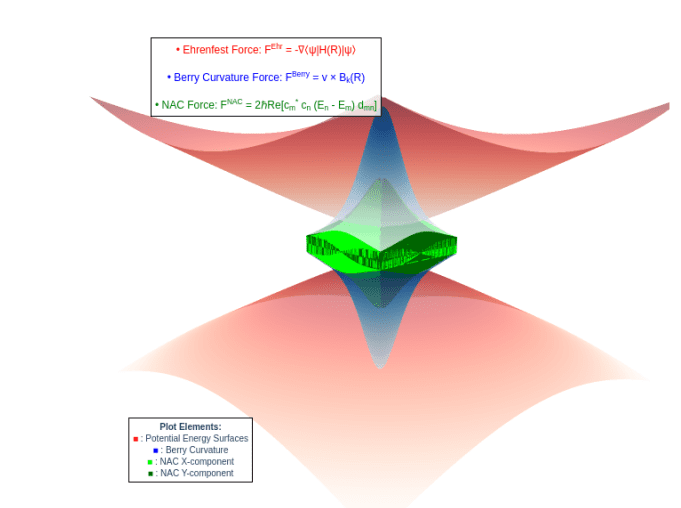
The interplay of quantum mechanics and molecular motion governs chemical reactions, yet accurately simulating these processes remains a significant challenge, particularly when electronic states closely approach each other. Dhruv Sharma from the University of Luxembourg, along with colleagues, now presents a new computational framework for modelling these ‘nonadiabatic’ dynamics, explicitly incorporating the subtle influence of geometric phase effects. Their approach tackles various types of electronic state crossings, including conical and elliptical intersections, by modifying standard molecular dynamics simulations with forces derived from the curvature of the electronic states. This method not only reproduces established theoretical predictions for well-studied conical intersections, but also reveals a surprising and potentially useful phase protection effect at elliptical intersections, opening new avenues for designing novel spectroscopic techniques and exploring potential applications in quantum computing. The team’s work provides a valuable tool for understanding and predicting molecular behaviour where these quantum effects are crucial, offering fresh insights into the fundamental processes that drive chemical change.
Non-Adiabatic Molecular Dynamics, Methods and History
This document presents a comprehensive overview of the theoretical and computational methods used to study how molecules change over time, particularly when standard approximations in chemistry break down. It covers a wide range of techniques, from classical simulations of atomic motion to advanced quantum mechanical approaches, and highlights ongoing challenges and advancements in the field. This work demonstrates the evolution of methods and identifies current research frontiers. Researchers employ surface hopping, multiple spawning, and exact propagation methods to model non-adiabatic processes, while molecular dynamics and transition state theory provide classical approximations.
Density functional theory, configuration interaction, and coupled cluster methods are used to calculate electronic structure, and machine learning is increasingly integrated to accelerate simulations and improve accuracy. A clear trend exists towards combining different methods to balance accuracy and computational cost. Computational power remains a limiting factor, driving the need for more efficient algorithms and hardware. Multiscale modeling, connecting simulations at different length and time scales, is also a recurring theme. This comprehensive overview demonstrates the complexity of simulating molecular behavior and the ongoing efforts to develop more accurate and efficient methods.
Simulating Nonadiabatic Dynamics with Geometric Phase Effects
Scientists have developed a new computational framework to simulate how molecules change energy states during chemical reactions, explicitly accounting for geometric phase effects, subtle quantum phenomena influencing molecular behavior. This work centers on a two-level Hamiltonian model capable of representing various types of electronic state crossings, including conical, avoided, and elliptic intersections. A key innovation is a prelooping trajectory initialization scheme that efficiently encodes the memory of prior molecular motion as an initial phase, accurately capturing the evolution of the system on the potential energy surface. The team’s method incorporates Berry curvature-based force corrections to the Ehrenfest dynamics, ensuring accurate representation of the topological nature of these crossings.
Numerical simulations rigorously tested the consistency of this approach with theoretical predictions for state mixing and inhibition of mixing due to geometric phase effects. This innovative methodology opens avenues for the design of degenerate materials and promises to facilitate the development of new spectroscopic techniques and potential qubit applications. The study further reveals a pathological phase protection effect, expressed as E = kr, which holds significant utility in the design of novel spectroscopic methods.
Geometric Phase Effects in Molecular Dynamics
Scientists have developed a comprehensive computational framework to simulate how molecules change energy states, explicitly accounting for geometric phase effects, subtle quantum phenomena influencing molecular behavior. This work centers on a two-dimensional Hamiltonian model capable of representing various types of electronic state crossings, including conical, avoided, and elliptic intersections. A key innovation is a prelooping trajectory initialization scheme that efficiently encodes the memory of prior molecular motion as an initial phase, accurately capturing the evolution of the system on the potential energy surface. The team’s method incorporates Berry curvature-based force corrections to the Ehrenfest dynamics, ensuring accurate representation of the topological nature of these crossings.
Numerical simulations demonstrate the consistency of the method with theoretical predictions for the mixing of electronic states and the inhibition of mixing due to geometric phase effects. The framework accurately predicts the behavior of molecules at these critical junctures, providing a valuable tool for studying classical interactions where these quantum effects are significant. Specifically, the research reveals that the elliptical intersection and associated geometric phase effects open avenues for the design of degenerate states, potentially leading to new spectroscopic techniques and qubit applications. The team discovered a pathological phase protection effect, expressed as E = kr, which holds significant utility in the design of novel spectroscopy methods.
Geometric Phase Effects in Molecular Simulations
This work presents a new computational framework for simulating how molecules change energy states during chemical reactions, explicitly accounting for geometric phase effects, subtle quantum phenomena influencing molecular behavior. Researchers developed a method based on a generalized two-level Hamiltonian model capable of representing different types of electronic state crossings, including conical, avoided, and elliptic intersections. A key innovation is a prelooping trajectory initialization scheme that effectively samples geometric phase effects without requiring extensive random starting points, allowing for a more efficient exploration of complex energy landscapes. The simulations demonstrate that the inclusion of Berry curvature-based force corrections to standard Ehrenfest dynamics accurately captures the influence of geometric phase on molecular motion, particularly at points where energy surfaces intersect.
Results confirm theoretically predicted behavior, such as the accumulation of a specific phase shift at conical intersections and a tunable phase shift at elliptic intersections, demonstrating the framework’s ability to model diverse scenarios. The team validated the prelooping initialization scheme by comparing trajectories originating from pre-looped and randomly initialized conditions, confirming its effectiveness in probing regions of strong non-adiabatic coupling. The authors acknowledge that the current model utilizes a simplified Hamiltonian and future work could explore its application to more complex molecular systems and higher-dimensional potential energy surfaces. Furthermore, they suggest that this framework opens avenues for designing new spectroscopic techniques and exploring potential applications in quantum computing, particularly through the exploitation of the unique phase protection effects observed at elliptic intersections.
👉 More information
🗞 Phenomenological Ehrenfest Dynamics with Topological and Geometric Phase Effects and the curious case of Elliptical intersection
🧠 ArXiv: https://arxiv.org/abs/2510.14181