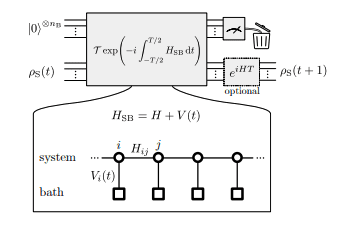
Researchers demonstrate a practical method for approximating thermal states – crucial for many-body physics simulations – using readily implementable quantum operations. The scheme relies on simulating a Hamiltonian, local interactions with ancillary qubits, and qubit reset, offering performance guarantees independent of specific system details beyond locality.
Understanding the behaviour of complex quantum systems necessitates the ability to accurately prepare their initial states, with thermal states – representing systems in equilibrium with a heat bath – being particularly crucial. Achieving this preparation efficiently presents a significant challenge for both classical simulation and implementation on quantum hardware. Researchers at the University of Oxford’s Rudolf Peierls Centre for Theoretical Physics – Dominik Hahn, S. A. Parameswaran, and Benedikt Placke – detail a novel approach to approximate thermal state preparation in their paper, “Provably Efficient Quantum Thermal State Preparation via Local Driving”. Their scheme circumvents the resource demands of existing methods by leveraging readily implementable quantum operations – analog Hamiltonian simulation, local interactions with ancillary qubits, and qubit reset – while providing mathematically rigorous guarantees on the fidelity of the resulting thermal state, independent of specific system details beyond locality.
Efficient Preparation of Thermal States for Quantum Simulation
Accurate preparation of initial states is fundamental to simulating complex quantum systems. Thermal states – representing systems in thermal equilibrium with an environment – are particularly important, yet their efficient preparation poses a considerable challenge for both classical computation and implementation on quantum hardware. Researchers at the University of Oxford’s Rudolf Peierls Centre for Theoretical Physics – Dominik Hahn, S. A. Parameswaran, and Benedikt Placke – have detailed a new scheme for approximately preparing thermal states, utilising standard quantum operations and providing quantifiable performance guarantees. This approach addresses a key bottleneck in many-body physics, offering a route towards simulating complex systems on near-term quantum computers.
The team tackles the problem of preparing thermal density matrices, a mathematical representation of the statistical state of a quantum system. These are central to numerous areas of physics, and particularly relevant for quantum simulations aiming to model real-world materials and phenomena. While recent work has demonstrated the possibility of constructing efficiently simulable Lindblad master equations – equations describing the time evolution of open quantum systems – that yield the desired thermal state as a steady state, implementing these equations demands substantial resources and remains difficult on current and near-term devices. Hahn, Parameswaran, and Placke circumvent these limitations with a scheme relying on three readily available components: analog simulation of the system’s Hamiltonian, strictly local, time-dependent couplings to ancilla qubits (additional qubits used as auxiliary components), and ancilla qubit reset.
The scheme begins with the system in an arbitrary initial state. Couplings to ancilla qubits are then activated, allowing energy exchange to occur. The time-dependent nature of these couplings carefully guides the system towards thermal equilibrium, ensuring a gradual relaxation towards the desired state. After a precisely determined interaction time, the researchers measure the ancilla qubits and reset them to their initial state, completing one cycle. Repeating this cycle multiple times progressively refines the approximation to the thermal state, enhancing its accuracy and reliability.
A key advantage of this scheme is its ability to provide rigorous performance guarantees independent of detailed physical knowledge of the system beyond its locality. This means the accuracy of the approximation does not depend on specific properties of the Hamiltonian, only on the fact that interactions are local, broadening its applicability. The use of strictly local couplings simplifies implementation on quantum hardware, avoiding the need for long-range interactions, which are particularly challenging for near-term devices.
The researchers demonstrate that their approach effectively prepares thermal states through repeated local operations and reset cycles. They begin by implementing analog simulation of the Hamiltonian, accurately representing the system’s energy landscape. Subsequently, they establish strictly local, time-dependent couplings to ancilla qubits, facilitating controlled energy exchange between the system and the thermal reservoir.
This method offers a practical solution to the challenge of preparing thermal density matrices. The proposed scheme circumvents the limitations of existing methods by leveraging readily available quantum operations and offering rigorous performance guarantees independent of detailed physical knowledge beyond the Hamiltonian’s locality. The team highlights the broad applicability of their scheme, noting that its accuracy is not contingent on specific Hamiltonian properties, only on the locality of interactions. This makes it suitable for a wide range of many-body systems, expanding its potential impact on various fields of physics.
The researchers emphasize that their approach provides a practical alternative to existing methods for preparing thermal states, offering a pathway to overcome the limitations of current technology. By leveraging readily available quantum operations and providing rigorous performance guarantees, they demonstrate the feasibility of simulating complex systems on near-term quantum computers. This advancement opens up new possibilities for studying a wide range of physical phenomena, from condensed matter physics to high-energy physics.
👉 More information
🗞 Provably Efficient Quantum Thermal State Preparation via Local Driving
🧠 DOI: https://doi.org/10.48550/arXiv.2505.22816