

Researchers including those from Parity Quantum Computing have made a breakthrough in quantum computing, developing a new approach to encode and decode quantum information using “parity qubits”. This innovation enables the creation of a “spanning line” where the full logical state of all qubits can be deduced from a subset of encoded qubits. The team used CNOT gates to encode and decode parity information, allowing for the recovery of logical information from parity qubits. This method eliminates the need for SWAP operations, reducing algorithmic runtime.
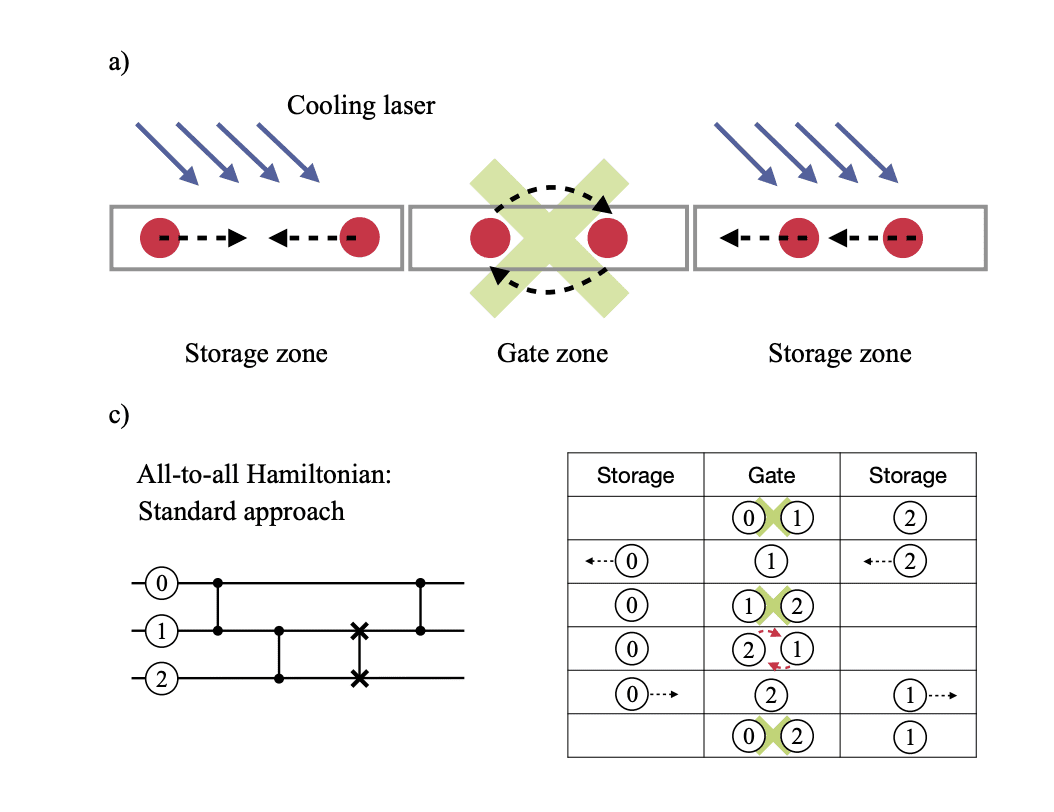
The Parity Flow approach was demonstrated in a linear quantum charge-coupled device (QCCD) featuring an interaction zone with high-power laser light, multiple storage zones, and cooling lasers. The researchers implemented all-to-all Hamiltonian interactions without swapping ions, showcasing the potential of this technology for large-scale quantum computing. This work paves the way for more efficient and scalable quantum computers.
The authors present a novel approach to quantum error correction called Parity Flow. This method enables the efficient encoding and decoding of logical qubits using a combination of base and parity qubits. It allows for the creation of a “spanning line” that contains all the necessary information to reconstruct the logical state of multiple qubits.
In traditional quantum computing architectures, qubits are typically arranged in a 2D grid, which requires complex swap operations to enable interactions between arbitrary qubits. However, these swap operations can be error-prone and slow computation.
On the other hand, the Parity Flow approach uses a linear chain of ions (qubits) and eliminates the need for swap operations. This is achieved by encoding parity information using CNOT gates, which act as a “parity generator” to create a superposition of the binary sum of two eigenvalues (si ⊕ sj).
The authors demonstrate how this approach can implement various quantum gates, including Rzz and Rx gates, without requiring swap operations. They also show how Parity Flow can be applied to simulate an all-to-all Ising-type Hamiltonian in a three-qubit system. It is typically challenging to achieve using traditional methods.
The benefits of Parity Flow are twofold: it reduces the number of error-prone swap operations, and it enables faster computation times. This approach has significant implications for developing more robust and efficient quantum computing architectures.
In summary, the Parity Flow method offers a promising solution to the challenges of quantum error correction and qubit interactions in linear quantum computing architectures. By eliminating the need for swap operations, this approach can lead to faster and more reliable quantum computations.
External Link: Click Here For More


