Quantum walks, the quantum equivalent of classical random walks, have been recognized for their algorithmic purposes since their introduction in the 1990s. They have been used in quantum search algorithms, solving hard KSAT instances, graph isomorphism problems, and quantum simulation. A recent study proposed an efficient and scalable quantum circuit for implementing discrete-time quantum walks on a 2n-cycle. The proposed circuit, tested on an IBM quantum device, requires fewer two-qubit gates for t-time steps than the current most efficient implementation, leading to lower computational costs and paving the way for more complex quantum computations.
What is the Significance of Quantum Walks in Quantum Computing?
Quantum walks, introduced in the 1990s, are the quantum equivalent of classical random walks. The concept, however, dates back to Feynman’s checkerboard, which links the spin with the zigzag propagation of a particle spreading at the speed of light across a 1-dimensional spacetime lattice. Quantum walks have proven to be a universal model for quantum computation and have been used in algorithms for quantum search, solving hard KSAT instances, graph isomorphism problems, algorithms in complex networks such as link prediction and community detection, and quantum simulation. Quantum communication protocols based on quantum walks have also been proposed.
The potential of quantum walks lies in their unique features – quantum superposition of multiple paths, ballistic spread faster than the diffusive spread of a classical random walker, and entanglement. These features have been recognized for their algorithmic purposes since their introduction. Quantum walks have been implemented in platforms that natively support the conditional walk operations, such as photonic systems. However, efficient implementations on digitized quantum computers are desirable to develop quantum algorithms for general-purpose quantum computers and quantum protocols to be implemented in circuit models.
What are the Different Models of Quantum Walks?
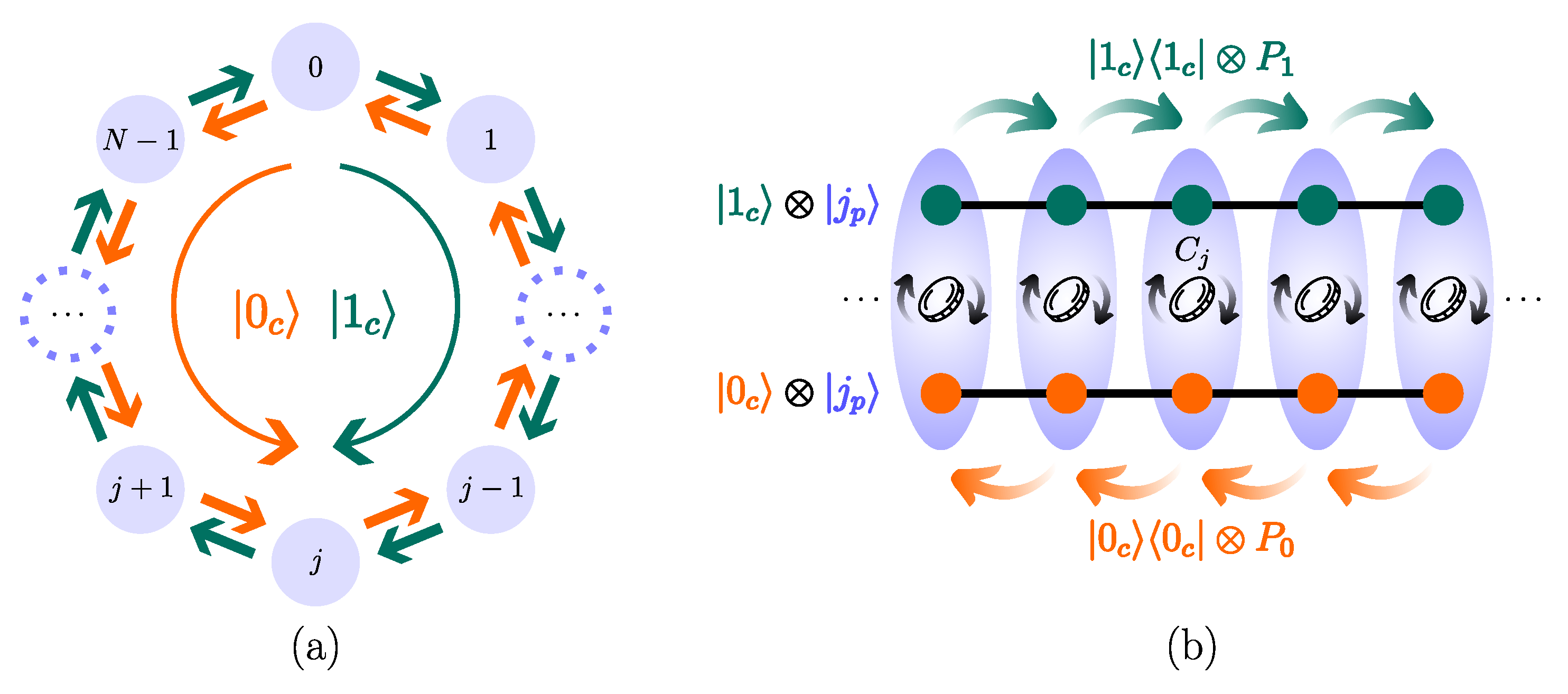
There are two main models of quantum walks – the discrete-time quantum walk (DTQW) and the continuous-time quantum walk (CTQW). The CTQW is defined on the position Hilbert space of the quantum walker, and the evolution is driven by the Hamiltonian of the system. The DTQW, on the other hand, is defined on a Hilbert space comprising an additional coin space, and the evolution is driven by a position shift operator controlled by a quantum coin operator acting at discrete time steps.
The evolution operator of a DTQW is simplified by the fact that the time is discrete, the evolution is repetitive, and it acts locally on the coin-vertex states encoding the graph. Implementing it will propagate the corresponding amplitudes only to adjacent vertices. A first circuit implementation of a DTQW on the cycle was realized on a multi-qubit nuclear magnetic resonance system, and thereafter, proposals for efficient implementation on certain graphs, for position-dependent coin operators, and for staggered quantum walks have been devised.
What is the New Proposal for Implementing Discrete-Time Quantum Walks?
In a recent study, an efficient and scalable quantum circuit implementing the DTQW on the 2n-cycle, a finite discrete line with 2n vertices and periodic boundary conditions, was proposed. This model, although simple, highlights the limitations of actual quantum devices. In this model, the position state of the quantum walker is encoded in an n-qubit state. The most efficient state-of-the-art implementation of a DTQW overall requires On^2t two-qubit gates for t-time steps.
The proposed circuit, based on the diagonalization of the conditional shift operator, requires only On^2nt two-qubit gates, which is a significant improvement over the current most efficient implementation based on quantum Fourier transforms. The proposed circuit was tested on an IBM quantum device for a Hadamard DTQW on the 4-cycle and 8-cycle, characterized by periodic dynamics and by recurrent generation of maximally entangled single-particle states.
What are the Implications of the Proposed Quantum Circuit?
The proposed quantum circuit for implementing the DTQW on the 2n-cycle is efficient and scalable, which is a significant advancement in the field of quantum computing. The circuit’s efficiency is demonstrated by its requirement of only On^2nt two-qubit gates for t-time steps, compared to the On^2t of the current most efficient implementation. This leads to a lower computational cost and allows for a greater number of time steps to be reliably implemented on current quantum computers.
The experimental results obtained from testing the proposed circuit on an IBM quantum device are meaningful well beyond the regime of few time steps. This paves the way for reliable implementation and use on quantum computers. The successful implementation of the proposed circuit could potentially lead to the development of more efficient quantum algorithms and quantum protocols, thereby advancing the field of quantum computing.
What is the Future of Quantum Walks in Quantum Computing?
The efficient implementation of discrete-time quantum walks on quantum computers is a significant step forward in the field of quantum computing. The proposed quantum circuit, which is both efficient and scalable, could potentially lead to the development of more efficient quantum algorithms and quantum protocols. This, in turn, could advance the field of quantum computing and pave the way for the realization of more complex quantum computations.
The experimental results obtained from testing the proposed circuit on an IBM quantum device are promising and suggest that the proposed circuit could be reliably implemented and used on quantum computers. This could potentially lead to the development of more efficient quantum algorithms and quantum protocols, thereby advancing the field of quantum computing. The future of quantum walks in quantum computing looks promising, with the potential for significant advancements in the field.
Publication Date: 2024-04-02
Authors: Luca Razzoli, Gabriele Cenedese, Maria Bondani, Giuliano Benenti, et al.
Source: Entropy (Basel. Online)
DOI: https://doi.org/10.3390/e26040313