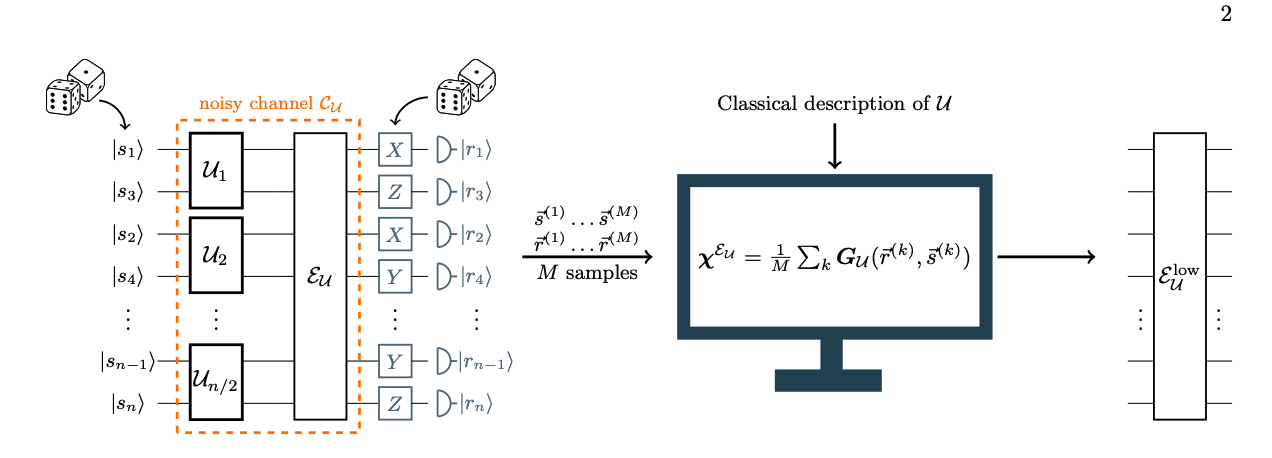
Quantum computation promises transformative capabilities, yet realising practical quantum computers necessitates precise control and characterisation of the errors that inevitably accompany quantum operations. These errors, arising from imperfections in physical systems and control mechanisms, degrade the fidelity of computations and limit the scalability of quantum processors. Marianna Crupi, J. Ignacio Cirac, and colleagues detail a novel process tomography protocol outlined in their article ‘Efficient characterization of coherent and correlated noise in layers of gates’, which efficiently diagnoses the impact of noise on quantum gates. Their approach, utilising a low-degree mathematical representation of the quantum channel – the transformation a quantum state undergoes – and random measurements, offers a scalable method for characterising errors without requiring complex hardware inversions. Instead, it employs classical post-processing to achieve equivalent results. This advancement represents a significant step towards building robust and reliable quantum computers.
Quantum computation continues to advance, yet maintaining qubit coherence and fidelity remains a substantial challenge. Researchers actively explore error mitigation techniques to construct robust quantum systems, and a promising approach involves classical post-processing of quantum computations. This innovative strategy circumvents the immediate need for complex quantum error correction, offering an alternative pathway toward reliable quantum processing and enabling the construction of larger, more capable quantum computers. A recent study details the feasibility of mitigating errors in quantum computations through classical post-processing, focusing on layers of two-qubit gates and revealing potentially favourable scaling properties for computational resources.
The study establishes that classical computation, applied after a quantum process, effectively reduces the impact of noise introduced during gate operations under specific conditions. This methodology proves particularly relevant when dealing with layers containing non-Clifford gates, essential for universal quantum computation but notoriously difficult to correct. Universal quantum computation requires the ability to implement any quantum operation, and non-Clifford gates, such as the T gate, are necessary to achieve this. However, these gates introduce complexities that make traditional quantum error correction challenging.
Researchers derive analytical bounds on the variance of the error function after post-processing, providing a theoretical understanding of the scaling behaviour and establishing a foundation for optimising error mitigation strategies. Numerical simulations validate these bounds, generating random positive semi-definite matrices and computing the variance of the error function to ensure the robustness and accuracy of the findings. The study reveals that the variance of measurements following a layer of iSWAP gates – a specific type of two-qubit gate – and associated noise saturates to a constant value, suggesting efficient post-processing is achievable. Conversely, layers incorporating T-gates exhibit exponential scaling of variance, highlighting the increased difficulty in mitigating errors arising from these gates.
Positive semi-definite matrices play a crucial role in characterising the noise and error propagation within the system, directly influencing the scaling of post-processing requirements. The study demonstrates that the sum of elements within these matrices does not increase with system size, supporting the claim of potentially constant scaling in certain scenarios. This suggests that the computational cost of post-processing may not grow rapidly as the number of qubits increases, a critical factor for scalability.
The research establishes a potentially favourable scaling of computational resources required for post-processing, with initial analytical bounds suggesting a polynomial scaling relationship with system size. However, numerical simulations suggest that this scaling may be constant in many practical scenarios, representing a significant advantage for large-scale quantum computation. This constant scaling implies that the overhead associated with post-processing remains manageable even as the quantum computer grows in size.
The study focuses on layers containing non-Clifford gates, such as the T gate, which present a significant challenge to efficient post-processing due to their inherent complexity. Researchers reveal that these gates lead to exponential scaling of variance, substantially increasing the computational complexity of error mitigation. This finding highlights the importance of developing targeted strategies to mitigate errors introduced by non-Clifford gates.
Researchers employ a combined approach of analytical derivations and numerical simulations to ensure the robustness and accuracy of their findings. They derive analytical bounds on the variance of the error function after post-processing and validate these bounds through rigorous numerical simulations. These simulations involve generating random positive semi-definite matrices and computing the variance of the error function, providing a detailed understanding of the scaling behaviour of post-processing.
The methodology effectively inverts the effect of gate layers through classical post-processing, rather than attempting to do so directly within the quantum hardware, thereby avoiding the introduction of additional errors. Researchers demonstrate that this approach maintains the efficiency and accuracy of the error mitigation process, particularly when dealing with channels consisting of a layer of gates, including a fixed number of non-Clifford gates, followed by a low-degree noise channel.
Future research will focus on extending these findings to more complex quantum circuits and exploring the impact of different noise models on the performance of post-processing. Researchers plan to investigate the use of machine learning techniques to optimise the post-processing algorithms and improve their ability to correct errors in real-world quantum systems. The team also intends to explore the integration of post-processing with other error mitigation techniques to create a more comprehensive and robust error mitigation strategy.
👉 More information
🗞 Efficient characterization of coherent and correlated noise in layers of gates
🧠 DOI: https://doi.org/10.48550/arXiv.2507.02030