

Controlling materials with light offers a powerful means of achieving precise, rapid manipulation without physical contact, and recent attention has focused on exploiting this technique within the exotic realm of moiré superlattices. Xiangbin Cai, Haiyang Pan, Yuzhu Wang, and colleagues demonstrate a robust method for optically switching between different magnetic states, including both conventional and fractional Chern ferromagnets, in twisted layers of molybdenum ditelluride. The team achieves this efficient control of spin orientation using remarkably low light power, as little as 28 nanowatts per square micrometer, and successfully demonstrates magnetic switching and the creation of magnetic domain walls with spatial precision. This work establishes a reliable optical control scheme, which promises to advance the development of energy-efficient spintronic devices and novel quantum technologies.
Light Controls Magnetism in Twisted MoTe2 Bilayers
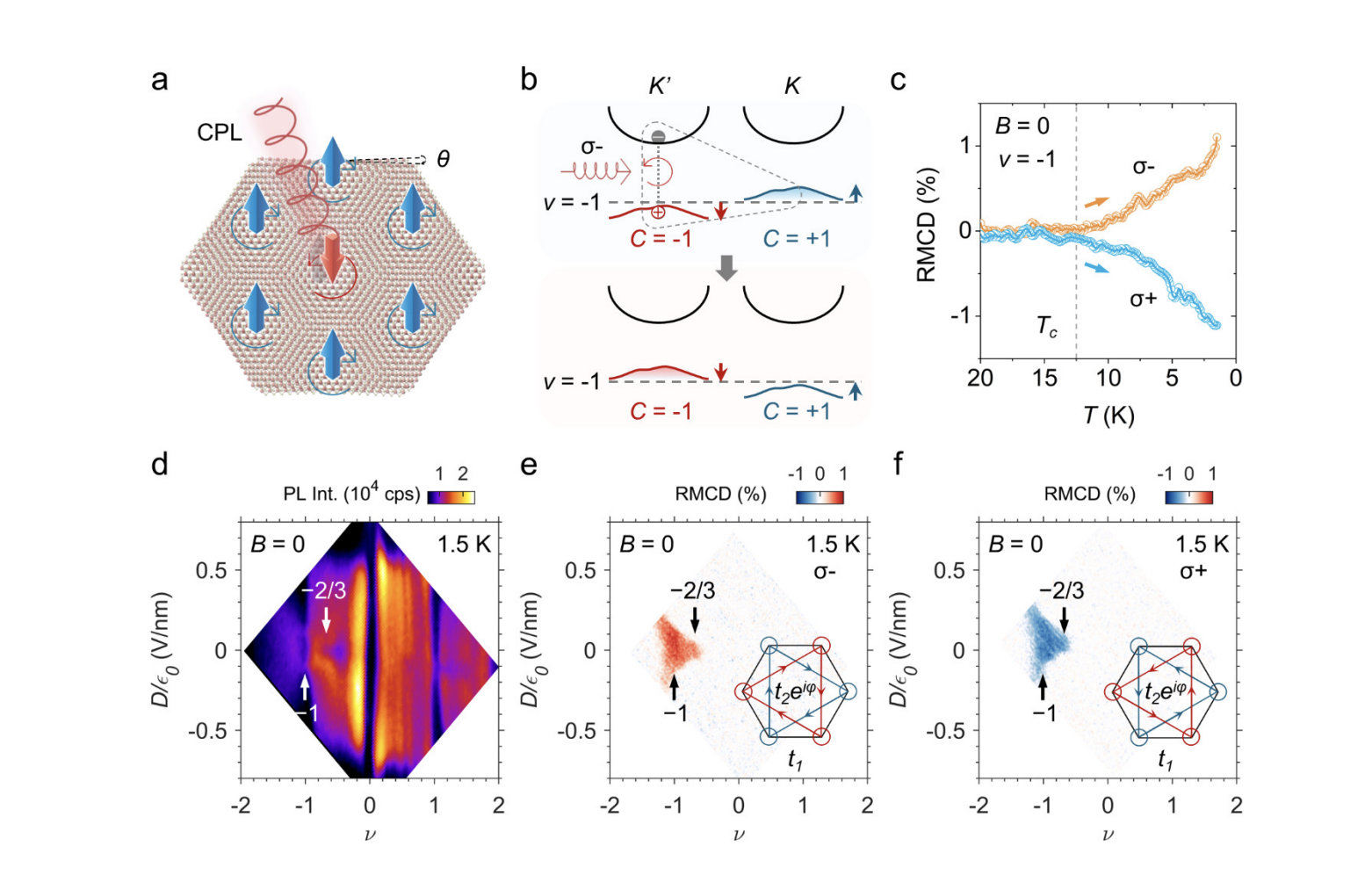
Researchers have engineered a novel optical method to control magnetism within moiré superlattices, specifically twisted bilayers of MoTe2. The team demonstrates robust switching of both integer and fractional Chern ferromagnets using circularly polarized light. They employed a pump-and-probe technique, aligning a circularly polarized light beam with reflective magnetic circular dichroism to precisely track spin orientation and magnetization strength, allowing detailed monitoring of changes in the material’s magnetic state induced by the light. Scientists harnessed the unique properties of these twisted bilayers, where the arrangement of atoms creates a periodic structure called a moiré superlattice, enabling a continuous description of the material’s electronic structure.
At specific carrier densities, the material exhibits ferromagnetism and fractional Chern insulating states, arising from strong electronic interactions and spin-orbit coupling. The core of the method involves using circularly polarized light to selectively excite electrons and holes in different valleys of the material’s band structure, influencing the spin orientation within each moiré unit cell. By carefully controlling the polarization and intensity of the light, as low as 28 nanowatts per square micrometer, scientists induce a spin flip, reversing the magnetic order within the material. This optically injected spin polarization forms a long-lived valley polarization, even after the light is switched off, enabling zero-field all-optical initialization of the moiré Chern ferromagnet.
Further characterization involved mapping photoluminescence across a range of conditions, revealing the formation of integer and fractional Chern insulators. Zero-field magnetic measurements confirm correlation-promoted ferromagnetism, while magnetic hysteresis loops provide detailed insight into the correlated ferromagnetic states. This innovative approach establishes a reliable and efficient optical control scheme, paving the way for dissipationless spintronics and quantized Chern junction devices.
Optical Control of Magnetism in Moiré Systems
Researchers have demonstrated a groundbreaking method for optically controlling magnetism in moiré Chern ferromagnets, achieving robust switching of both integer and fractional magnetic states using circularly polarized light. This innovative approach allows for precise manipulation of spin orientations at zero magnetic field, requiring a remarkably low pump light power of only 28 nanowatts per square micrometer. The team successfully demonstrated not only magnetic bistate cycling but also spatially resolved writing of ferromagnetic domain walls, opening new avenues for advanced device applications. Experiments reveal that the efficiency of this optical control is highly dependent on the energy and polarization of the light, reaching nearly 100% when the light resonates with specific absorption features of the twisted MoTe2 bilayers.
Repeated bidirectional switching cycles confirm the reliability of this optically induced magnetic phase transition, while high-resolution patterning demonstrates the potential for creating programmable Chern junctions and topological memory devices. This work establishes a highly efficient, non-volatile optical control protocol for these materials, paving the way for dissipationless spintronics and novel quantum devices. The team achieved zero-field initialization of the moiré Chern ferromagnet by manipulating valley polarization within the material. By shining circularly polarized light onto the twisted MoTe2 bilayer, researchers selectively excited electron-hole pairs, effectively reversing the spin orientation within each moiré unit cell.
This process creates a long-lived valley polarization, even after the light source is switched off, and ultimately reverses the overall ferromagnetic order. Photoluminescence mapping and magnetic measurements confirm the formation of correlated ferromagnetic states at specific carrier densities. These findings establish a new paradigm for controlling magnetism with light, offering a pathway towards energy-efficient spintronic devices and advanced quantum technologies.
Optical Control of Moiré Chern Ferromagnets Demonstrated
This research demonstrates efficient and robust optical control of moiré Chern ferromagnets using circularly polarized light. Researchers achieved highly efficient manipulation of spin orientations, even at zero magnetic field, with a remarkably low power density of 28 nanowatts per square micrometer. This control extends to the ability to write and manipulate ferromagnetic domain walls with high spatial resolution, paving the way for programmable topological devices and potentially novel spintronic applications. The study acknowledges that further investigation is needed to fully understand the behavior of topological chiral edge currents at these engineered domain walls, specifically exploring the interactions between oppositely propagating edge currents and the resulting emergence of new neutral and charge modes, which could offer insights into the stability of topological phases and advance quantum information processing. This approach offers a unique platform to study these phenomena, differing from conventional quantum Hall systems by realizing interfaces between two distinct topological phases rather than a phase and vacuum.
🗞 Optical Switching of Moiré Chern Ferromagnet
🧠 ArXiv: https://arxiv.org/abs/2508.19602


