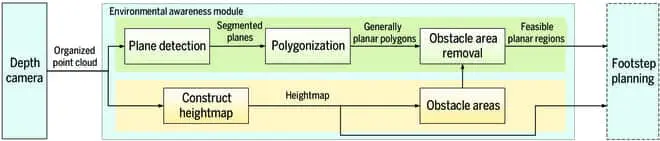
Scientists at Beijing Institute of Technology have developed an efficient perception method tailored for bipedal robots’ look-and-step behavior, published in Cyborg and Bionic Systems on April 23, 2025. The research introduces a hybrid environment expression combining feasible planar regions and heightmaps to enhance navigation safety and adaptability. By leveraging the structured nature of point clouds for nearest neighbor searches, the method efficiently extracts planar regions and constructs heightmaps without requiring additional computing units like GPUs. This approach completes perception in 0.16 seconds per frame using only CPUs, ensuring real-time processing suitable for continuous locomotion. The study addresses current limitations in computational efficiency and environmental adaptability, offering a practical solution for bipedal robots operating in unknown environments.
The study introduces an efficient perception method tailored for bipedal robots, focusing on enhancing their adaptability in unknown environments through a look-and-step approach. This strategy involves rapid environmental perception, step execution, and continuous repetition, crucial for correcting walking deviations during navigation.
Central to the method is the hybrid environment expression, combining feasible planar regions with heightmaps. Planar regions are utilized for footstep planning and obstacle avoidance, while heightmaps ensure safe foot trajectories during swinging phases. The extraction of these regions leverages organized point clouds for efficient nearest neighbor searches, optimizing computational resources.
The system’s efficiency is highlighted by its completion
The system’s efficiency is highlighted by its completion of the perception process in 0.16 seconds per frame using only a CPU, eliminating the need for additional GPUs that could increase weight and space requirements. This approach ensures lightweight design without compromising performance.
Key contributions include an efficient method under limited computing resources, innovative use of point cloud structure for faster planar extraction, and experimental validation demonstrating both efficiency and safety in typical environments. However, the reliance on empirically set thresholds presents a limitation, though future research aims to develop adaptive techniques addressing this constraint.
The study focuses on extracting feasible planar regions efficiently for bipedal robots navigating unknown environments. These regions are crucial for footstep planning and obstacle avoidance, ensuring safe locomotion. The extraction process leverages organized point clouds to perform efficient nearest neighbor searches, optimizing computational resources without the need for additional hardware like GPUs.
By completing the perception process in 0.16 seconds per frame on a CPU, the system maintains lightweight design while ensuring performance. However, reliance on empirically set thresholds presents a limitation, as these parameters may not adapt well to varying environments. Future research aims to develop adaptive techniques to address this constraint.
Heightmap construction is integral for safe foot trajectories during movement
Heightmap construction is integral for safe foot trajectories during movement. Utilizing organized point clouds allows real-time updates in dynamic environments, ensuring accurate and relevant heightmaps. The challenge lies in balancing resolution with computational overhead; the system achieves a balance that supports efficient processing while maintaining obstacle detection accuracy. Experimental validation confirms effective navigation support, though adaptive thresholds remain a target for future improvements.
The study focuses on enhancing bipedal robot navigation through efficient extraction of feasible planar regions and precise heightmap construction. Feasible planar regions are crucial for footstep planning and obstacle avoidance, ensuring safe locomotion. These regions are identified using organized point clouds, which facilitate efficient nearest neighbor searches, enabling quick identification of safe areas without the need for additional hardware like GPUs.
In summary, the study presents an efficient method for bipedal robots to navigate unknown environments using planar regions and heightmaps constructed from point clouds, with potential enhancements through adaptive thresholding.
External Link: Click Here For More