

Harnessing waste heat represents a significant challenge in energy technology, with conventional methods limited by fundamental efficiency constraints. Hikaru Yamazaki, Masashi Uemura, and Haruhi Tanaka, along with colleagues at their respective institutions, now demonstrate a novel approach to energy harvesting using a non-thermal Tomonaga-Luttinger liquid. Their research reveals that this unique state, naturally occurring in Hall edge channels, surpasses the limitations of traditional systems by operating outside of thermal equilibrium. The team successfully tested a prototype energy harvester driven by waste heat from a transistor, showing that the non-thermal liquid generates a substantially larger electromotive force and achieves higher conversion efficiency than its quasi-thermalized counterpart, offering a promising pathway towards more effective and sustainable energy solutions.
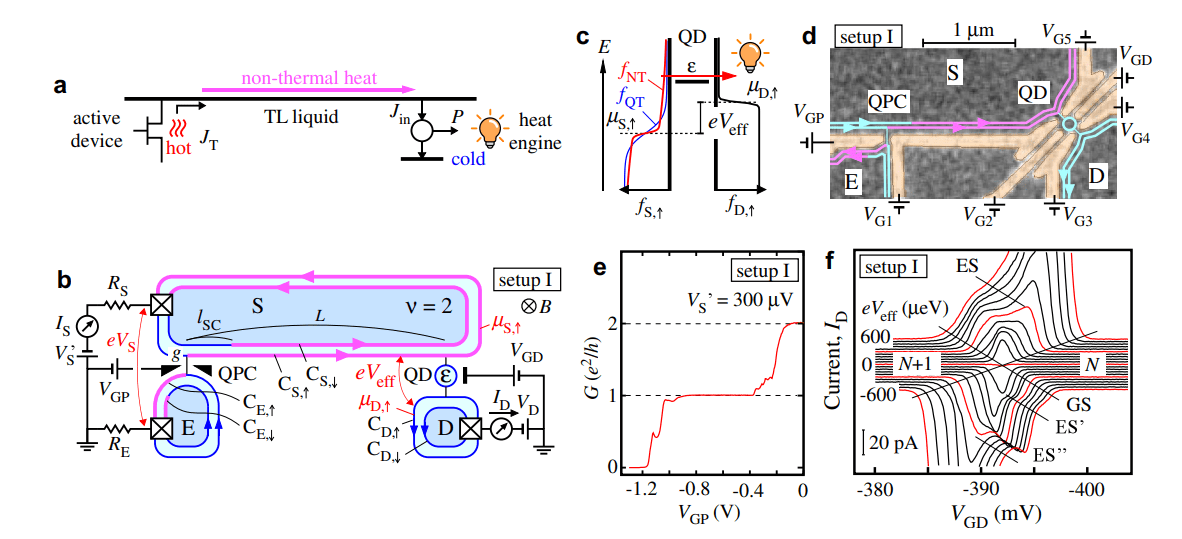
Conventional energy harvesters operating under local thermal equilibrium face limitations imposed by thermodynamic principles, such as the Carnot efficiency. Quantum heat engines utilizing non-thermal reservoirs offer the potential to surpass these boundaries. This work demonstrates energy harvesting from a non-thermal Tomonaga-Luttinger (TL) liquid in quantum Hall edge channels, where the absence of thermalization naturally creates a non-thermal state. The team tested a quantum-dot energy harvester powered by a non-thermal TL liquid supplied with waste heat from a quantum-point-contact transistor, and observed enhanced performance compared to a quasi-thermalized system.
Waste Heat Extraction via Tomonaga-Luttinger Liquid
Scientists engineered a novel energy harvesting system utilizing a non-thermal Tomonaga-Luttinger (TL) liquid within Hall edge channels, circumventing limitations imposed on conventional heat engines operating under thermal equilibrium. The study pioneered a method for extracting energy from waste heat by harnessing the unique properties of this non-thermal state, which arises naturally from the absence of thermalization within the TL liquid. A quantum-dot energy harvester was constructed, supplied with waste heat from a quantum-point-contact transistor, to test this approach. The team meticulously characterized the system’s performance by measuring drain current as a function of gate voltage and effective energy bias, generating detailed maps of electric power output.
To analyze the data, scientists developed a conversion method to translate original measurements into energy-dependent data, specifically plotting power as a function of electrochemical potential and effective voltage. Researchers then employed this converted data to derive the distribution functions for electrons in both the source and drain channels, revealing significant differences between the non-thermal and quasi-thermal states. By analyzing these distribution functions, the team calculated fundamental thermoelectric characteristics, including electromotive force and idealized efficiency. Results demonstrate that the non-thermal state achieves a significantly higher electromotive force, approximately 130 μV, and improved efficiencies, with a zero-power limit of 0.
65 and a maximum power efficiency of 0. 45, compared to the quasi-thermal state, which exhibited 50 μV and efficiencies of 0. 58 and 0. 35, respectively. The study further investigated heat currents and power generation, establishing a framework for optimizing energy harvesting from non-thermal carriers.
Non-Thermal Liquid Harvests Waste Heat Efficiently
Scientists have demonstrated a novel energy harvesting technique utilizing a non-thermal Tomonaga-Luttinger (TL) liquid, achieving enhanced performance compared to conventional methods limited by the Carnot efficiency. This work focuses on extracting useful energy from waste heat using a specially prepared state within the TL liquid, formed in Hall edge channels where thermalization does not occur. The team constructed an integrated heat circuit incorporating a quantum point contact and a quantum dot, operating in the quantum Hall regime at a Landau-level filling factor of 2, to test this concept. Experiments revealed that the non-thermal state, generated by carefully controlling the conductance of the quantum point contact, delivers a larger electromotive force and higher conversion efficiency than a quasi-thermalized state prepared under identical heat conditions.
Specifically, the researchers tuned the quantum point contact’s conductance to values around 0. 03 e²/h to create the non-thermal state, contrasting with 0. 5 e²/h for the quasi-thermalized state. This manipulation of the electronic energy distribution function within the TL liquid results in an excess of high-energy electrons and low-energy holes, enhancing its ability to drive a quantum dot heat engine. Measurements of the drain current in the quantum dot revealed that the non-thermal state provides a significantly improved capacity for generating electric power.
The team observed distinct current steps associated with electron transport through the ground and excited states of the quantum dot, demonstrating the effectiveness of the non-thermal state as a heat source. This breakthrough delivers a promising pathway for utilizing previously untapped waste heat, potentially leading to more efficient and sustainable energy solutions. The researchers emphasize that the non-thermal state within the TL liquid is a stable, equilibrated state, making it particularly attractive for practical energy harvesting applications.
Non-Thermal Liquid Powers Quantum Dot Harvester
This research demonstrates a novel approach to energy harvesting by utilizing a non-thermal Tomonaga-Luttinger (TL) liquid, specifically within Hall edge channels, to convert waste heat into useful energy. Unlike conventional energy harvesters limited by thermodynamic efficiencies applicable to systems in thermal equilibrium, this scheme exploits the unique properties of a non-thermal state where traditional limits do not apply. The team successfully tested a device incorporating a quantum dot energy harvester powered by a non-thermal TL liquid supplied with heat from a transistor, demonstrating its feasibility and performance characteristics. The results show that the non-thermal state significantly outperforms a quasi-thermalized TL liquid, generating a larger electromotive force and achieving both higher conversion efficiency in the zero power limit and at maximum power output.
This improvement stems from the binary Fermi distribution function inherent in the non-thermal state, which allows for more effective energy conversion. Furthermore, the research indicates that tailoring the energy filtering function can enhance heat recovery efficiency by selectively collecting high-energy electrons. While the experiments focused on a specific device configuration, the authors acknowledge that the single-level model used for simulations provides a reasonable approximation even with excited states present. The authors note that the presented scheme and underlying principles are potentially applicable to a broader range of non-equilibrium states, other TL systems, and even other integrable systems, suggesting a versatile pathway for future energy harvesting technologies.
👉 More information
🗞 Efficient heat-energy conversion from a non-thermal Tomonaga-Luttinger liquid
🧠 ArXiv: https://arxiv.org/abs/2509.26387

