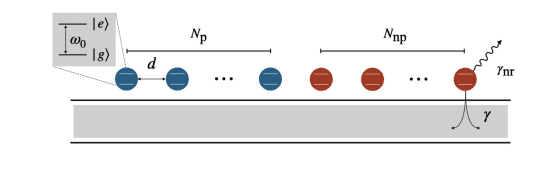
In an April 17, 2025, study titled Excitation transfer and many-body dark states in WQED, researchers Wei Chen, Guin-Dar Lin, and Hiang-Hua Jen uncovered new mechanisms for efficient energy transfer in quantum systems through the use of symmetrized dark states.
In one-dimensional waveguide systems, emitters exhibit long-range interactions leading to complex many-body dynamics. Researchers constructed symmetrized M-excitation dark states, deriving analytic expressions for their evolution, enabling efficient modeling of excitation transport and storage. They identified a fundamental bound on energy redistribution tied to dark state structure and dissipation, finding optimal transfer converges to an initial pumped fraction for large systems. Robustness against imperfections like disorder and decay was demonstrated, highlighting the role of many-body dark states in dissipative energy transfer.
Superabsorption is closely linked to superradiance, where a group of atoms collectively emits light. In contrast, superabsorption involves synchronized absorption of light by atoms or artificial structures, such as those in superconducting circuits. This collective behavior leads to enhanced efficiency compared to traditional independent photon absorption.
This phenomenon allows for the creation of highly sensitive quantum sensors and advanced communication systems, crucial components in quantum computing. By engineering strong interactions between atoms and electromagnetic fields, researchers can achieve more efficient light absorption, paving the way for innovative applications.
Superabsorption holds significant potential for quantum computing. It enables the development of quantum sensors with unprecedented sensitivity, capable of detecting minute changes in magnetic fields or environmental factors. These sensors have practical applications in medical imaging and geophysical exploration, offering new insights into these fields.
Additionally, superabsorption enhances quantum communication systems by improving photon absorption efficiency. This leads to more reliable and faster communication channels, essential for scaling up quantum computing networks. The ability to transmit information over long distances with greater reliability is a critical advancement in the field.
The study of superabsorption represents a significant step forward in understanding quantum phenomena and their applications. By harnessing collective atomic behavior, researchers are developing new technologies that could transform quantum computing. As research progresses, we can anticipate innovative solutions that expand the boundaries of quantum information processing.
In summary, superabsorption not only deepens our understanding of fundamental quantum mechanics but also opens exciting possibilities for practical applications in quantum computing and beyond. The future of quantum technology is poised to benefit greatly from these advancements.
👉 More information
🗞 Excitation transfer and many-body dark states in WQED
🧠 DOI: https://doi.org/10.48550/arXiv.2504.12677