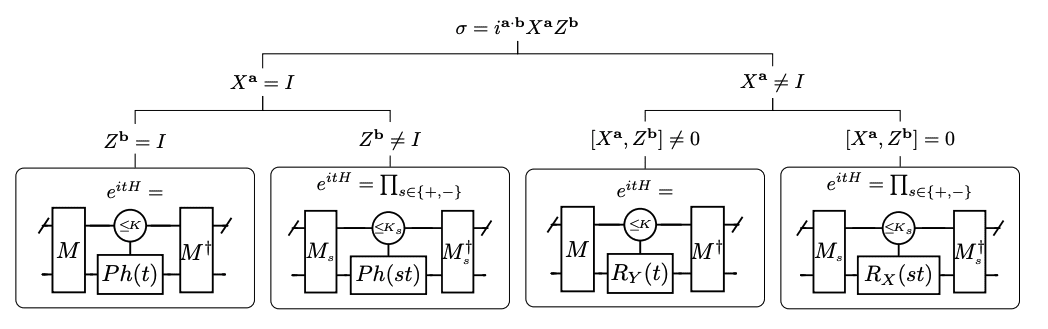
On April 12, 2025, Franz G. Fuchs and Ruben P. Bassa published Compact Circuits for Constrained Quantum Evolutions of Sparse Operators, detailing a novel framework to construct efficient quantum circuits that minimize non-transversal gates, particularly T-gates, crucial for fault-tolerant computing. Their work advances applications in constrained mixers for QAOA, fermionic operators in VQE, and lattice gauge theory.
The research presents a framework for constructing compact quantum circuits implementing real-time evolution of specific Hamiltonians relevant to algorithms like QAOA, VQE, and lattice gauge theory. The method minimizes non-transversal gates, particularly T-gates, critical for fault-tolerant computing. Circuits require CX gates and T-gates, with complexity dependent on qubits, subspace dimension, and precision. For group-generated subspaces, gate counts are further reduced. Applications include improved transposition circuits, efficient fermionic excitations, and oracle operators for combinatorial optimization.
Efficient Quantum Gate Decompositions
One of the foundational challenges in quantum computing is breaking down complex quantum operations into simpler, more manageable gates. Recent research has made progress in this area, particularly in decomposing multi-controlled single-qubit gates and special unitary operations. These advancements are critical because they reduce the computational overhead required to implement quantum algorithms, making them more feasible for execution on current hardware.
For example, studies have shown that by breaking down complex operations into sequences of Clifford and T gates—two of the most basic building blocks in quantum computing—it is possible to significantly simplify the implementation of quantum circuits. This not only improves computational efficiency but also enhances the scalability of quantum algorithms, bringing us closer to achieving practical quantum advantage.
Magic State Distillation
Another key area of progress has been in magic state distillation, a process essential for fault-tolerant quantum computing. Magic states are special quantum states that enable universal quantum computation when combined with Clifford gates. However, these states are highly susceptible to noise and errors, which can degrade their performance. Recent work has demonstrated more efficient methods for distilling magic states, reducing the resource requirements and improving the fidelity of computations.
This is particularly important as researchers aim to build large-scale, fault-tolerant quantum computers capable of performing error-free calculations at scale. By minimizing the overhead associated with magic state preparation and distribution, these innovations are helping to bridge the gap between theoretical models and practical implementations.
Variational Algorithms and Quantum Chemistry
Variational algorithms have emerged as a promising approach for leveraging near-term quantum hardware to solve real-world problems. These algorithms combine classical optimization techniques with quantum computations to find approximate solutions to complex problems, such as those in quantum chemistry. Recent research has focused on improving the efficiency and accuracy of variational methods, particularly in the context of preparing sparse quantum states.
By developing simpler and more efficient protocols for state preparation, scientists are enabling faster and more reliable simulations of molecular systems. This has significant implications for fields like drug discovery, materials science, and energy production, where understanding the behavior of quantum systems is crucial.
Applications in Computational Chemistry
The intersection of quantum computing and computational chemistry has been a fertile ground for innovation. Researchers have developed novel quantum circuits tailored to simulate chemical reactions and molecular structures with high precision. These circuits leverage advances in gate decomposition and error correction to achieve results that are both accurate and computationally efficient.
For example, recent work has demonstrated the ability to perform precise simulations of chemical systems using variational algorithms, providing insights into reaction mechanisms and material properties that would be difficult or impossible to obtain through classical methods. As quantum hardware continues to improve, these techniques will likely play an increasingly important role in advancing our understanding of the natural world.
Conclusion
The advancements discussed here represent just a few of the many innovations shaping the field of quantum computing today. From more efficient gate decompositions to improved error correction and novel applications in chemistry, these developments are paving the way for practical implementations of quantum technologies. While challenges remain, the progress made so far underscores the potential of quantum computing to transform industries and solve problems that are currently beyond our reach.
👉 More information
🗞 Compact Circuits for Constrained Quantum Evolutions of Sparse Operators
🧠 DOI: https://doi.org/10.48550/arXiv.2504.09133