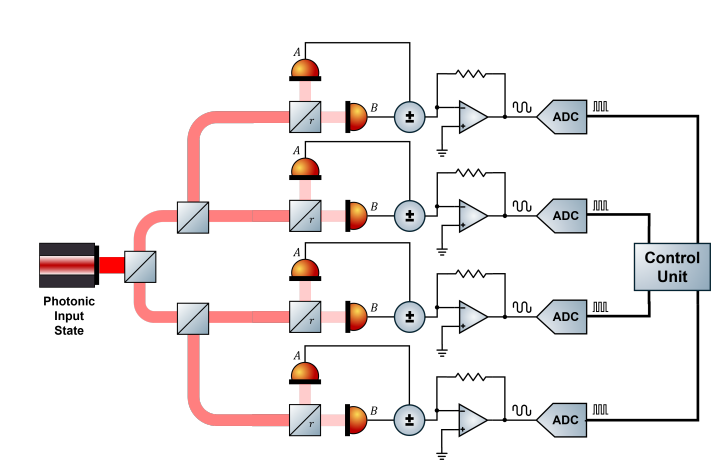
Probabilistic computing offers a powerful new approach to solving complex problems, and researchers are now demonstrating significant advances in both speed and efficiency. Ramy Aboushelbaya, Annika Moslein, and Hadi Azar, along with colleagues from Quantum Dice Limited, have developed a self-correcting optoelectronic system that harnesses the inherent randomness of quantum physics to perform calculations. This innovative architecture integrates quantum p-bits with robust electronic control, achieving a flip rate of 2. 7x 10^9 flips per second with remarkably low energy consumption. The team’s design not only surpasses existing magnetic-based systems by nearly three orders of magnitude in speed and efficiency, but also incorporates a self-certification protocol that corrects errors in real-time, paving the way for scalable and reliable probabilistic computing with applications in fields like machine learning and complex system modelling.
Probabilistic Computing and Neuromorphic Hardware Development
Researchers are developing computing systems that move beyond traditional methods by embracing probabilistic approaches, often inspired by the brain’s architecture. This involves utilizing probabilistic models, such as Boltzmann Machines, to solve complex problems and building specialized hardware to accelerate these algorithms. A key goal is to overcome the limitations of the traditional von Neumann architecture and apply these techniques to machine learning and inference tasks. Several technologies are central to this effort, including Magnetic Tunnel Junctions (MTJs) for nanoscale probabilistic elements, silicon photonics for integrated optical circuits, and Lithium Niobate for electro-optic modulators.
Quantum Random Number Generators, leveraging quantum phenomena, produce truly random numbers, and CMOS integration combines conventional silicon circuitry with these new technologies to create versatile systems. Specific computing architectures include Ising Machines, inspired by statistical physics, and Boltzmann Machines, which are probabilistic generative models for learning complex patterns. Researchers are also developing Photonic Neural Networks that use light to implement neural network operations and exploring Heterogeneous Computing, combining different hardware types to leverage their strengths. Massively Parallel Computing, building systems with numerous processing elements, aims to achieve high performance. These advancements have potential applications in diverse fields, including machine learning, optimization problems, signal processing, communications, and artificial intelligence. Research groups are focusing on areas like nanomagnetics, integrated photonics, quantum optics, neuromorphic engineering, and specialized machine learning hardware.
Photonic P-bits and Electronic Control Integration
Scientists have engineered an optoelectronic architecture for probabilistic computing, integrating quantum photonic p-bits with robust electronic control systems. This system manipulates 64000 logical p-bits, achieving a flip rate of 2. 7x 10 9 flips per second with an energy consumption of 4. 9 nanojoules per flip. This represents a nearly three-order-of-magnitude improvement in both speed and energy efficiency compared to state-of-the-art magnetic tunnel junction (MTJ) based systems. The team combined the inherent randomness and high bandwidth of quantum p-bits with the programmability and scalability of classical electronics, overcoming limitations of software-based probabilistic computing. By implementing a dedicated probabilistic processor with a quantum photonic p-bit architecture, they deliver significant performance gains and establish quantum p-bits as a promising platform for scalable, high-performance probabilistic computing.
Photonic P-bits Enable Fast Computation
Scientists have achieved a breakthrough in probabilistic computing by developing an optoelectronic architecture that leverages quantum photonic p-bits integrated with robust electronic control. This system implements and manipulates 64000 logical p-bits, achieving a flip rate of 2. 7x 10 9 flips per second with an energy consumption of 4. 9 nanojoules per flip. These measurements represent a nearly three-order-of-magnitude improvement in both speed and energy efficiency compared to existing magnetic tunnel junction-based systems. The research team’s system utilizes a source-device independent (SDI) protocol, enabling real-time self-certification and error correction, ensuring reliable operation even as the number of p-bits scales. This achievement delivers a significant advancement in the field, paving the way for more efficient and powerful computational systems.
Fast, Scalable Optoelectronic Probabilistic Computing Demonstrated
This research demonstrates a novel optoelectronic architecture for probabilistic computing, integrating quantum p-bits with robust electronic control systems. The team successfully built and tested a prototype capable of manipulating 64000 logical p-bits, achieving a flip rate of 2. 7x 10 9 flips per second with an energy consumption of 4. 9 nanojoules per flip. These results represent a substantial improvement over existing magnetic tunnel junction-based systems.
The architecture’s self-correcting protocol and source-device independent design address the challenges of hardware variability as systems scale, ensuring reliable operation across diverse conditions. This work establishes quantum p-bits as a promising platform for high-performance probabilistic computing, with potential applications in areas such as combinatorial optimisation, machine learning, and complex system modelling. Future research will focus on increasing system performance by utilising a single photonic source for multiple p-bits, enhancing the bandwidth of electronic circuitry, and developing a dedicated mixed-signal application-specific integrated circuit (ASIC) optimised for probabilistic computing.
🗞 Self-correcting High-speed Opto-electronic Probabilistic Computer
🧠 ArXiv: https://arxiv.org/abs/2511.04300