

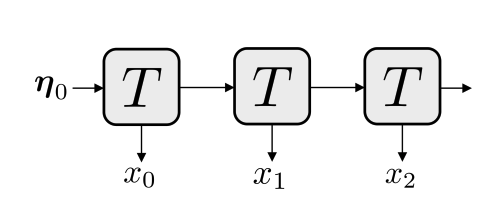
Understanding the world around us relies on building models that accurately capture observed behaviours, and a fundamental question arises when multiple models appear to produce the same results. Paul M. Riechers from the Beyond Institute for Theoretical Science and Thomas J. Elliott from the University of Manchester investigate this problem of ‘identifiability’ specifically for classical stochastic processes, sequences of correlated random variables. Their work addresses whether two different models genuinely represent distinct underlying mechanisms, or simply mimic the same observable behaviour, a crucial distinction for accurate interpretation and efficient computation. The researchers resolve this identifiability challenge by developing a method to compare any two models, whether classical or utilising quantum or ‘post-quantum’ approaches, and importantly, establish limits on the complexity, or minimal dimension, required for a model to faithfully represent a given process. This advancement offers a powerful tool for model selection and optimisation, potentially leading to more efficient and insightful simulations of complex systems.
To make sense of the world around us, we develop models constructed to replicate, describe, and explain observed behaviours. This work focuses on the broad case of sequences of correlated random variables, known as classical stochastic processes, and tackles the question of determining whether two different models produce the same observable behaviour. Interestingly, the physics underpinning a model need not correspond to the physics of the observations themselves; recent work demonstrates that employing quantum models to generate classical stochastic processes can be advantageous in terms of both memory and thermal efficiency.
Quantum Simulation of Stochastic Processes
This paper investigates the fundamental limits of how efficiently we can model and simulate stochastic processes, comparing classical methods to those leveraging quantum mechanics. The central question is whether quantum mechanics can provide a significant reduction in the complexity, such as memory requirements and computational cost, needed to represent and predict these processes. Specifically, the authors seek situations where quantum models are demonstrably better than the best classical models, not just faster, but fundamentally requiring less information. Stochastic processes describe systems that evolve randomly over time, like weather patterns or stock prices.
Hidden Markov Models (HMMs) are a common framework for modeling these processes, where an underlying hidden state generates observable outputs. The research considers concepts like quantum memory, the amount of quantum information needed, and expressibility, the ability of a model to accurately represent a wide range of processes. The team utilizes mathematical frameworks like Liouville space to describe quantum state evolution, and employs measures like transfer entropy to quantify information flow and crypticity, which describes how much information about the past is hidden in the present. The paper demonstrates scenarios where quantum models provably require less memory to represent certain stochastic processes than the best possible classical models, representing a fundamental reduction in information needed.
Quantum models achieve significant dimensionality reduction, representing complex processes with fewer variables than classical models. The authors also show a connection between the crypticity of a process and the amount of memory needed to model it, allowing quantum models to achieve better compression. The research links model complexity to thermodynamic concepts like entropy and free energy, suggesting fundamental limits on how efficiently we can model stochastic processes. This work pushes the boundaries of our understanding of what is fundamentally possible when modeling complex systems, with implications for quantum machine learning, artificial intelligence, and information theory. The results could have applications in fields ranging from finance and robotics to weather forecasting and materials science.
Unified Model Identifiability via Generalized Hidden Markov Models
Researchers have successfully addressed the long-standing problem of identifiability, determining whether different models can produce the same observable behaviour in stochastic processes. This breakthrough extends beyond classical physics, encompassing both quantum and even more general ‘post-quantum’ models, providing a unified framework for comparison. The team achieved this by mapping any linear model, classical, quantum, or otherwise, to a minimal, canonical linear latent model known as a generalized hidden Markov model (GHMM). This innovative approach allows scientists to compare models and establish bounds on the complexity required to generate a given stochastic process.
The core of this work lies in the development of GHMMs, which represent a powerful tool for understanding and generating stochastic processes from various theoretical frameworks. Researchers demonstrate that any stochastic process can be described using a GHMM, enabling a direct calculation of the probability of any sequence of events through linear algebra. A key finding is that the minimal number of dimensions necessary to generate a classical stochastic process can be determined, providing a lower bound for quantum models attempting to replicate the same behaviour. This establishes a fundamental connection between classical and quantum descriptions of seemingly random phenomena.
Furthermore, the team’s method simplifies the complex task of model comparison by identifying a unique, minimal generative model within a broader space of linear models. By relaxing the constraints typically imposed on classical and quantum models, they created a more versatile framework for analysis. The results demonstrate that the probability of any sequence of events can be calculated directly using the GHMM framework, ensuring accurate and efficient modeling of stochastic processes. This advancement has significant implications for fields ranging from physics and engineering to finance and data science.
Quantum Advantage in Stochastic Model Complexity
This research successfully addresses the problem of identifying whether two different models generate the same observable behaviour in classical stochastic processes. The authors developed a canonical representation using generalized hidden Markov models (GHMMs) that allows comparison of any generative model, regardless of its underlying physics, classical, quantum, or otherwise. This approach also establishes lower bounds on the minimal dimension required for a quantum generative model to produce a given process, demonstrating that these bounds are generally smaller than those for classical models. The findings indicate a potential quadratic advantage for quantum models over their classical counterparts, although the authors acknowledge that these bounds are not always tight.
Importantly, quantum models possess the advantage of physical realizability, a characteristic not always shared by classical GHMMs. Future work could explore connections between this research and other areas, such as finitely-correlated states and matrix product states, potentially revealing a correspondence between the canonical representation and a fixed gauge representation of infinite matrix product states. The authors also suggest that related work on bounding quantum model dimension, based on spectral properties, likely stems from the same underlying structure.
🗞 Identifiability and minimality bounds of quantum and post-quantum models of classical stochastic processes
🧠 ArXiv: https://arxiv.org/abs/2509.03004


