

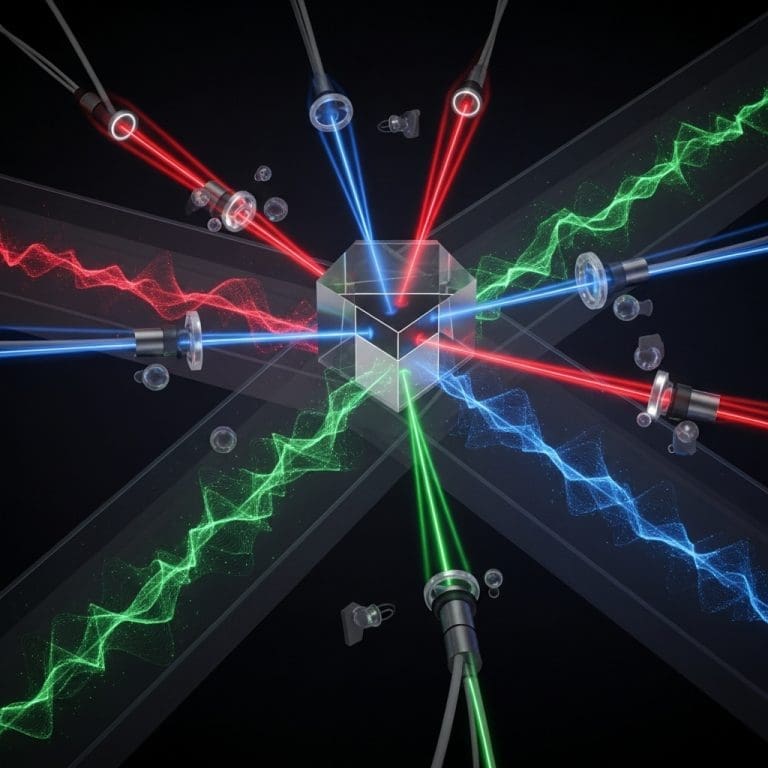
Visible light communication presents a promising solution for future wireless networks, offering advantages over traditional radio-frequency systems, yet its potential alongside advanced techniques like semantic communication requires further investigation. Zhouxiang Zhao, Zhaohui Yang, and Mingzhe Chen, from Zhejiang University and the University of Miami respectively, alongside colleagues, address this gap by exploring energy efficiency within probabilistic semantic communication systems utilising visible light networks. Their research focuses on a system where data compression reduces transmission size, balanced against computational demands, and employs rate splitting multiple access to simultaneously deliver both essential knowledge and information. This work is significant as it develops an algorithm to optimise energy use by carefully managing transmission power, data rates, and compression levels, demonstrating a pathway towards sustainable and efficient wireless communication. The findings offer valuable insights into resource allocation for semantic communication, paving the way for more practical and energy-conscious VLC deployments.
This work addresses a critical gap in current wireless communication systems, where combining the physical-layer advantages of VLC with higher-layer semantic techniques has remained largely unexplored. The research team achieved a novel system model where light-emitting diode (LED) transmitters employ semantic compression, reducing data size at the cost of computational overhead, and transmit compressed information via rate splitting multiple access (RSMA). This innovative approach enables simultaneous transmission of both essential knowledge and information data, optimising resource allocation within the network.
The study reveals a method for optimising energy efficiency in resource-constrained VLC-based PSCom systems by jointly optimising several key parameters. Researchers focused on transmit beamforming, direct current (DC) bias, common rate allocation, and the semantic compression ratio, all while carefully accounting for both communication and computational costs. A probabilistic knowledge base, represented by probabilistic graphs, is used for semantic inference and requires periodic updates to maintain synchronisation between the transmitter and users. This complex optimisation problem is solved using an alternating optimisation algorithm, built upon successive convex approximation (SCA) and the Dinkelbach method, providing a robust and effective solution.
This breakthrough establishes a framework for maximising energy efficiency in VLC networks, moving beyond simple bit transmission to focus on semantic content. Experiments show that the proposed approach effectively balances the trade-offs between communication, computation, and data compression, leading to substantial gains in energy efficiency. The team’s work opens new avenues for designing intelligent communication systems that prioritise meaningful data transfer, particularly in bandwidth-limited environments. The research contributes a practical solution for applications demanding low-latency, high-throughput data transfer, such as the Internet of Things (IoT), smart cities, and autonomous systems. By leveraging the unique properties of VLC, its abundance of bandwidth, immunity to electromagnetic interference, and inherent security, and combining it with the efficiency of semantic communication, this study paves the way for more sustainable and reliable wireless networks. Simulation results confirm the effectiveness of the developed algorithm, demonstrating its potential for real-world implementation and further development.
Probabilistic Semantic VLC with Rate Splitting
The research team pioneered a probabilistic semantic communication (PSCom) system leveraging visible light communication (VLC) to maximise energy efficiency in resource-constrained environments. Scientists engineered a system where light-emitting diode (LED) transmitters perform semantic compression, reducing data size at the cost of computational overhead, and transmitting compressed information to users. This approach utilises rate splitting multiple access (RSMA) to simultaneously transmit both knowledge and information data, a key innovation for efficient resource allocation. The study employed a shared knowledge base, represented by probabilistic graphs, requiring periodic updates to maintain synchronisation between transmitter and receiver.
To address the energy efficiency challenge, the researchers developed an alternating optimisation algorithm. This algorithm jointly optimises transmit beamforming, direct current (DC) bias, common rate allocation, and semantic compression ratio, carefully balancing communication and computation costs. The core of this method lies in successive convex approximation (SCA) and the Dinkelbach method, techniques used to transform a non-convex problem into a series of solvable convex sub-problems. This allows for efficient computation of the optimal parameters, maximising energy efficiency within the defined system constraints.
Experiments employed a detailed model of the VLC channel, accounting for the unique characteristics of visible light propagation and the impact of LED characteristics on transmission performance. The system delivers a framework for optimising the trade-off between semantic compression levels and the associated computational burden. Simulation results were generated to demonstrate the effectiveness of the proposed approach, validating the performance gains achieved through the combined use of semantic communication, RSMA, and the developed optimisation algorithm. The work demonstrates a significant advancement in VLC system design, paving the way for more energy-efficient wireless communication networks.
Visible Light Semantic Communication for Energy Efficiency
Scientists achieved a significant breakthrough in visible light communication (VLC) by integrating it with probabilistic semantic communication (PSCom) to maximize energy efficiency in resource-constrained systems. The research focused on a VLC system employing light-emitting diode (LED) transmitters that perform semantic compression, reducing data size while accounting for computation overhead. Experiments revealed that employing rate splitting multiple access (RSMA) enables simultaneous transmission of both knowledge and information data within the PSCom framework. The team measured and optimized key parameters to achieve peak energy efficiency, focusing on jointly optimizing transmit beamforming, direct current (DC) bias, common rate allocation, and semantic compression ratio.
The developed alternating optimization algorithm, based on successive convex approximation (SCA) and the Dinkelbach method, successfully addresses the complex interplay between communication and computation costs. Results demonstrate the effectiveness of this approach in maximizing energy efficiency while maintaining reliable semantic inference through a shared, periodically updated probabilistic knowledge base represented by graphs. Measurements confirm that the proposed system effectively balances the trade-offs between data compression, transmission power, and computational demands. The study details how the optimization algorithm dynamically adjusts these parameters to minimize energy consumption without compromising the accuracy of semantic information delivery.
This breakthrough delivers a pathway towards more sustainable and efficient wireless communication networks, particularly suited for applications like the Internet of Things, smart cities, and AI-driven systems. Tests prove the viability of combining VLC’s physical-layer advantages, including immunity to electromagnetic interference and inherent security, with the semantic compression capabilities of PSCom. The research highlights the potential for significant energy savings by transmitting only essential semantic content, reducing the overall communication load and enhancing system performance. This work establishes a foundation for future investigations into advanced semantic communication techniques tailored for VLC environments, paving the way for high-speed, low-energy wireless solutions.
👉 More information
🗞 Energy-Efficient Probabilistic Semantic Communication Over Visible Light Networks With Rate Splitting
🧠 ArXiv: https://arxiv.org/abs/2601.10452


