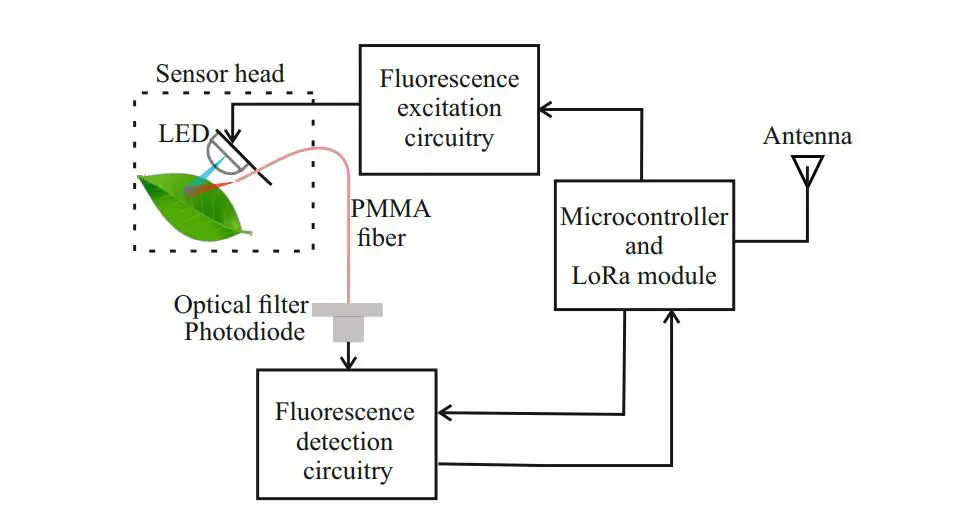
Understanding the efficiency of photosynthesis is crucial for monitoring plant health and productivity, yet current methods often rely on expensive and cumbersome equipment. Samaneh Baghbani, Uygar Akkoc, and Clara Stock, from the Department of Microsystems Engineering at the University of Freiburg, alongside Christiane Werner and Stefan J. Rupitsch, have developed a low-cost, autonomous chlorophyll fluorometer that overcomes these limitations. This innovative device measures the efficiency of Photosystem II, a key indicator of photosynthetic performance, with remarkable accuracy comparable to commercial instruments, as demonstrated by a strong correlation in tests across multiple plant species. The prototype, costing approximately 150 EUR and weighing just 50 grams, promises to enable large-scale, in-situ monitoring of plant health in diverse environments, offering a significant advancement in plant physiology research and ecological monitoring.
Low-Cost Wireless Chlorophyll Fluorescence Monitoring
This research details the development and validation of a low-cost, autonomous, and wireless chlorophyll fluorometer designed for long-term ecosystem monitoring. The device enables widespread, continuous monitoring of photosynthetic performance in plants, particularly within complex ecosystems, and addresses the limitations of existing, often expensive and cumbersome, instruments. Key features include low cost, autonomous operation, wireless data transmission, and suitability for long-term data collection in field settings. The device integrates into larger sensor networks for comprehensive ecosystem monitoring as part of the Ecosense project, offering a promising solution for comprehensive and affordable ecosystem monitoring and plant physiological studies, providing valuable insights into the complex interactions between plants and their environment.
Compact PAM Fluorometer for Plant Monitoring
Scientists developed a novel autonomous PAM fluorometer to overcome limitations in existing technologies for monitoring plant photosynthetic performance, particularly for large-scale deployments in challenging environments. The study pioneered a low-cost, high-accuracy instrument, achieving a unit cost below 150 EUR with dimensions of 3cm x 6cm x 2cm and a weight of approximately 50g, facilitating scalable field deployment and enabling continuous monitoring of plant physiological responses. The instrument relies on the principle of pulse-amplitude modulation fluorometry, employing short, modulated flashes of measuring light to separate weak chlorophyll fluorescence signals from strong ambient light. The team engineered a system that delivers measuring light pulses lasting only a few microseconds, maintaining low frequency while achieving relatively high intensity, avoiding alterations to the leaf’s physiological state while capturing sufficient signal for analysis.
Low-Cost Sensor Matches Commercial Fluorescence Measurements
This work presents a new autonomous chlorophyll fluorescence measurement system designed for detailed plant health monitoring, achieving high performance at a significantly reduced cost. The prototype device measures just 3cm x 6cm x 2cm, weighs approximately 50g, and costs around 150 EUR to construct. Validation experiments directly compared the developed sensor against a state-of-the-art commercial instrument, the Micro-PAM, across three plant species, sycamore maple, cherry laurel, and European beech, demonstrating a strong correlation with a correlation coefficient of R^2 = 0. 95 achieved when combining all measurements across species and light intensities. The team meticulously assessed the accuracy of the new sensor by measuring the quantum yield efficiency of photosystem II (PhiPSII) under varying light conditions, closely matching the performance of the commercial instrument and reproducing both the shape and magnitude of the light response curves. Measurements were repeatable across a batch of 20 sensors under controlled conditions, confirming that the new sensor reliably reproduces light response curves across different plant species and provides accurate measurements of chlorophyll fluorescence, opening possibilities for large-scale deployment in forest canopies and other challenging environments.
Compact Fluorometer Monitors Photosynthetic Efficiency Reliably
This work details the development and validation of a low-cost, compact autonomous PAM fluorometer for real-time monitoring of photosynthetic efficiency in natural environments. The prototype, measuring just 3cm x 6cm x 2cm and weighing 50g, offers a scalable and lightweight solution for deployment in ecosystems such as forests. The device accurately measures photosystem II yield efficiency, a key indicator of plant health and stress, using a single LED that alternates between measuring and saturating light modes. Measurements obtained with the new fluorometer demonstrate strong correlation with those from state-of-the-art commercial instruments. Ongoing work focuses on determining whether individual sensors require calibration factors and how these should be applied, acknowledging that long-term performance and environmental influences require further study. A batch of 20 sensors is currently deployed in a forest environment alongside existing instruments, enabling continuous monitoring of photosynthetic efficiency throughout the growing season and providing valuable data on sensor durability and stability under natural conditions.
🗞 Development of a Low-Cost, Autonomous Pulse Amplitude Modulated (PAM) Chlorophyll Fluorometer for In-Situ Monitoring of Photosystem II Efficiency
🧠 ArXiv: https://arxiv.org/abs/2511.13580