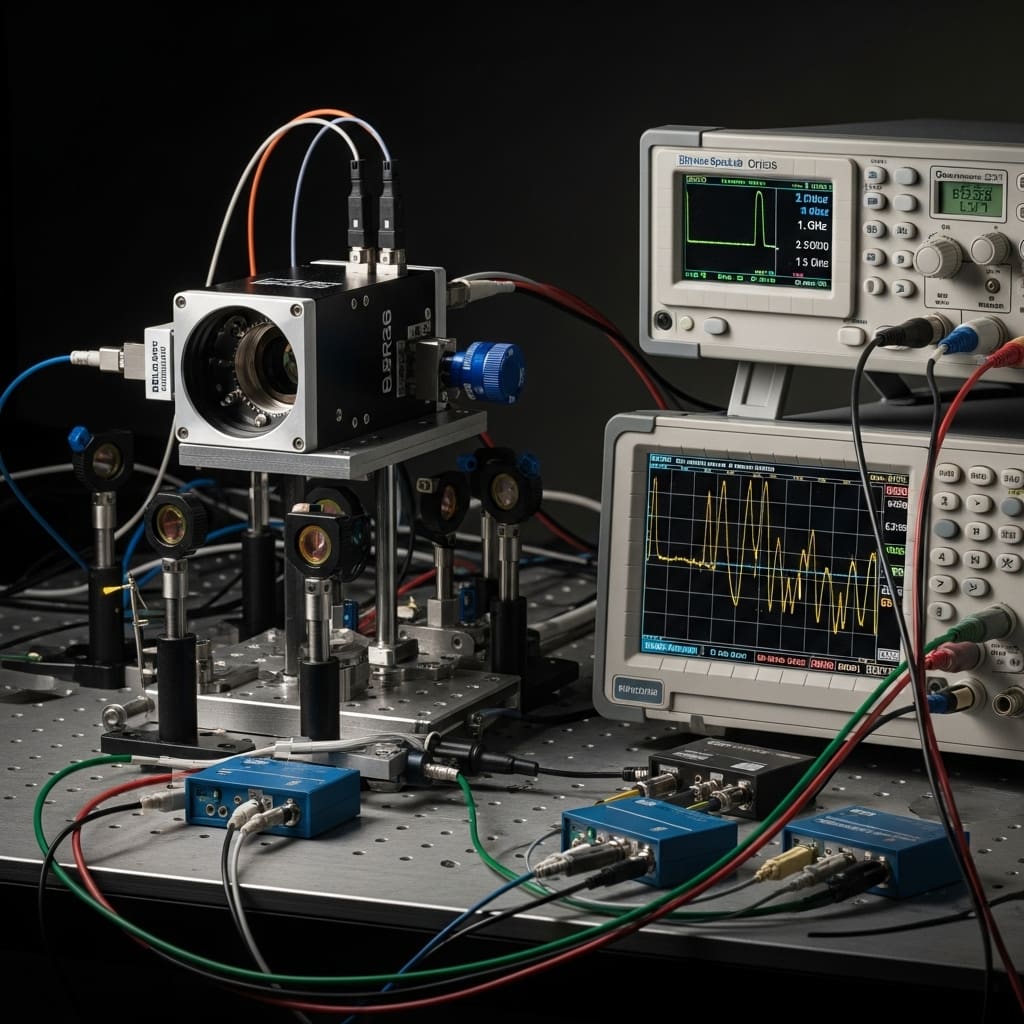
Detecting incredibly fast events, those occurring in fractions of a picosecond, remains a central challenge in modern optics and photonics. Amr Farrag, Assegid M. Flatae, and colleagues from the University of Siegen, alongside researchers from Alfred University, the European Laboratory for Non-Linear Spectroscopy, and Università di Parma, now demonstrate a significant advance in this field. The team developed an ultrafast optical Kerr gate, a technique for measuring these fleeting phenomena, that operates at an impressive 1GHz repetition rate using bismuth borosilicate glass. This new scheme achieves a time resolution of just 175 femtoseconds with exceptionally low pulse energy, promising a substantial improvement in the efficiency and speed of probing ultrafast dynamics, particularly for single-photon detection, and opening new avenues for research in areas like materials science and nanophotonics.
Bismuth Glass Enables Ultrafast Photon Detection
This research details the development and characterization of an ultrafast single-photon detection system utilizing bismuth-based glass and a technique called optical Kerr gating. The team explored optical Kerr gates, a nonlinear optical method, to create a fast and efficient detector for single photons, crucial for applications demanding high temporal resolution. They employed a bismuth-based glass, composed of bismuth oxide, boron oxide, and silicon dioxide, due to its strong nonlinear optical properties and exceptionally fast response time. The researchers achieved high repetition rates for single-photon detection, overcoming limitations of traditional methods, and meticulously characterized the glass’s nonlinear optical properties and optimized the entire setup. This method addresses the limitations of existing time-resolved techniques, which typically analyze ensembles rather than individual emitters. The team specifically selected bismuth borosilicate glass for its high nonlinear coefficient, enabling enhanced detection efficiency and a sub-picosecond response time while ensuring compatibility with standard microscopy platforms. This approach offers a robust platform for investigating ultrafast processes at the level of individual light emitters, with potential applications in diverse fields including single-photon detection, quantum information processing, high-speed optical switching, and time-resolved spectroscopy within nanophotonic and biological systems.
Bismuth Glass Enables 175 Femtosecond Ultrafast Detection
Scientists have achieved ultrafast detection capabilities using bismuth borosilicate glass, a material demonstrating exceptional nonlinear optical properties. The work centers on an optical Kerr gating technique, enabling the probing of dynamics on sub-picosecond timescales with a remarkable time resolution of 175 femtoseconds. Measurements confirm high transparency in both the visible and near-infrared regions, essential for efficient light transmission. The experimental setup utilizes a tunable ultrafast laser system operating at a 1 gigahertz repetition rate, delivering pulses with durations less than 80 femtoseconds and an average power of 2.
1 Watts at 800 nanometers. The nonlinear refractive index of the glass was estimated, and the nonlinear response time was measured to be below 90 femtoseconds, significantly faster than other commonly used materials. These results confirm bismuth borosilicate glass as a superior Kerr medium for ultrafast optical applications, delivering exceptional temporal resolution and enabling the detection of extremely rapid processes.
Bismuth Glass Enables Ultrafast Light Detection
This work demonstrates a new ultrafast detection scheme based on the nonlinear optical properties of bismuth borosilicate glass. Researchers achieved a time resolution of 175 femtoseconds, operating at a 1 gigahertz repetition rate with minimal pulse energy. The team selected bismuth borosilicate glass due to its strong nonlinear response, rapid reaction time, and compatibility with existing microscopy techniques. The authors acknowledge that the observed response is likely due to third-order nonlinearity, and while two-photon absorption is unlikely under their conditions, it cannot be entirely excluded. Future research may focus on further refining the technique and exploring its capabilities in specific applications.
👉 More information
🗞 Ultrafast optical Kerr Gate at 1 GHz repetition rate by focusing on BBS glass
🧠 ArXiv: https://arxiv.org/abs/2511.17493