Heat engines typically rely on temperature differences to generate power, but researchers are now exploring novel approaches using quantum systems and light. Aritra Ghosh, Nilamoni Daloi, and M. Bhattacharya from the Rochester Institute of Technology demonstrate a theoretical design for a heat engine that harnesses the unique properties of superfluid atoms and twisted light. Their work reveals how manipulating the angular momentum of light within a specially designed cavity allows precise control over the engine’s operation and efficiency. This innovative approach establishes a new pathway for building microscopic heat engines, potentially paving the way for advanced quantum technologies and offering a deeper understanding of energy conversion at the nanoscale.
Light-Driven Quantum Heat Engine with Bose-Einstein Condensates
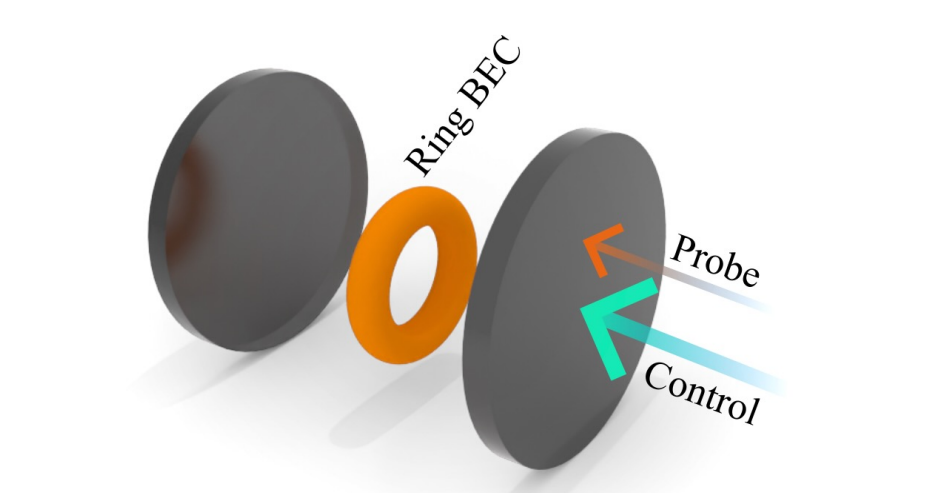
Researchers propose a novel quantum heat engine that utilizes a ring-shaped Bose-Einstein condensate trapped within an optical cavity. This engine operates by controlling the condensate with twisted light, specifically manipulating its orbital angular momentum. The team demonstrates that carefully tuning the light within the cavity alters the way the condensate interacts with its surroundings, creating conditions for converting thermal energy into mechanical work. This process relies on the unique properties of the superfluid condensate and the way it responds to the angular momentum of the light, driving a circulating flow within the system.
The theoretical analysis reveals that the engine’s power output and efficiency are strongly influenced by the characteristics of the light and the condensate itself, offering opportunities for optimisation. Importantly, the engine can achieve performance exceeding the limits of classical heat engines under certain conditions, thanks to the quantum nature of the working substance and the superfluidity of the condensate. By switching between different excitation types, the engine can extract work from distinct thermal reservoirs, offering a versatile approach to energy conversion.
Ring BECs Controlled by Orbital Angular Momentum
This research investigates the intersection of ring-shaped Bose-Einstein condensates and cavity optomechanics, a powerful combination enabling precise control and measurement of the condensate’s properties. A central theme is the use of orbital angular momentum to manipulate and probe the ring condensate, providing a degree of freedom for controlling its state and extracting information. The ultimate goal is to explore the possibility of building quantum heat engines based on this system, aiming to understand how to extract work from the condensate by controlling its thermodynamic cycle. The ring geometry is crucial because it supports persistent currents, a hallmark of superfluidity, which are essential for the engine’s operation.
Researchers developed a comprehensive theoretical model describing the interaction between the condensate, the cavity field, and the orbital angular momentum beam. They employed quantum Langevin equations to account for noise and dissipation, and used numerical simulations to solve the equations of motion and obtain quantitative results. The simulations demonstrate that the orbital angular momentum beam effectively drives the rotation of the condensate, controlling the magnitude and direction of the persistent current. The cavity optomechanical interaction enhances the coupling between the beam and the condensate, leading to stronger control and more efficient energy transfer.
Orbital Angular Momentum Drives Quantum Engine Performance
This work presents a theoretical framework for quantum heat engines powered by a ring-shaped Bose-Einstein condensate within an optical cavity, demonstrating control through manipulation of the condensate’s orbital angular momentum. Researchers successfully showed that by tuning the properties of light within the cavity, they can switch between different excitation types, enabling work extraction governed by distinct thermal reservoirs. Analytical expressions for work and efficiency were derived, revealing how orbital angular momentum can be used to reconfigure engine performance. The team also addressed the challenges of operating engines in finite time, demonstrating that shortcuts to adiabaticity can maintain ideal efficiency levels despite incomplete thermalization.
Furthermore, a simplified analytical approach was developed for lower orbital angular momentum values, retaining the key physical principles of the full model while reducing complexity. The parameters explored in this study are within the reach of current experimental capabilities, suggesting a viable pathway towards programmable quantum heat engines. Future research could investigate the effects of measurement backaction and explore operation with engineered, non-thermal reservoirs, as well as explore non-equilibrium signatures within ring geometries, opening avenues for further advancements in this field.
🗞 Atomic-superfluid heat engines controlled by twisted light
🧠 ArXiv: https://arxiv.org/abs/2510.19821