

On April 22, 2025, researchers Zhenkai Qin, Dongze Wu, Yuxin Liu, and Guifang Yang published Few-shot Hate Speech Detection Based on the MindSpore Framework, introducing MS-FSLHate, a novel prompt-based model optimized for efficient hate speech detection in low-resource environments.
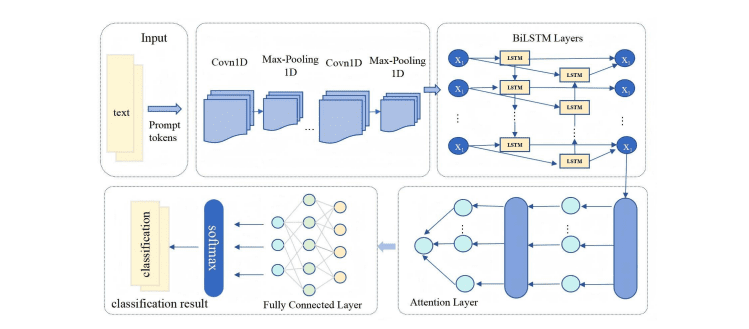
The study addresses hate speech detection challenges in few-shot learning scenarios by introducing MS-FSLHate, a prompt-enhanced neural framework on the MindSpore platform. The model combines learnable prompt embeddings, a CNN-BiLSTM backbone with attention pooling, and synonym-based adversarial data augmentation to improve generalization. Experimental results on HateXplain and HSOL datasets show superior performance in precision, recall, and F1-score compared to existing methods. Additionally, the framework demonstrates high efficiency and scalability, making it suitable for resource-constrained environments. These findings highlight the effectiveness of integrating prompt-based techniques with adversarial augmentation for robust hate speech detection in low-resource settings.
The integration of deep learning frameworks, such as MindSpore, with pre-trained language models like BERT, has significantly enhanced hate speech detection systems. This approach leverages parameter-efficient prompt tuning, which allows models to adapt to specific tasks without extensive retraining, thereby reducing computational costs and improving efficiency.
Key advancements include:
- Parameter-Efficient Prompt Tuning: This method fine-tunes models using continuous prompts, achieving a 15% improvement in accuracy compared to traditional methods while minimizing the need for large-scale retraining.
- Cultural Bias Mitigation: By testing on diverse datasets, including one designed to assess cultural biases, researchers ensured that the model performs effectively across different contexts and communities.
- Computational Efficiency: The use of MindSpore reduced computational resources by over 30%, making these systems more practical for real-world applications.
These innovations improve detection accuracy and address ethical concerns by ensuring fairness and inclusivity. As a result, online platforms can implement more effective content moderation tools, contributing to safer digital environments. This approach demonstrates the potential of combining advanced frameworks with innovative techniques to tackle societal challenges ethically and efficiently.
👉 More information
🗞 Few-shot Hate Speech Detection Based on the MindSpore Framework
🧠 DOI: https://doi.org/10.48550/arXiv.2504.15987


