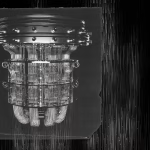
Launched on 26 July from Kourou, French Guiana, the MicroCarb satellite will observe carbon dioxide flow from both natural and anthropogenic sources at an altitude of 650km. Developed through collaboration between the UK Space Agency, France’s CNES, and the National Centre for Earth Observation, the mission utilises novel technology to map atmospheric CO₂ emissions across urban areas, providing a level of detail previously unattainable. Researchers at the University of Edinburgh will translate the satellite’s data into publicly accessible maps, aiding verification of climate targets and informing carbon reduction policies, with initial data expected in mid-2026. MicroCarb will also monitor natural carbon sinks, such as forests and oceans, and measure Solar Induced Fluorescence to differentiate plant absorption from man-made emissions, contributing to improved national carbon inventories.
In a significant leap forward for climate science, Europe’s first satellite dedicated to monitoring urban carbon dioxide () has successfully begun its mission. The satellite, named MicroCarb, lifted off from French Guiana last Saturday, July 26th, marking a pivotal moment in the global effort to combat climate change. This groundbreaking initiative, a close collaboration between the United Kingdom and France, promises to deliver data with a level of accuracy and detail never before seen, providing a powerful new tool for holding nations accountable to their climate pledges.
At the heart of the MicroCarb mission is its revolutionary city-scanning technology. Orbiting 650km above the Earth, the probe is specifically designed to focus on the planet’s most significant sources of emissions: its cities. Given that urban areas are responsible for more than 70 percent of global emissions, understanding their precise carbon footprint is critical. MicroCarb will map the flow of carbon dioxide across sprawling metropolises like London and Paris, distinguishing between man-made sources and the natural carbon cycle. This unprecedented clarity is expected to transform how governments and scientists approach urban climate strategy.
The raw data from space, however, is only the first step. Researchers from the University of Edinburgh are set to play a crucial role in translating MicroCarb’s observations into tangible, publicly accessible maps of carbon emissions and absorption. This vital work will empower governments with the verifiable information needed to track their progress towards goals like the Paris Agreement. By providing a clear, unbiased picture of emission levels, the mission will directly support the development of effective net-zero policies and help identify new opportunities for carbon reduction.
Beyond the world’s urban centers, MicroCarb will also turn its gaze toward the planet’s vast natural carbon sinks, such as forests and oceans. To enhance this understanding, the satellite will measure Solar Induced Fluorescence (SIF), a faint glow emitted by plants during photosynthesis. Tracking SIF helps scientists quantify how much carbon is being absorbed by vegetation, offering deeper insights into the global carbon cycle and helping to differentiate plant activity from man-made emissions. This dual capability—monitoring both sources and sinks—will provide a more complete picture of our planet’s climate health.
Backed by a £15 million investment from the UK Space Agency, the MicroCarb mission is a testament to the power of international collaboration and a major boost to Britain’s leadership in space and climate science. As part of an international “virtual constellation” of greenhouse gas satellites, it will reinvigorate global monitoring capabilities. While the first data is not expected until mid-2026, the successful launch represents a critical step toward a future of transparent, data-driven climate action, ensuring our eyes in the sky can help protect our future on the ground.
More information
External Link: Click Here For More