Recent advances in 3D reconstruction are transforming Earth observation, and a new method called EOGS++ represents a significant step forward. Pierrick Bournez, Luca Savant Aira, and Thibaud Ehret, along with Gabriele Facciolo and colleagues, developed this innovative technique that builds upon existing Gaussian Splatting approaches to create detailed 3D models from satellite imagery. EOGS++ uniquely processes raw, high-resolution data directly, eliminating the need for complex pre-processing steps and streamlining the reconstruction process. The team also integrated camera refinement directly into the training process, resulting in more accurate models and sharper reconstructions, and demonstrated substantial improvements in reconstruction quality and efficiency compared to existing methods on benchmark datasets, achieving notably lower error rates in modelling buildings.
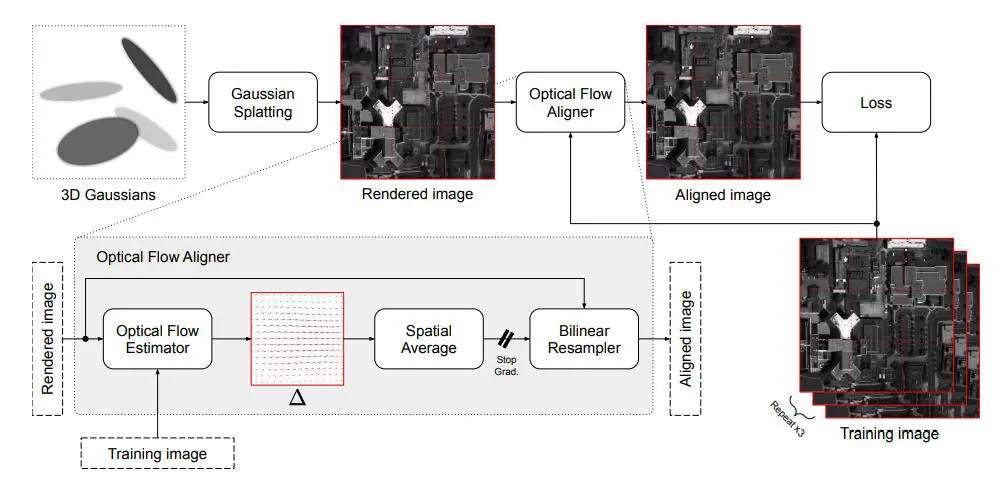
Splatting presents a compelling alternative to Neural Radiance Fields (NeRF) for Earth observation, delivering competitive reconstruction quality with significantly reduced training times. This work extends the Earth Observation Gaussian Splatting (EOGS) framework to propose EOGS++, a novel method tailored for satellite imagery that directly operates on raw, high-resolution panchromatic data, bypassing the need for external preprocessing. Leveraging optical flow techniques, the researchers embed bundle adjustment directly within the training process, refining camera pose estimation and avoiding reliance on external optimisation tools. The team also incorporated several improvements to the original implementation, enhancing overall performance.
Raw Satellite Data, Integrated Bundle Adjustment
Scientists developed EOGS++, a novel framework for 3D reconstruction from satellite imagery, extending the capabilities of EOGS while eliminating dependencies on external preprocessing steps. This work directly processes raw, high-resolution panchromatic data, removing the need for pansharpening typically required in photogrammetric workflows. The team engineered an internal bundle adjustment technique, utilizing optical flow to refine camera localization and correct errors during training, thus avoiding separate optimization tools. This innovative approach embeds camera pose estimation directly into the reconstruction pipeline, enhancing both accuracy and efficiency.
To further improve reconstruction quality, scientists incorporated an early stopping mechanism, halting training when performance plateaus, and implemented a truncated signed distance function-based post-processing operation to refine the final 3D model. The study pioneers the use of these combined techniques to achieve sharper reconstructions and improved geometric accuracy, particularly in complex Earth observation scenarios. Experiments employed the IARPA 2016 and DFC2019 datasets to rigorously evaluate the performance of EOGS++. Results demonstrate that EOGS++ achieves state-of-the-art performance, surpassing both the original EOGS method and other NeRF-based techniques while maintaining the computational advantages of Gaussian Splatting.
Specifically, the model demonstrates a significant improvement in building reconstruction, reducing mean absolute errors from 1. 33 to 1. 19 compared to the original EOGS models. This advancement stems from the integrated bundle adjustment and direct processing of raw panchromatic data, allowing for more precise camera localization and a more detailed representation of the Earth’s surface. The team’s methodology provides a streamlined and efficient solution for 3D reconstruction, enabling more accurate and detailed mapping of our planet.
D Reconstruction From Raw Satellite Imagery
Researchers have developed EOGS++, an enhanced framework for 3D reconstruction from satellite imagery using Gaussian Splatting. Building upon previous work, this new method eliminates the need for external preprocessing steps such as image pansharpening and separate bundle adjustment, instead integrating pose refinement directly into the training process and operating directly on raw panchromatic imagery. Additional improvements, including opacity resetting, early stopping, and post-processing with TSDF techniques, further enhance reconstruction sharpness and geometric accuracy. Experiments conducted on the IARPA 2016 and DFC2019 datasets demonstrate that EOGS++ achieves state-of-the-art reconstruction accuracy, surpassing existing methods. The framework consistently improves upon previous approaches, achieving a reduction in mean absolute error for building reconstructions. While challenges remain in accurately capturing fine vegetation structures, the team acknowledges that performance is somewhat dependent on input data quality, with reconstructions from raw panchromatic imagery exhibiting slightly higher error rates than those derived from pansharpened data.
EOGS++ Achieves Accurate 3D Satellite Reconstruction
The research team developed EOGS++, a novel framework for 3D reconstruction from satellite imagery, achieving significant improvements over existing methods. This work extends the Earth Observation Gaussian Splatting (EOGS) framework to directly process raw, high-resolution panchromatic data, eliminating the need for time-consuming preprocessing steps like pansharpening. Experiments demonstrate that EOGS++ achieves state-of-the-art performance in both reconstruction quality and efficiency, surpassing the original EOGS method and other Neural Radiance Field (NeRF)-based techniques. A key innovation is the integration of bundle adjustment directly within the training process, utilizing optical flow techniques to refine camera pose estimation and correct localization errors.
This internal bundle adjustment enhances the accuracy of the 3D reconstructions by minimizing reprojection errors and improving geometric consistency. Furthermore, the team introduced early stopping and truncated signed distance function (TSDF) post-processing, resulting in sharper reconstructions and improved geometric accuracy. Quantitative results on the IARPA 2016 and DFC2019 datasets reveal a substantial reduction in mean absolute error for building reconstructions, improving from 1. 33 to 1. 19 compared to the original EOGS models. This demonstrates a measurable advancement in the precision of 3D models generated from satellite data. By eliminating preprocessing and integrating pose refinement, EOGS++ delivers a streamlined and highly accurate solution for generating detailed 3D representations of the Earth’s surface.
🗞 EOGS++: Earth Observation Gaussian Splatting with Internal Camera Refinement and Direct Panchromatic Rendering
🧠 ArXiv: https://arxiv.org/abs/2511.16542