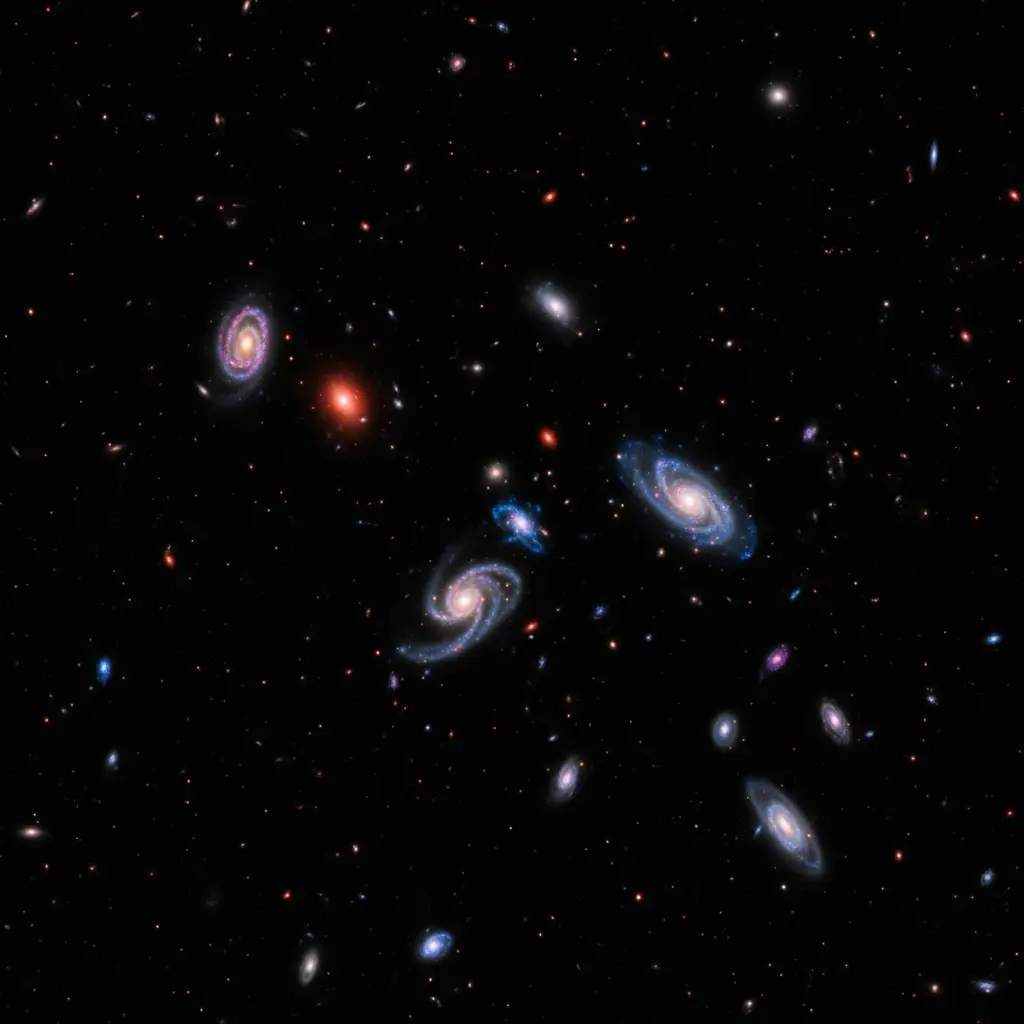
The early Universe is yielding its secrets thanks to a powerful combination of the Atacama Large Millimeter/submillimeter Array and the James Webb Space Telescope. Rodrigo Herrera-Camus of UDEC, alongside Natascha Förster Schreiber, Livia Vallini, Rychard Bouwens et al., have been at the forefront of this revolution, investigating the formation and evolution of galaxies in the cosmos’s infancy. Their work provides unprecedented spatially resolved insights into the gas, dust and stars of these distant objects, revealing intricate details of their internal workings. This research is significant because it is fundamentally reshaping our understanding of how galaxies first assembled and began to form stars during the first billion years of cosmic history.
Scientists are now able to observe high-redshift galaxies at unprecedented spatial resolutions, revealing intricate details of their interstellar medium, internal motions, overall structure, and the activity of supermassive black holes at their cores. This breakthrough stems from the synergistic capabilities of these two observatories, allowing for a comprehensive multi-wavelength view of gas, dust, and stars extending back to the first galaxies in the Universe. Over the past three years, ALMA and JWST have provided an unparalleled view of galaxies, pushing the boundaries of observation to the very first luminous structures.
Where multi-wavelength studies were previously limited to nearby galaxies, researchers can now directly probe the earliest stages of galaxy formation at redshifts of z≈10 and beyond. This capability allows them to address fundamental questions regarding the physical conditions of these primordial galaxies, the speed and mechanisms of heavy element production, and the role of energetic feedback processes in regulating star formation and chemical enrichment. An international workshop held in December 2024 brought together experts to examine recent progress and chart a course for future research. The research focuses on the interstellar medium, galaxy kinematics and structure, and the influence of outflows and active galactic nuclei.
Observations reveal a complex interplay between stellar radiation, ionized gas, neutral gas, molecular clouds, and interstellar dust, including polycyclic aromatic hydrocarbons. Surprisingly, substantial dust reservoirs have been detected in systems dating back to when the universe was only 600 million years old, at a redshift of z≈8, challenging existing theories of dust formation and prompting a re-evaluation of production mechanisms in supernova ejecta and within the interstellar medium. JWST measurements of ultraviolet/optical attenuation curves in galaxies at z≈7, including the characteristic 2175 Å bump, demonstrate the rapid emergence of carbonaceous grains and the efficiency of early dust production. The direct detection of the 3.3μm PAH feature in a dusty star-forming galaxy at z≈4 further supports this picture.
Simultaneously, JWST and ALMA are illuminating the timeline of heavy element enrichment, with the detection of CIII] and CIV UV emission lines in galaxies just 350 million years after the Big Bang (z≈12) suggesting carbon formed much earlier than previously thought, potentially as one of the first metals to appear in the universe.
ALMA and JWST Reveal Early Galaxy Metallicities
The study harnessed the combined power of ALMA and JWST to investigate galaxy formation and evolution within the first billion years of cosmic history. Researchers employed ALMA to detect far-infrared emission lines, specifically focusing on [C II] 158μm and [O III] 88μm transitions, crucial for understanding the cold neutral interstellar medium. Large ALMA programs, including ALPINE, CRISTAL, and REBELS, were instrumental in measuring these lines in massive star-forming galaxies at redshifts of 4 and 8.
Scientists developed a methodology utilizing JWST/NIRSpec to derive metallicities up to redshift 10 via the ‘direct-Te’ method, employing faint auroral emission lines. This approach enables new calibrations for strong-line diagnostics, vital for future large spectroscopic surveys, though the study acknowledges potential underestimation of metallicities due to limitations in tracing low-density gas. Further analysis combined optical lines ([O II] and [O III]) with far-infrared lines to refine these metallicity measurements and account for variations in gas density.
To constrain dust and metal properties, the research team leveraged ALMA’s high-frequency bands (8, 10) to sample the peak of the dust spectral energy distribution, reducing uncertainties in dust temperature and infrared luminosity. Cosmological zoom-in simulations, such as the SERRA suite, were employed to predict key line ratios on sub-galactic scales, guiding the interpretation of observed interstellar medium properties. These simulations achieve resolutions down to approximately 10 parsecs in both the rest-frame optical/UV and far-infrared wavelengths.
The study pioneered multi-line observations, combining far-infrared tracers with UV/optical indicators like the [C III]/[C II] ratio to assess starburst activity, though currently limited to luminous or lensed galaxies. Ongoing efforts, including the ALMA Large Program PHOENIX, aim to expand these observations to bright systems at redshifts greater than 8, promising a more comprehensive understanding of the high-redshift interstellar medium and its evolution. Researchers are also investigating the molecular gas reservoir, acknowledging the challenges posed by low metallicities and the limitations of CO line detection at high redshift.
Early Galaxies Show Metal Enrichment and Star Formation
Recent collaborative work leveraging ALMA and JWST is fundamentally reshaping our understanding of galaxy formation and evolution within the first billion years of cosmic history. Scientists achieved spatially resolved observations of high-redshift galaxies, revealing intricate details of their interstellar medium, kinematics, and star formation activity. Experiments revealed the detection of far-infrared [O III] emission in a galaxy at redshift 8.312, indicating early metal enrichment during the reionization era.
Data shows that observations of galaxies at redshift 7 demonstrate a dust-obscured cosmic star formation rate density, furthering insights into the conditions of luminous galaxies in the early universe. The team measured carbonaceous dust grains present within the first billion years, a discovery made possible through detailed analysis of galactic emissions. Tests prove the existence of spatial variations in aromatic hydrocarbon emission within dust-rich galaxies, providing clues about the complex chemical processes occurring in these early structures.
Measurements confirm carbon enrichment occurring just 350 million years after the Big Bang, as observed in JADES galaxies. Further investigations utilising JWST NIRSpec spectroscopy have identified a galaxy, GHZ2/GLASS-z12, at redshift 12.34, offering unprecedented spectral data from an incredibly distant source. Scientists recorded an electron density evolution from redshift 0 to 9, utilising JWST/NIRSpec spectra and line-spread function determinations.
The ALPINE-ALMA [CII] survey has provided comprehensive data processing, catalogs, and statistical source properties, allowing for detailed analysis of physical conditions and the origins of [CII] halos. Researchers have also begun to explore the gas, dust, and stars in star-forming galaxies approximately one billion years after the Big Bang, through the ALMA-CRISTAL survey. These combined efforts are paving the way for future research requiring enhanced angular resolution and sensitivity, motivating upgrades to current instruments and the development of next-generation observatories.
Early Galaxies Revealed by ALMA and JWST
Recent observations with ALMA and JWST are fundamentally reshaping our understanding of galaxy formation and evolution in the early Universe. These instruments allow researchers to examine the gas, dust, and stars within high-redshift galaxies with unprecedented spatial resolution, revealing details of their internal structure and activity. This detailed analysis extends to the interstellar medium, galactic kinematics, morphology, and the processes of star formation and active.