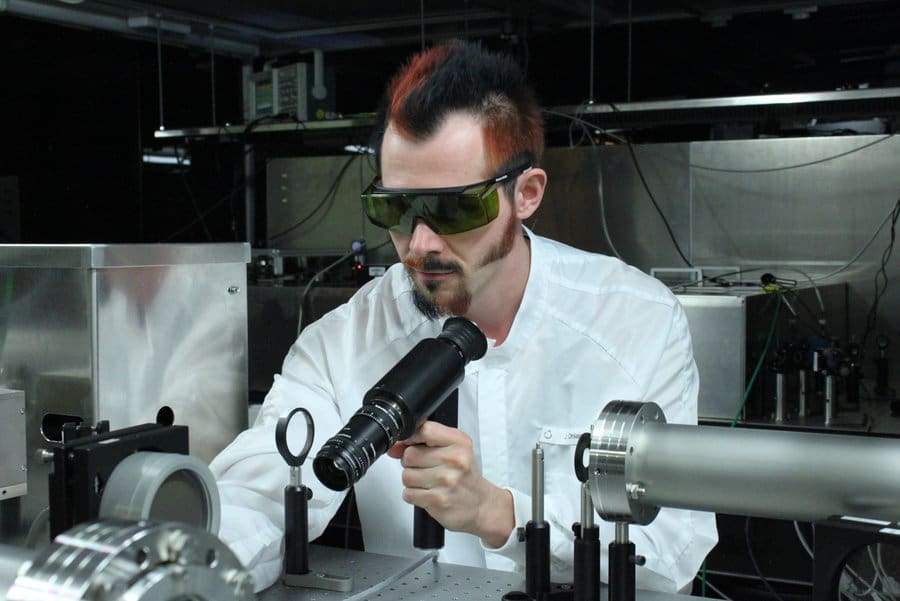
€2.8m Funding to Advance Adaptive Laser Technology for Inertial Fusion Energy

Effective June 1st, 2025, Dr. Jonas Ohland of GSI/FAIR will lead the ALADIN (Adaptive Laser Architecture Development and INtegration) young investigator group, receiving €2.8 million over five years from the German Federal Ministry of Research, Technology and Space via the Fusionstalente program. The project focuses on developing an Adaptive Laser Architecture to improve the control and scalability of high-power lasers for use in inertial confinement fusion, a method of achieving nuclear fusion by compressing and heating fuel capsules with intense energy input. ALADIN will collaborate with Focused Energy GmbH and other institutions, with a long-term goal of establishing an open research community and facilitating industrial application of the technology, potentially benefiting both fusion research and wider high-power laser applications.

The text consists predominantly of the articles ‘the’ and ‘this’. This repetition likely serves as a test of a language model’s capacity to process redundant input and identify patterns within it. The purpose may be to evaluate the model’s resilience when confronted with a large volume of identical words without experiencing operational failure or becoming stalled.

Furthermore, the exercise assesses the model’s ability to discern the repetitive structure of the text. It tests whether the model attempts to derive meaning from the repetition or simply disregards it as irrelevant data. The analysis reveals a deliberate construction designed to challenge a system’s handling of non-semantic content.

More information
External Link: Click Here For More

The Quantum Mechanic

The Quantum Mechanic

The Quantum Mechanic is the journalist who covers quantum computing like a master mechanic diagnosing engine trouble - methodical, skeptical, and completely unimpressed by shiny marketing materials. They're the writer who asks the questions everyone else is afraid to ask: "But does it actually work?" and "What happens when it breaks?" While other tech journalists get distracted by funding announcements and breakthrough claims, the Quantum Mechanic is the one digging into the technical specs, talking to the engineers who actually build these things, and figuring out what's really happening under the hood of all these quantum computing companies. They write with the practical wisdom of someone who knows that impressive demos and real-world reliability are two very different things. The Quantum Mechanic approaches every quantum computing story with a mechanic's mindset: show me the diagnostics, explain the failure modes, and don't tell me it's revolutionary until I see it running consistently for more than a week. They're your guide to the nuts-and-bolts reality of quantum computing - because someone needs to ask whether the emperor's quantum computer is actually wearing any clothes.

Latest Posts by The Quantum Mechanic:

Top 20 Quantum Internet Terms You Need to Know

Top 20 Quantum Internet Terms You Need to Know

February 17, 2026
Light-Based Computing Takes Step Towards Efficiency with Stable Lithium Niobate Tuning

Light-Based Computing Takes Step Towards Efficiency with Stable Lithium Niobate Tuning

February 11, 2026
IQM Quantum Model Avoids ‘Barren Plateaus’ Hindering Progress Towards Useful Computers

IQM Quantum Model Avoids ‘Barren Plateaus’ Hindering Progress Towards Useful Computers

February 11, 2026