

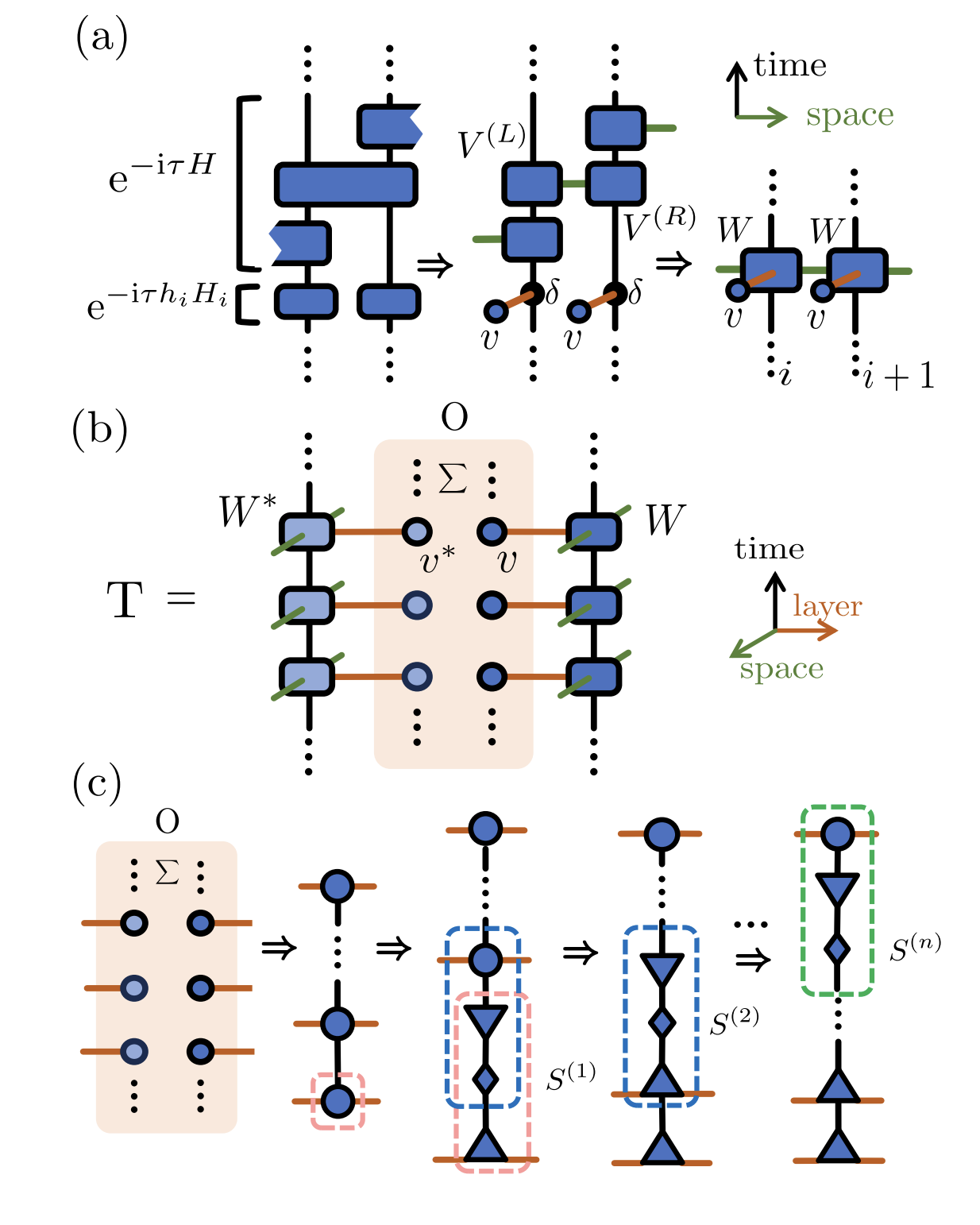
Understanding the behaviour of complex quantum systems, particularly those with inherent disorder, presents a significant challenge for physicists. Hao Zhu from Beihang University, Ding-Zu Wang from Singapore University of Technology and Design, Shi-Ju Ran from Capital Normal University, and Guo-Feng Zhang from Beihang University, have developed a new approach to tackle this problem, called the statistics-encoded tensor network (SeTN). This method restores a crucial symmetry, translational invariance, by cleverly encoding disorder into an additional layer, allowing researchers to accurately simulate these complex systems. The team’s work establishes a clear relationship between the necessary resolution of simulations, the strength of the disorder, and the length of time the system evolves, offering a powerful tool for investigating disorder-driven dynamics in quantum materials and potentially unlocking new insights into chaotic behaviour.
Researchers propose a new approach, the statistics-encoded tensor network (SeTN), to study these complex systems. This method efficiently encodes disorder into an auxiliary layer and, crucially, restores translational invariance, allowing for a well-defined transfer matrix formulation. The team derived a universal criterion linking discretization, disorder strength, and evolution duration, establishing the resolution needed for accurate disorder averaging and demonstrating optimal efficiency in weakly disordered, chaotic regimes.
Transfer Matrix Calculations for Spectral Properties
This document provides a detailed exploration of the methods and theoretical foundations behind research on quantum chaos and the disordered transverse-field Ising model. The focus lies on the numerical techniques used to study spectral properties, particularly the transfer matrix approach and its efficient implementation using tensor networks. Matrix Product States and Tensor Networks represent the variational state and the transfer matrix, while Density Matrix Renormalization Group (DMRG) finds the leading eigenvalues of the transfer matrix, addressing challenges posed by its non-Hermitian nature with an eigenvalue tracking scheme. The document details how the transfer matrix is applied to vectors without explicitly forming the full matrix, leveraging the structure of the model and the factorization of interaction terms, crucial for computational efficiency.
The research demonstrates the power of tensor networks and DMRG for studying quantum chaotic systems, with optimizations essential for tackling larger systems and longer times. The level of detail provided makes the research highly reproducible and extensible, validating the theoretical framework. Further exploration could involve analyzing the scaling of computational cost, comparing results with other methods, extending the approach to other models, and investigating the near-degeneracies in the transfer matrix eigenvalues.
Statistics-Encoded Tensor Networks Reveal Quantum Chaos
Researchers developed a novel approach, the statistics-encoded tensor network (SeTN), to simulate dynamics in disordered systems, overcoming a fundamental challenge in physics. This method efficiently encodes disorder into an auxiliary layer and, crucially, restores translational invariance, allowing for a well-defined transfer matrix formulation. The team derived a universal criterion linking discretization, disorder strength, and evolution duration, establishing the resolution needed for accurate disorder averaging and demonstrating optimal efficiency in weakly disordered, chaotic regimes. Experiments reveal that the spectral form factor, a key indicator of quantum chaos, is governed by the leading eigenvalue of the transfer matrix when using SeTN, a result differing from observations in related systems.
Numerical investigations demonstrate excellent agreement between the predicted and observed singular value spectra, validating the analytic results and highlighting the efficiency of the SeTN method. Analysis of the coefficients governing singular value decay shows they decrease faster than exponentially but slower than Gaussian, and are well-approximated by a gamma-like function, further emphasizing SeTN’s effectiveness. Results show that SeTN reproduces converged results obtained from numerical integration, even at long times, and achieves greater accuracy than both disorder-averaged exact diagonalization and second-order perturbation theory. This breakthrough delivers a powerful new tool for probing disorder-driven dynamical phenomena in various physical systems and opens avenues for exploring complex quantum many-body problems.
Disorder Averaging with Tensor Networks Reveals Spectral Form
Researchers introduce the statistics-encoded tensor network (SeTN), a new approach for simulating the dynamics of disordered quantum systems. SeTN effectively restores spatial translational invariance by encoding disorder into an auxiliary layer and averaging separately, enabling accurate simulations even in the challenging, typically chaotic regime of weak disorder. The team derived a criterion linking discretization, disorder strength, and evolution duration, establishing the resolution needed for faithful disorder averaging and demonstrating the method’s efficiency. Applying SeTN to the disordered transverse-field Ising model, researchers found the spectral form factor is governed by the leading transfer-matrix eigenvalue, offering insights into the crossover to random-matrix-theory behaviour in disordered systems. Overall, SeTN provides a unifying framework for exploring the interplay between locality, unitarity, disorder, and chaos in time-independent many-body quantum systems. Future work could extend this approach to other disordered models and physical observables, including Rényi entropies and out-of-time-ordered correlators.
🗞 Statistics-encoded tensor network approach in disordered quantum many-body spin chains
🧠 ArXiv: https://arxiv.org/abs/2508.16286


