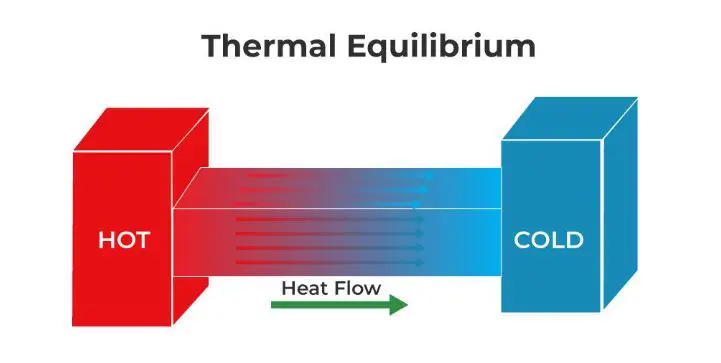
Gibbs states form the cornerstone of statistical mechanics, providing the standard way scientists describe thermal equilibrium, but their fundamental justification has long relied on assumptions made after the fact. Now, Vjosa Blakaj from the University of Copenhagen and the Max Planck Institute for the Science of Light, working with Matthias C. Caro from the University of Warwick and Anouar Kouraich and Michael M. Wolf from the Technical University of Munich, demonstrate that Gibbs states emerge directly from the principle of dynamical stability. The team proves that assuming a system remains stable, even when weakly connected to any environment, completely characterises these crucial states, removing the need for an additional assumption previously known as the “zeroth law”. This work builds upon earlier research, yet establishes a more robust foundation for understanding thermal equilibrium, showing that even a simple environment consisting of harmonic oscillators is enough to uniquely define Gibbs states as the only dynamically stable possibility.
Now, researchers demonstrate that Gibbs states emerge directly from the principle of dynamical stability. The team proves that assuming a system remains stable, even when weakly connected to any environment, completely characterises these crucial states, removing the need for an additional assumption previously known as the “zeroth law”. This work builds upon earlier research, establishing a more robust foundation for understanding thermal equilibrium, showing that even a simple environment consisting of harmonic oscillators is enough to uniquely define Gibbs states as the only dynamically stable possibility.,.
Stability Guarantees Thermal Equilibrium Without Zeroth Law
This work establishes a fundamental connection between dynamical stability and the emergence of Gibbs states, the standard description of thermal equilibrium in statistical mechanics. Researchers rigorously demonstrate that assuming a system’s stability, its resistance to change when weakly interacting with an environment, completely characterises Gibbs states, simplifying previous derivations. The study builds upon earlier research, conclusively proving that the previously assumed “zeroth law of thermodynamics” is unnecessary; stability of order two alone is sufficient to guarantee a system will evolve towards a Gibbs state. Scientists employed a sophisticated mathematical framework to analyze the stability of quantum systems, focusing on how they respond to small perturbations when coupled to an environment.
The core of the method involves demonstrating that if a system remains approximately stationary when interacting with any other system, it must be in a Gibbs state. Crucially, the team proved that an environment consisting solely of harmonic oscillators, fundamental building blocks of many physical systems, is sufficient to uniquely identify Gibbs states as the only dynamically stable states. This approach significantly streamlines the derivation of thermodynamics from first principles, eliminating the need for assumptions about multiple copies of the system or complex auxiliary systems.,.
Stability Defines Equilibrium in Statistical Mechanics
Scientists have demonstrated a fundamental connection between dynamical stability and the existence of Gibbs states, which are central to describing thermal equilibrium in statistical mechanics. The research establishes that Gibbs states are uniquely characterised by the inherent stability of a system and its interaction with an arbitrary environment, strengthening a previous result from 1986. This work proves that an additional assumption, previously considered necessary, is in fact redundant, simplifying the theoretical framework for understanding equilibrium. The team rigorously established conditions for the existence of Gibbs states, demonstrating that the Hamiltonian, the operator describing the system’s energy, must have energy levels that grow faster than logarithmic to ensure the mathematical validity of these states.
Specifically, the research confirms that for every inverse temperature, the trace of the exponential of the negative Hamiltonian must be finite, a condition met when energy levels increase sufficiently rapidly. This ensures the mathematical consistency of the statistical description of the system. Further investigation focused on the concept of dynamical stability, defining how a system maintains equilibrium when subjected to small perturbations or brought into contact with another system. Scientists defined increasingly stringent levels of stability, starting with first-order stability, which requires the system to remain largely unchanged under minor disturbances. They then extended this to second-order stability, which considers the system’s behavior when interacting with an auxiliary system, modeling thermal contact. The research conclusively shows that second-order stability alone is sufficient to guarantee that a state is a Gibbs state, removing the need for the previously assumed third-order stability.,.
Dynamical Stability Defines Thermal Equilibrium States
This research establishes a fundamental connection between dynamical stability and the emergence of Gibbs states, which are central to statistical mechanics and describe systems in thermal equilibrium. Scientists demonstrated that Gibbs states are uniquely characterised by the dynamical stability of a system and its interaction with an environment, strengthening a previous result from 1986. Importantly, this work proves that an additional assumption, previously known as the “zeroth law of thermodynamics”, is unnecessary; a simple environment composed of harmonic oscillators is sufficient to guarantee the emergence of Gibbs states as the only dynamically stable configuration. These findings provide a more streamlined and robust foundation for understanding how macroscopic thermodynamic behavior arises from the underlying microscopic dynamics of a system.
By removing the need for the previously assumed “zeroth law”, the research clarifies the minimal requirements for establishing thermal equilibrium. The authors acknowledge that their analysis focuses on specific conditions and that extending these results to more complex systems remains an area for future investigation. Further research could explore the implications of these findings for open quantum systems and non-equilibrium statistical mechanics, potentially offering new insights into the foundations of thermodynamics.
👉 More information
🗞 Gibbs state postulate from dynamical stability — Redundancy of the zeroth law
🧠 ArXiv: https://arxiv.org/abs/2512.13451