Researchers demonstrated a trainable dynamical mask, utilising existing high-speed communication technology, to enhance extreme learning machines. This approach alters system parameters during training, achieving improved performance in both regression and time series prediction tasks, offering an alternative to conventional software-based coefficient adjustments.
Optical computing, a paradigm shifting away from conventional electronic processors, leverages light to perform calculations, offering potential advantages in speed and energy efficiency. Researchers are now exploring methods to imbue these systems with learning capabilities without relying on traditional software-based training. A team from Aston University, comprising S. Bogdanov, E. Manuylovich, and S. K. Turitsyn, detail a novel approach in their paper, ‘Trainable dynamical masking for readout-free optical computing’, demonstrating how readily available telecommunications components can be configured to create a trainable ‘mask’ within an optical system, enabling machine learning tasks such as regression and time series prediction without the need for extensive post-processing or complex software algorithms.
Optical Computing with Telecom Components Demonstrates Machine Learning Capabilities
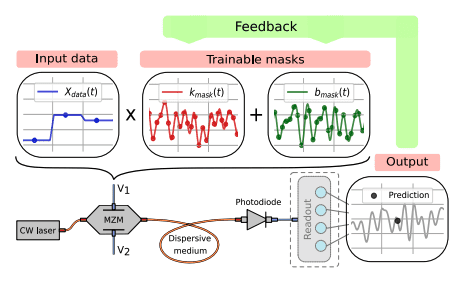
This research details a new approach to machine learning utilising the nonlinear characteristics of standard telecommunications components. Researchers demonstrate the feasibility of constructing a trainable dynamical system – a system whose state evolves over time – capable of mapping input signals into a high-dimensional feature space, employing a Mach-Zehnder Modulator (MZM) as the core computational element. This circumvents the need for extensive software-based parameter adjustments, instead relying on dynamic control of the optical system itself, potentially offering a cost-effective alternative to more complex photonic computing architectures.
The innovation centres on exploiting the inherent nonlinearities within the MZM – specifically effects such as Four-Wave Mixing and Self-Phase Modulation – to achieve this high-dimensional mapping. Four-Wave Mixing occurs when multiple optical frequencies interact within a nonlinear medium, generating new frequencies. Self-Phase Modulation alters the phase of light based on its intensity. Rather than functioning as a simple optical switch, the MZM operates as a dynamic reservoir, processing input signals through its nonlinear response. Researchers implement a trainable dynamical mask, effectively shaping the input signal and controlling the reservoir’s behaviour. This dynamic masking technique enhances system performance and allows adaptation to different computational tasks, offering a potentially more adaptable and efficient computational paradigm.
Experimental validation involved applying the system to several benchmark datasets. The team successfully predicted chaotic time series using the Mackey-Glass time series, a standard test for time series forecasting algorithms. They also demonstrated proficiency in regression tasks using the Yacht Hydrodynamics dataset, sourced from the UCI Machine Learning Repository, and a dataset designed for training artificial neural networks, confirming the system’s ability to perform complex computations and generalise across different problem domains.
This research establishes a pathway towards building practical optical computers using existing telecommunications infrastructure. By leveraging the nonlinearities of standard components like the MZM, researchers circumvent the need for specialised fabrication or materials. The demonstrated ability to perform machine learning tasks, including time series prediction and regression, highlights the potential of this approach for applications requiring fast and energy-efficient computation. Future investigations will focus on expanding the scope of datasets and tasks, and researchers plan to investigate the integration of more sophisticated input masking techniques and explore the potential of metamaterials for enhanced nonlinear mapping.
👉 More information
🗞 Trainable dynamical masking for readout-free optical computing
🧠 DOI: https://doi.org/10.48550/arXiv.2505.23464