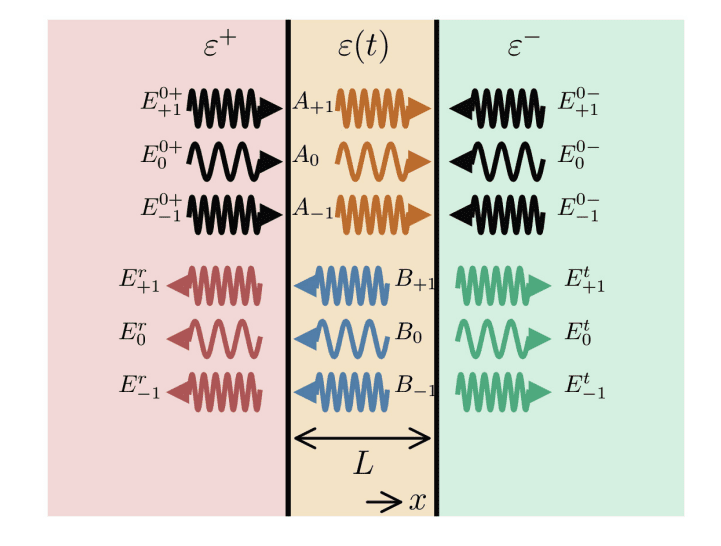
The manipulation of electromagnetic waves represents a cornerstone of modern technology, and recent research focuses on utilising time-varying materials to achieve dynamic control over these waves. This necessitates advanced theoretical frameworks capable of accurately predicting and modelling the behaviour of light within these complex systems. Benjamin Vial, from the Department of Mathematics at Imperial College London, and Richard V. Craster, jointly affiliated with Imperial College London and the CNRS, alongside colleagues, present a detailed analysis of this phenomenon in their article, “Quasinormal modes of Floquet media slabs”. They establish a theoretical foundation linking quasinormal modes – a mathematical tool used to describe the decay of disturbances in dissipative systems – with time-modulated metamaterials, paving the way for the design of optical devices with precisely tailored scattering characteristics.
Recent research establishes a robust framework for analysing electromagnetic wave interactions within time-modulated media, successfully bridging theoretical concepts of quasinormal modes (QNMs) and time-varying metamaterials. This work demonstrates the capacity to model and predict behaviour in systems where material properties change over time, offering a pathway toward dynamically controllable optical devices. The core achievement lies in formulating a QNM expansion that accurately captures resonant characteristics of these complex systems, paving the way for innovative designs.
The research presents a numerical methodology for solving eigenvalue problems encountered when modelling electromagnetic wave propagation in complex media, with a specific focus on non-Hermitian systems. These systems, characterised by gain and loss or open boundaries, necessitate specialised computational techniques to determine resonant frequencies and corresponding wave patterns accurately. Researchers employ the finite element method (FEM) to discretise the electromagnetic problem, dividing the physical domain into smaller elements and approximating the solution within each, thereby transforming the continuous problem into a discrete algebraic one.
The work establishes a framework linking quasinormal modes (QNMs) – intrinsic resonant states of a system – with time-varying metamaterials, artificial structures exhibiting properties not found in nature. Researchers utilise the Scalable Library for Eigenvalue Problem Computations (SLEPc) to solve the resulting matrix eigenvalue problem, facilitating the use of iterative solvers, such as Arnoldi iteration. Arnoldi iteration constructs a Krylov subspace, a vector space used to approximate eigenvalues. It incorporates restarting techniques to manage computational cost while maintaining precision, ensuring accurate results even with complex models.
The methodology centres on solving the nonlinear eigenvalue problem associated with slabs possessing time-periodic permittivity, a property describing a material’s response to electric fields. By establishing a QNM framework, the authors derive a QNM expansion that captures the resonant characteristics of the system, providing a reduced-order model for efficient simulation. This reduced-order model significantly enhances the efficiency of simulating scattered fields, providing insights into how modulation couples to resonant modes and enabling tailored gain-loss engineering.
Validation through numerical experiments confirms the accuracy and reliability of the QNM framework when applied to time-modulated systems, demonstrating the ability to engineer tailored excitations and selectively amplify or suppress specific modal contributions. This precise control over modal behaviour is crucial for applications requiring dynamic filtering, signal enhancement, or targeted energy delivery. The research highlights the potential for designing optical devices with prescribed scattering properties, thereby opening avenues for advanced functionalities that surpass the capabilities of conventional static metamaterials.
Researchers are currently exploring future work to extend this framework to more complex geometries and material properties, to unlock even greater potential for dynamic optical devices. They also plan to investigate the application of this methodology to other areas of wave physics, such as acoustics and seismology, broadening the impact of this research. This innovative approach promises to revolutionise the design and development of advanced optical technologies, paving the way for a new era of dynamic and adaptable devices.
👉 More information
🗞 Quasinormal modes of Floquet media slabs
🧠 DOI: https://doi.org/10.48550/arXiv.2507.02784