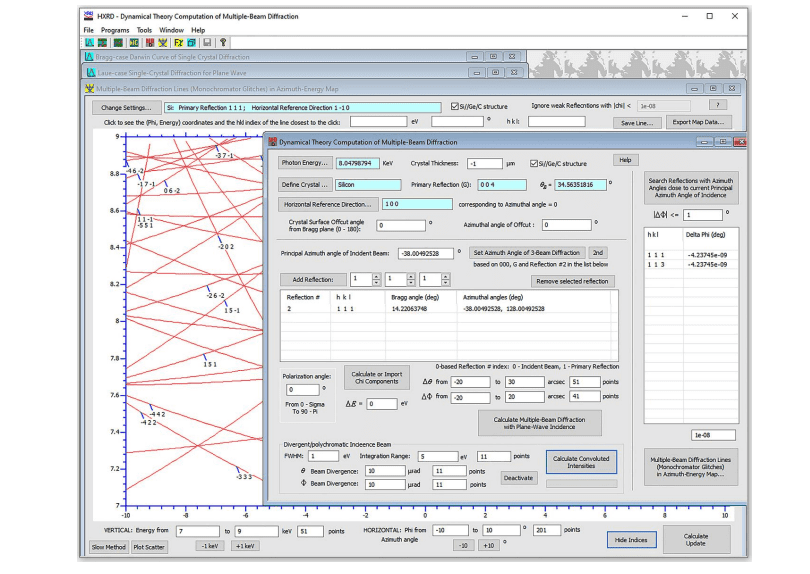
Understanding how X-rays interact with crystals is fundamental to many scientific disciplines, and now XianRong Huang and Lahsen Assoufid, both from the Advanced Photon Source at Argonne National Laboratory, have developed a powerful new software suite called DXRD to simplify these complex calculations. DXRD provides user-friendly interfaces for modelling X-ray diffraction, enabling researchers to accurately simulate how crystals respond to X-ray beams in a variety of geometries, including challenging scenarios like grazing incidence and backward diffraction. This achievement represents a significant step forward because DXRD is the first program to offer a convenient graphical tool for simulating multiple-beam diffraction with arbitrary numbers of beams, using a universal matrix method. The software promises to accelerate the design of crucial crystal-based components for synchrotron facilities and enhance both crystal characterisation and X-ray diffraction education.
GUI-Based Dynamical X-ray Diffraction Simulations
Scientists developed the DXRD program suite, a comprehensive set of programs designed for calculating X-ray diffraction from single crystals using dynamical theory. This work pioneers a user-friendly approach to complex calculations, integrating interactive graphic user interfaces that guide users through simulations with minimal expertise. DXRD accurately calculates plane-wave Darwin curves for both Bragg and Laue cases, modeling diffraction including grazing incidence and backward diffraction, even with Bragg angles approaching 90 degrees, and simulates rocking curves for divergent X-ray beams with finite bandwidths. A key innovation of DXRD is its unique multiple-beam diffraction program, the first to provide a convenient GUI-based solution for rapidly computing diffraction in any geometry.
This program employs a universal matrix method, enabling accurate calculations for both coplanar and non-coplanar diffraction scenarios. Highly optimized computing algorithms allow the program to generate two-dimensional intensity contours with approximately 10,000 points with minimal computational delay. The software package, written in Visual C++, is freely available for academic research and operates as a stand-alone application, requiring no installation on Windows computers. DXRD accepts crystal structure information compiled in a simple text file, requiring only the crystal name, lattice constants, number of atoms, atomic positions, and Debye characteristic temperatures. The program then calculates structure factors for any reflection at any X-ray energy using established methods. This provides a convenient and powerful tool for researchers in synchrotron optics, crystallography, and X-ray spectroscopy, as well as a valuable teaching resource for students learning X-ray diffraction.
Accurate Simulation of Crystal X-ray Diffraction
The DXRD program suite represents a significant advancement in dynamical X-ray diffraction, offering a comprehensive toolkit for analyzing single crystals. The suite features a unique multiple-beam diffraction program capable of accurately calculating diffraction patterns for any geometry using a universal matrix method. DXRD accurately simulates plane-wave Darwin curves, including those for grazing incidence and backward diffraction, even with Bragg angles approaching 90 degrees. The core of DXRD’s capability lies in its ability to model multiple-beam diffraction, accurately simulating how X-rays interact with crystals in complex ways.
Experiments demonstrate that the program can accurately predict the behavior of X-rays as they are diffracted by multiple reflections within a crystal, including those that would normally be considered “forbidden”. Simulations of silicon crystals under specific conditions, such as an 8 keV energy input, reveal how secondary reflections influence the intensity and shape of the primary reflection, showing distortions of the diffraction pattern due to the sharing of incident energy. Further tests demonstrate DXRD’s ability to model “detour reflections”, where X-rays are diffracted through a series of reflections, including those normally considered forbidden. Simulations of the 111 reflection under specific conditions at 8 keV show the characteristic intensity loss and diffraction pattern distortions expected from multiple-beam diffraction.
The program accurately predicts the emergence of strong diffraction intensities even for forbidden reflections when the X-rays follow a detour route involving multiple reflections. Moreover, the program accurately models the impact of real-world beam conditions, such as angular divergence and bandwidth, smoothing sharp features in the diffraction patterns. These results confirm that DXRD correctly models all diffraction configurations and provides a powerful tool for crystal-based synchrotron and X-ray applications, as well as for educational purposes. Beyond simulations, DXRD includes a mapping program that visualizes “monochromator glitches”, subtle distortions in X-ray beams, in azimuth-energy space.
This program uniquely accounts for the influence of “forbidden” reflections, which have been largely ignored in previous studies. Calculations demonstrate that these reflections can contribute to glitches, and DXRD accurately maps their effects. The program also accurately predicts continuous monochromator glitches, a phenomenon often missing in other software, by correctly modeling specific diffraction geometries. These capabilities establish DXRD as a comprehensive and accurate tool for both simulating and visualizing complex X-ray diffraction phenomena.
Efficient Dynamical Diffraction Calculations with DXRD
The development of the DXRD program suite represents a significant advance in the computational study of X-ray diffraction from single crystals. This software package enables researchers to model complex diffraction phenomena using dynamical theory, offering a user-friendly interface that simplifies calculations previously demanding considerable expertise. DXRD accurately simulates various diffraction scenarios, including Bragg and Laue cases, grazing incidence, and backward diffraction, accommodating both plane waves and divergent X-ray beams with finite bandwidths. A key achievement of DXRD lies in its ability to perform multiple-beam diffraction (MBD) computations, a notoriously difficult task.
The software employs a novel and efficient algorithm allowing users to easily tackle complicated MBD calculations in three-dimensional space, applicable to both coplanar and non-coplanar diffraction. Furthermore, DXRD includes a mapping tool for visualizing MBD lines in azimuth-energy space, which is particularly useful for identifying and indexing monochromator glitches in X-ray spectroscopy. While acknowledging the existence of other programs capable of calculating approximate glitch intensities, the authors highlight that DXRD’s method offers greater computational speed and accuracy. The authors note that the software’s capabilities are limited to perfect single crystals and do not address the complexities of imperfect or polycrystalline materials. Future work may focus on extending the software to model these more complex scenarios.
👉 More information
🗞 DXRD, a user-friendly suite of two- and multiple-beam dynamical X-ray diffraction programs
🧠 ArXiv: https://arxiv.org/abs/2509.22509