Dualities, surprising relationships revealing hidden connections between seemingly different physical systems, have become central to modern physics over the last half-century. Sebastian De Haro from the University of Amsterdam and Enrico Cinti from the University of Geneva investigate these powerful tools, exploring how they solve previously intractable problems across fields ranging from mechanics to condensed matter physics. Their work delves into the fundamental nature of dualities, offering a comprehensive overview of key examples and the philosophical questions they raise concerning scientific theories, realism, and the emergence of complex phenomena. By examining whether dual systems are truly equivalent and proposing a geometric view of theories, this research provides a crucial entry point into understanding the profound implications of dualities for both physics and philosophy.
These mathematical relationships reveal that distinct descriptions can represent the same underlying physics, often exposing hidden symmetries and simplifying complex calculations. This work explores the historical development and conceptual foundations of dualities, focusing on their role in reshaping our understanding of fundamental physical laws, and examines how they have emerged across electromagnetism, quantum mechanics, and string theory, highlighting their unifying power and predictive capabilities. The investigation begins with an analysis of classical dualities, such as the Legendre transformation in Hamiltonian mechanics, which demonstrates how different mathematical formulations can yield equivalent physical results.
The research progresses to explore dualities in quantum field theory, including the strong-weak coupling duality in supersymmetric gauge theories, which provides a powerful tool for studying strongly interacting systems. A central theme is the holographic principle, arising from the AdS/CFT correspondence, which posits a duality between gravity in anti-de Sitter space and a conformal field theory on its boundary, offering a potential pathway towards quantum gravity. This work further investigates dualities in string theory, including T-duality and S-duality, which relate different string compactifications and provide insights into the non-perturbative structure of the theory. It also examines the implications of dualities for our understanding of spacetime, symmetry, and physical reality, demonstrating how these mathematical equivalences challenge conventional notions and open up new avenues for theoretical exploration.
From quantum mechanics to statistical mechanics, condensed matter physics, quantum field theory and quantum gravity, dualities have proven useful in solving otherwise intractable problems. Being surprising and unexpected, dualities raise philosophical questions about the nature and formulation of scientific theories, scientific realism, and theory construction. This work discusses what dualities are, provides examples, explores the themes and roles that make dualities interesting, and highlights their most salient types, aiming to be an entry point into discussions of dualities.
String Theory Dualities and Compactifications
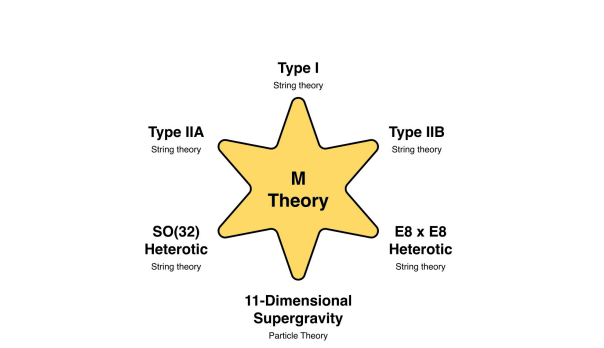
A comprehensive review of the existing literature reveals a strong focus on string theory and its related concepts, including foundational aspects of string theory, M-theory, branes, and compactifications. Specific dualities, such as electric-magnetic duality, T-duality, and S-duality, are also heavily represented, forming a crucial understanding of the mathematical structures and physical interpretations involved. Background knowledge in quantum field theory is essential for understanding string theory and the dualities within it. The AdS/CFT correspondence, linking gravity in Anti-de Sitter space to conformal field theories, is a central theme, with recent work exploring its implications for the information paradox.
Black holes frequently serve as test cases for understanding duality and information loss, and research explores the application of holographic principles to condensed matter systems, specifically strange metal cuprates. A significant portion of the literature addresses philosophical questions concerning scientific realism and structural realism, which are particularly relevant to dualities, emphasizing relationships between entities rather than the entities themselves, and considers the problem of underdetermination, where multiple theories fit the same evidence. Understanding the foundations of quantum mechanics is essential for interpreting the quantum aspects of dualities, and research explores how complex phenomena can arise from simpler underlying principles, a concept central to understanding emergent spacetime and holographic duality. Specific papers address the philosophical implications of equivalence and duality in physics, and mathematical tools, such as topology and solitons, play a role in understanding certain aspects of string theory and duality. Research also explores the application of concepts from computer science and logic to formalize the notion of equivalence between systems, which can be applied to understanding dualities, and a growing body of work applies concepts from string theory and holography to understand the behavior of exotic materials like strange metal cuprates, potentially providing experimental tests of theoretical ideas.
Dualities Unify Physics And Philosophy
This work presents a comprehensive exploration of dualities, surprising equivalences between distinct scientific theories, and their implications for both physics and philosophy. The authors demonstrate that dualities are not confined to high-energy physics or speculative theories, but appear across a broad range of physical theories, from quantum mechanics to statistical mechanics and beyond. They establish that a duality represents a specific type of isomorphism between theories, offering a powerful tool for tackling otherwise intractable problems and constructing new theoretical frameworks, and contributes to ongoing philosophical debates concerning theoretical equivalence, arguing for a nuanced view that requires both formal criteria and substantive interpretation. Furthermore, this work suggests that dualities offer a novel perspective on the very formulation of scientific theories, potentially favouring a geometric understanding of how theories are constructed and related. The authors acknowledge that many of the philosophical discussions surrounding dualities are ongoing, and that their analysis aims to contribute to these debates rather than simply applying existing philosophical concepts to dual theories, emphasizing the interactive nature of this approach, allowing dualities to challenge and refine existing philosophical perspectives.