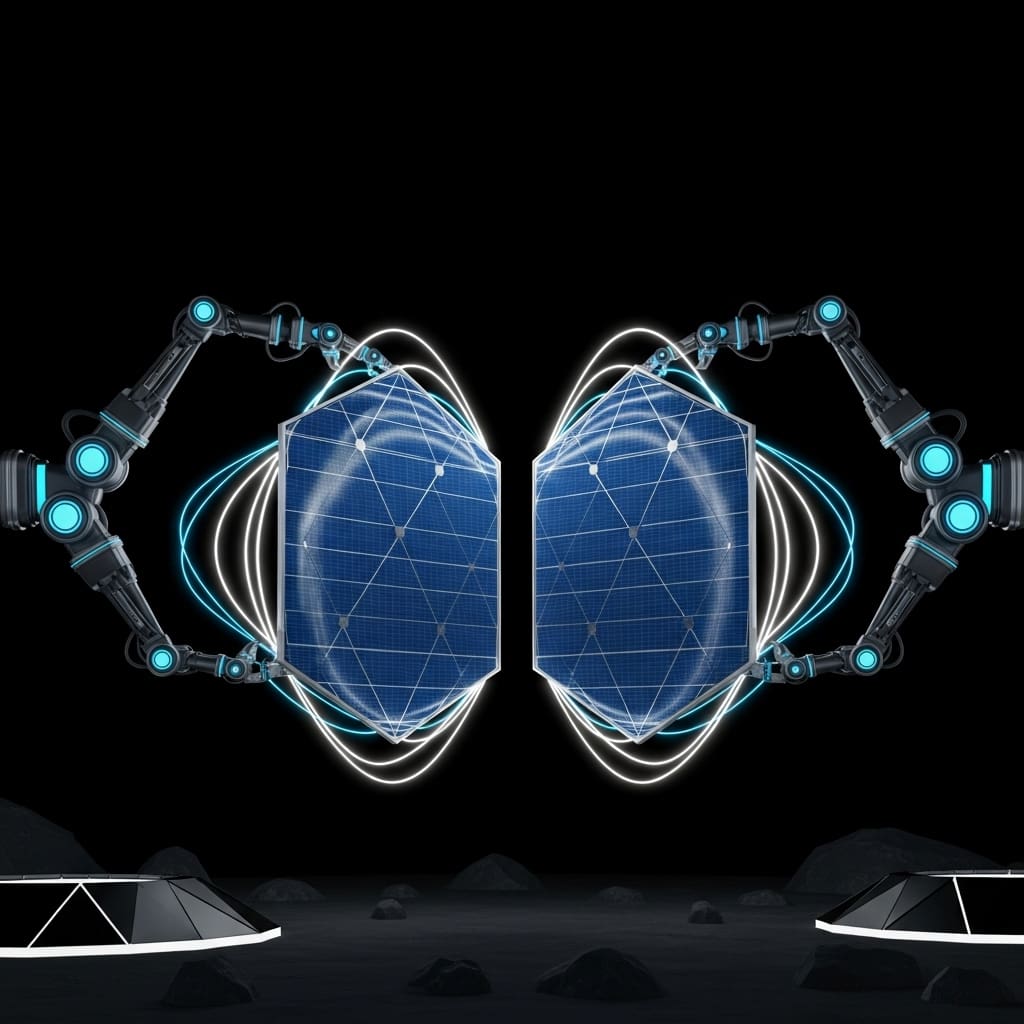
The ambition to establish a permanent lunar base is driving innovation in robotic construction techniques, essential for building infrastructure on celestial bodies. Luca Nunziante, Kentaro Uno, Gustavo H. Diaz, et al. from Sapienza University of Rome and Tohoku University have demonstrated a significant step towards this goal with a novel system for autonomously assembling solar panels. Their research details the integration of vision, control, and bespoke hardware within a dual-arm robotic system, designed to connect solar panel modules in a realistic lunar environment. This work is particularly important as it showcases a complete pipeline, from perception to physical connection, paving the way for fully automated outpost construction and reducing reliance on human astronauts for hazardous tasks. The successful execution of this method proves the feasibility of complex robotic assembly in space, mirroring the modular construction approach used for projects like the International Space Station.
Robotic Assembly of Space Solar Infrastructure
The development of large-scale space infrastructure, such as solar power generating towers, necessitates innovative construction techniques. Drawing parallels with the assembly of the International Space Station (ISS), a modular approach involving the shipment of components and in-situ assembly presents a viable solution. This paper details research into the integration of vision, control, and hardware systems for an autonomous dual-arm robotic sequence, specifically addressing the challenges of assembling modular structures in space. The work explores a perception and control pipeline designed for assembling solar panel modules, utilising a benchmark task to validate the system’s capabilities.
Ad hoc hardware was designed and rigorously tested through real-world experiments to support this research. A mock-up of modular solar panels, incorporating both active and passive connectors, was employed as the testbed for the robotic assembly sequence. This allowed for the control of the grappling fixture and evaluation of the complete system’s performance in a simulated space environment. The research contributes a fully integrated system demonstrating autonomous assembly of modular components, paving the way for more complex in-space construction tasks.
Lunar Solar Panel Assembly via Dual-Arm Robotics
Scientists have achieved a significant breakthrough in autonomous robotic assembly, demonstrating a fully integrated perception and control pipeline for dual-arm robots intended for lunar outpost construction. The research focused on assembling modular solar panel units, a crucial task for establishing sustainable power infrastructure on the Moon. Experiments revealed the successful connection of arbitrarily placed panels, validating the seamless integration of vision, control, and custom-designed hardware. This work represents a substantial step towards robotic systems capable of independently building essential infrastructure in space.
The team employed a perception module built around the YOLOv8.1 object detection model, coupled with a deprojection operation to accurately locate and identify solar panel components within the robot’s field of view. This system allows for precise visual guidance during the assembly process, enabling the robots to adapt to varying panel positions. Measurements confirm the system’s ability to reliably detect panels, forming the foundation for autonomous manipulation. The integration of this perception system with advanced control algorithms is central to the success of the assembly sequence.
Experiments utilized a mock-up of modular solar panels and active-passive connectors, allowing for realistic testing of the robotic assembly pipeline. The control strategy incorporates impedance control for initial approach and grasping, ensuring gentle and compliant interaction with the panels. Following initial contact, a force control scheme is implemented to precisely regulate contact forces during the connection process. Tests prove the system can achieve stable and secure connections between panels, even with slight misalignments or variations in connector engagement. Further enhancing the system’s capabilities, Nonlinear Model Predictive Control (NMPC) is used to optimize the lifting phase of the assembly, ensuring smooth and efficient transfer of connected panels.
The NMPC algorithm calculates an optimal trajectory for the robot arms, minimizing energy consumption and maximizing stability. Results demonstrate the ability to lift and reposition assembled structures with precision, paving the way for the construction of larger, more complex solar power generating towers. The successful implementation of this pipeline highlights the potential for fully autonomous robotic construction in challenging extraterrestrial environments.
Lunar Panel Assembly via Robotic Autonomy
This research details the development of a fully autonomous pipeline for assembling modular solar panels, a crucial task for establishing infrastructure on future lunar outposts. The team successfully integrated visual perception, utilising the YOLO algorithm to identify panel poses, with a nonlinear Model Predictive Control scheme for collision avoidance. A combination of impedance and force control was then employed during the insertion phase to accommodate uncertainties and ensure robust assembly. The demonstrated system showcases the effective collaboration of two robotic arms in a complex, real-world scenario, proving the seamless integration of vision, control, and specialised hardware.
This holistic approach offers a reliable method for tackling intricate assembly tasks within a multi-robot system, with implications for automated construction in space. The authors acknowledge limitations in depth estimation accuracy and note that the performance of force versus impedance control is dependent on exchanged forces during interaction. Future work will focus on implementing learning-based methods to transition between different control states and further refine the system’s ability to handle noisy depth data. While acknowledging these areas for improvement, the research represents a significant step towards achieving autonomous robotic assembly for space-based infrastructure projects.
👉 More information
🗞 Assembling Solar Panels by Dual Robot Arms Towards Full Autonomous Lunar Base Construction
🧠 ArXiv: https://arxiv.org/abs/2601.05491