Researchers are continually pushing the boundaries of data transfer speeds for superconducting circuits, and a team led by K. Kohopää, J. Nissilä, and E. Mykkänen are now reporting a significant advance in this field. They demonstrate a method for rapidly delivering data to a Josephson junction array, a technology with potential applications in low-dissipation control of superconducting bits and other advanced circuits. The team achieves data transfer rates of up to 60 Gbit/s, a fourfold improvement over existing Josephson Arbitrary Waveform Synthesizers, and opens up possibilities for faster and more efficient control of quantum and superconducting technologies. This breakthrough relies on a novel double-pulse technique and externally shunted Josephson junctions, paving the way for more complex and responsive superconducting systems.
This technology supports overdamped junctions exhibiting characteristic frequencies exceeding 100 GHz and critical currents around 100 μA, offering potential benefits for low-dissipation optical control of quantum circuits, including superconducting quantum bits. The research focuses on demonstrating the feasibility of this approach, leveraging the unique properties of these junctions to create a versatile waveform generator. This work aims to establish a pathway towards more energy-efficient and precise control mechanisms for advanced quantum technologies.
Josephson Junction Array Voltage Step Generation
Researchers have developed a new type of Josephson Junction Array (JJA) circuit, a Josephson Voltage Standard, designed to generate highly accurate voltage references for national and international standards laboratories. This innovative JJA configuration relies on precise timing of current pulses to achieve stable voltage steps. The JJA is fabricated using superconducting materials, likely niobium, and consists of multiple Josephson junctions in series. Researchers meticulously characterised the circuit’s parameters, including critical current, resistance values, and the timing of current pulses, using a complex setup involving precise current sources, voltage measurements, and a four-probe measurement configuration.
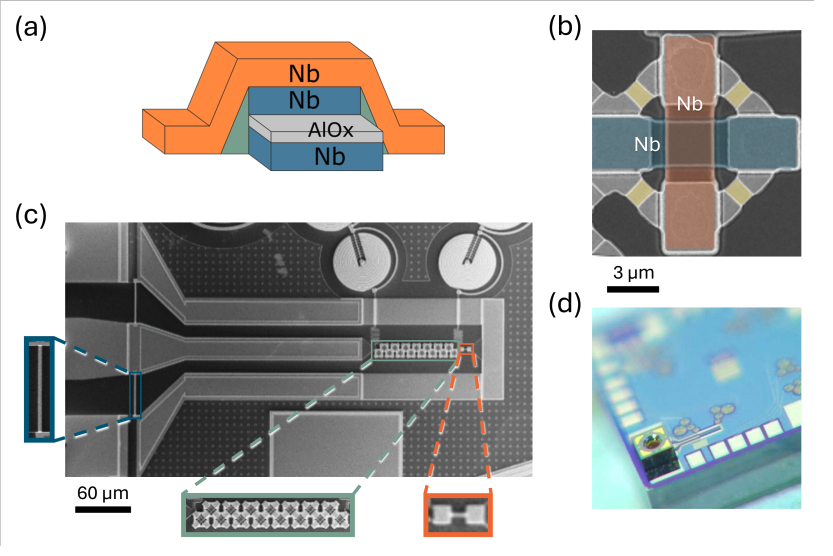
Simulations, initially using a simplified single-junction model and later a more complex transmission line model, helped understand the circuit’s behaviour. Researchers observed oscillatory behaviour in the voltage measurements as a function of the timing of current pulses, a central puzzle they are trying to understand. Detailed analysis of the data reveals the circuit’s behaviour under various conditions, helping identify and mitigate non-ideal effects that can limit its performance. This advancement relies on externally shunted Nb-AlO-Nb Josephson junctions, which enable the creation of overdamped junctions with characteristic frequencies exceeding 100 GHz and critical currents around 100 A, promising efficient control of superconducting circuits. Experiments involved a double-pulse technique to determine the maximum reliable data transfer rate to the superconducting circuit. Researchers investigated how closely spaced pulses affect data transmission, finding that the system accurately delivers data when pulses are clearly distinguishable, specifically at a pulse separation of 18 ps.
Further analysis revealed subtle oscillatory features in the data, suggesting the influence of transmission line effects and potential resonances within the system. A phenomenological simulation incorporating small oscillations in the current source provided an excellent fit to the experimental data, explaining the extended voltage plateau observed between 10 and 17 ps pulse separation. These findings imply that reliable data transfer into JAWS systems is feasible up to approximately 60 GHz, opening new possibilities for high-speed, low-dissipation control of superconducting circuits and advanced quantum technologies. This faster data transfer rate could improve the energy efficiency of quantum computing by enabling more effective control of superconducting qubits. The authors acknowledge that their system currently operates as a lumped element system, which may present limitations for scaling, and indicate that the data supporting this work will be made publicly available.
🗞 Fast optical data transfer into a Josephson junction array
🧠 ArXiv: https://arxiv.org/abs/2509.05074