

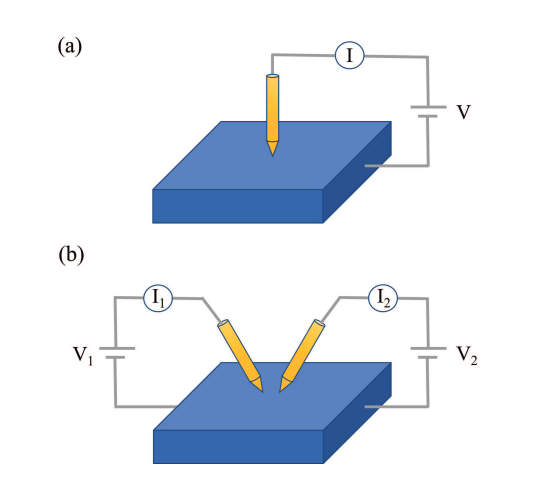
Understanding the behaviour of electrons in complex materials remains a central challenge in physics, and now, researchers are developing innovative techniques to directly observe how these particles interact. Yuehua Su, Guoya Zhang, and Dezhong Cao, along with colleagues at Yantai University, present a new method called coincidence double-tip scanning tunneling spectroscopy that allows scientists to probe the correlated movements of electrons with unprecedented spatial resolution. Unlike traditional scanning tunneling microscopy, this technique employs two independent probes to simultaneously measure electron flow at distinct locations, revealing how electrons influence each other’s behaviour. This advancement offers a powerful new tool for investigating strongly correlated electron systems, potentially unlocking insights into materials exhibiting exotic properties like high-temperature superconductivity and paving the way for future technological breakthroughs.
Spatially resolved dynamical two-body correlations of sample electrons are now achievable. This technique differs from conventional single-tip scanning tunneling microscopy through the employment of a double-tip scanning tunneling microscope (STM) equipped with two independently controlled tips, each biased at distinct voltages. Simultaneous measurement of the quantum tunneling currents yields a coincidence tunneling current correlation, and differentiation of this correlation with respect to the two bias voltages produces a coincidence dynamical conductance, which provides insight into electron interactions. Through the development of a theoretical framework, researchers demonstrate the potential of this method for investigating complex electronic systems.
Detecting Electronic Two-Particle Correlations with STM
This work focuses on developing new scanning tunneling microscopy (STM) techniques capable of directly measuring how electrons interact within materials. Traditional STM primarily examines the properties of single electrons, but understanding the relationships between multiple electrons is crucial for unraveling the behavior of complex materials like high-temperature superconductors. The researchers propose using a multi-tip STM, specifically with two tips, to achieve this, measuring quantities sensitive to the correlations between electrons and developing a theoretical framework to interpret the experimental signals. The core of the work lies in a detailed theoretical description of the multi-tip STM process, utilizing a Green’s function formalism and the Keldysh formalism to account for quantum transport and non-equilibrium conditions.
This framework allows for the calculation of the current flowing through the STM junction and the derivation of an expression that explicitly incorporates the effects of two-particle correlations. The theory is generalized to handle multiple probes, enabling even more sophisticated measurements and providing a solid foundation for interpreting experimental data. The researchers also address practical considerations for implementing a multi-tip STM experiment, including the fabrication of sharp tips, precise tip positioning, and sophisticated data acquisition techniques. They highlight potential applications in areas like high-temperature superconductivity, quantum spin liquids, and strongly correlated materials, where understanding electron correlations is paramount. This work represents a significant advancement in the field, offering a rigorous theoretical justification for the multi-tip STM technique and opening new possibilities for probing the electronic properties of complex materials.
Electron Correlation Measured with Double-Tip Spectroscopy
Researchers have developed a new technique called coincidence double-tip scanning tunneling spectroscopy (STS) to directly measure how electrons interact within materials. This method employs two independently controlled tips, simultaneously measuring the correlated flow of electrons between them, allowing scientists to probe the complex relationships between electrons beyond what is possible with single-tip techniques. The core principle relies on measuring the correlation between the tunneling currents from both tips, revealing how electron movement at one location influences electron behavior at another. Through a detailed theoretical framework, the researchers demonstrate that the measured coincidence tunneling current is directly linked to the fundamental properties of electron interactions within the sample material, providing a powerful way to map out the spatial distribution of these correlations and offering insights into the material’s electronic structure and behavior.
In experiments with standard metallic materials, the technique successfully captures information about the density of electrons, confirming its accuracy. However, the true potential of this method becomes apparent when applied to superconductors, where the measurements reveal not only standard electron behavior but also the emergence of new electron propagation channels arising from the superconducting state, demonstrating the technique’s sensitivity to subtle changes in material properties. Notably, this method provides a direct measurement of two-electron correlations, a feature absent in conventional single-tip STS.
Correlated Electron Dynamics via Double-Tip Spectroscopy
This work introduces a coincidence double-tip scanning tunneling spectroscopy (STS) technique for measuring dynamical two-body correlations of electrons in materials. By employing two independently controlled tips to simultaneously measure tunneling currents at distinct locations, the method probes how electrons propagate and interact, offering a new approach to study strongly correlated electron systems. The technique defines a coincidence dynamical conductance, which directly relates to a contour-ordered second-order current correlation function, revealing information beyond what can be understood from single-particle physics. The researchers demonstrate the capabilities of this technique by applying it to both a nearly free Fermi liquid and a superconducting state, identifying two key components to the conductance: a direct component reflecting independent local tunneling, and an exchange component capturing nonlocal correlated electron propagation between the tips. In superconducting materials, this exchange component reveals particularly rich physics, incorporating both normal electron propagation and processes arising from the superconducting condensate. The formalism has been extended to allow for time-resolved measurements, though the authors acknowledge that resolving these nonlocal correlations experimentally presents a significant challenge.
🗞 Coincidence double-tip scanning tunneling spectroscopy
🧠 DOI: https://doi.org/10.48550/arXiv.2507.17532


